
9 Incredible Shanghai Layover Experiences You Can’t Miss
Your “layover” in Shanghai can legally last ten full days. No visa, no application, no fee — just an onward ticket to a different country and a passport from one of 54 eligible nations. Almost nobody planning a Shanghai connection knows this.
As of 18 December 2024, China extended its visa-free transit policy at Shanghai Pudong from the previous 72/144-hour rule to a full 240 hours — ten days — for citizens of 54 countries including the United States, United Kingdom, Canada, Australia, and most of the EU. The requirement is simple: you need a confirmed onward ticket to a third country (not back to your country of departure), and the visa-free clock technically starts at midnight the day after you land, meaning you often get more than 240 hours in practice. During that window you can leave the airport, register your accommodation, and travel freely not just around Shanghai but across an approved list of nearby provinces — Jiangsu, Zhejiang, and beyond.
Most travel content covering Shanghai layovers is still written around the old 72 or 144-hour rule, or treats the city the way every other transit guide treats every other airport: as a place to kill four or five hours before the next flight. That framing badly undersells what’s actually on offer here. A “layover” with a flexible onward ticket can become a genuine, visa-free, multi-day trip to one of the most architecturally distinctive cities on earth — a waterfront lined with 52 buildings across a dozen European architectural styles, built between the 1860s and 1940s, standing directly across the river from a skyline of supertall towers that didn’t exist thirty years ago. This guide treats Shanghai as the genuine extended-stay opportunity it is, while still covering the shorter, conventional layover for anyone with a tighter window.
Shanghai Pudong International Airport (PVG) is one of China’s busiest and most internationally connected hubs, serving flights to nearly 300 cities across 47 countries. It sits in the Pudong district roughly 30km east of the city centre, built around two main terminals (T1, primarily SkyTeam and China Eastern; T2, Star Alliance, oneworld, and most other international carriers) connected to a vast Satellite Hall (S1 and S2) via an automated people mover. The airport runs a genuinely traveller-friendly transit system on paper — pre-screening, online arrival cards, same-counter processing — though the sheer physical scale of PVG means walking distances and connection buffers should not be underestimated.
PVG offers 24-hour direct transit, available to almost all nationalities, allowing a short exit from the airport or a same-day stay within the transit area without a visa. Separately, PVG offers 240-hour (10-day) visa-free transit for citizens of 54 specific countries, requiring a confirmed onward ticket to a third country and allowing travel across Shanghai and an approved list of nearby provinces. These are not the same policy and have different requirements — verify which one applies to your nationality and itinerary on the official China National Immigration Administration (NIA) website before you fly, and complete the visa-free formalities at the dedicated counters before joining the regular immigration queue.
Your onward flight must depart for a genuinely different country than the one you arrived from (this is checked) — a same-country round trip does not qualify. All visitors staying anywhere other than a hotel (which registers you automatically) must register their accommodation with the local Public Security Bureau within 24 hours of arrival. Work, study, and journalism are explicitly prohibited under this policy — it’s for tourism, business meetings, and family visits only. Overstaying carries real penalties: fines up to RMB 10,000 or 5-10 days detention, and a likely block on future visa-free transit applications.
If you hold a passport from one of the 54 eligible countries (US, UK, Canada, Australia, most EU nations, and others), have a passport valid 3+ months beyond your stay, and hold a confirmed onward ticket to a country different from where you departed — yes. You can apply at the dedicated visa-free transit counters on arrival; no advance application is required, though some sources note an online pre-application option exists too.
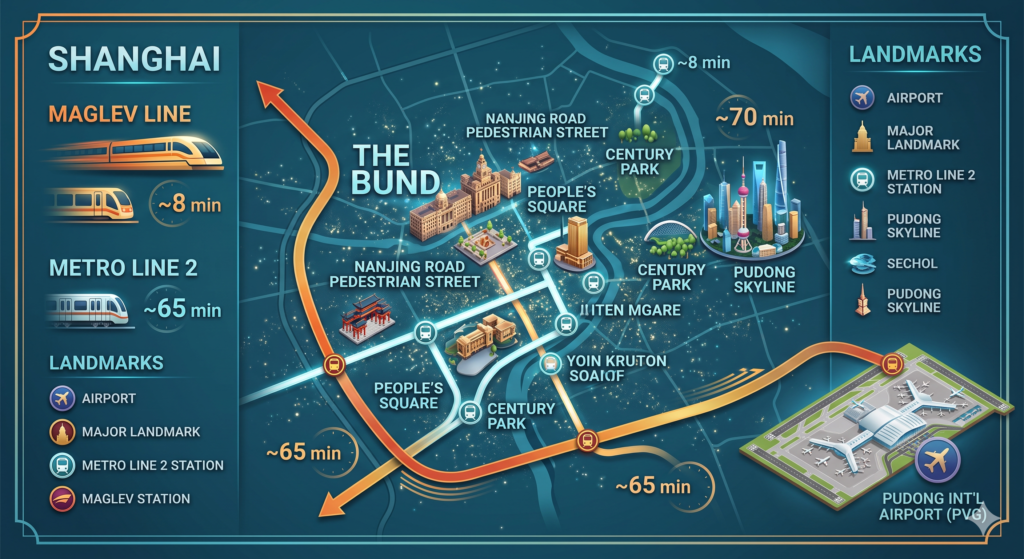
The Bund and Yu Garden, comfortably. Maglev to Longyang Road (8 minutes) or Metro Line 2 directly to the city centre, then the Bund’s riverside promenade and Yu Garden’s 16th-century classical grounds are both walkable from the same general area in the Old City/Huangpu District.
For the experience, yes — it’s the fastest commercial train in regular passenger service, reaching speeds up to 430 km/h and covering the airport-to-Longyang-Road run in about 8 minutes. Practically speaking, it only connects to one station, so you’ll still need a metro or taxi onward from there. Metro Line 2 is cheaper, runs direct to the city centre’s major stops, and is the more practical choice if speed-for-its-own-sake isn’t the point.
China’s domestic ecosystem runs heavily on WeChat Pay and Alipay QR codes, which can be genuinely difficult for foreign visitors to set up on a short trip. PVG has Wi-Fi kiosks to help set up temporary digital wallets, and e-CNY (China’s digital currency) is increasingly accepted with foreigner-friendly setup options. That said, carrying some cash (RMB) as a backup is sensible — not every small vendor accommodates foreign cards or apps smoothly.
Should You Leave? The Shanghai Layover Gauge
PVG is enormous, and the 30km distance to the city centre means a round trip alone can consume 2.5-3 hours before you’ve seen anything. Under 6 hours, stay in the terminal — the lounge network here is genuinely excellent (China Eastern’s flagship lounges in S1 include hot noodle bars and shower suites), and there’s an art wall, indoor garden, and small aviation museum in the Satellite Hall.
Take the Maglev or Metro Line 2 directly to the city centre, walk the Bund’s riverside promenade, see Yu Garden and the surrounding Old Street, and head straight back. This window doesn’t comfortably fit both the Bund/Yu Garden AND the French Concession — pick the historic core, save the Concession for a longer visit.
With 10+ hours, add the French Concession’s tree-lined streets and Tianzifang’s arts district to the Bund/Yu Garden core. But if you’re eligible for the 240-hour visa-free transit and have any flexibility in your onward ticket — this is where Shanghai stops being a “layover” question entirely. A multi-day stay opens up the Shanghai Museum, the Pudong observation decks, day trips to nearby water towns like Zhujiajiao, and a genuinely complete experience of the city rather than a few rushed highlights.
Work out your Shanghai window precisely
Enter your PVG landing time and departure gate-close. If you’re eligible for the 240-hour visa-free transit, the real question isn’t “how many hours” but “how many days” — the calculator helps with both scenarios.
Getting from PVG to Shanghai City Centre
| Option | Time | Cost | Notes |
|---|---|---|---|
| Shanghai Maglev Train Fastest | ~8 min (to Longyang Rd only) | ¥50 one-way, ¥80 round-trip | Reaches up to 430 km/h, typically cruising around 300 km/h. Only connects to Longyang Road station — you’ll need a metro transfer or taxi onward from there for most central destinations. |
| Metro Line 2 | ~50-80 min to central stops | ¥6-8 | Direct from PVG to People’s Square, Nanjing Road, Jing’an Temple, and other major stops. The most economical and practical option for most layover visitors, with no transfer required for central destinations. |
| Official Taxi | 50 min – 1 hr 20 min (traffic-dependent) | ¥150-200 | Metered, available at the official taxi rank outside arrivals. Useful with heavy luggage or for direct hotel drop-off, but subject to Shanghai traffic, which can extend journey times significantly at peak hours. |
| Airport Shuttle Bus | Varies by route | ¥20-30 | Multiple numbered routes (Line 1 through 8) covering different parts of the city; runs roughly 7am-11pm. Slower than the metro but useful if your destination isn’t well served by Line 2 directly. |
China’s “Great Firewall” blocks Google, Google Maps, WhatsApp, Instagram, and most Western apps and services entirely, regardless of which transit policy you’re on. A VPN activated before you land (most VPN provider websites are also blocked once you’re inside China) is close to essential if you want to use familiar navigation and messaging apps. Download a VPN, Maps.me or a similar offline map, and a translation app before you board.
What to Do in Shanghai on a Layover
The Bund
Shanghai’s most iconic stretch of riverfront, and the natural starting point for any visit. The Bund features 52 buildings spanning 12 distinct architectural styles — Gothic, Baroque, Romanesque, Art Deco, Beaux-Arts — constructed between the 1860s and 1940s along the Huangpu River, earning the nickname “Museum of Buildings.” Walk it in late afternoon and stay through dusk: directly across the river, Pudong’s skyline (Oriental Pearl Tower, Jin Mao Tower, Shanghai World Financial Center, Shanghai Tower) lights up in a genuinely spectacular display, creating one of the most dramatic before-and-after contrasts available in any city — colonial-era stone facades on one bank, supertall glass towers on the other, separated by a few hundred metres of water.
Yu Garden
A two-hectare classical Chinese garden founded in 1559 during the Ming Dynasty, taking 18 years to build for a retired official who wanted to give his elderly parents a peaceful retreat. Inside: the Great Rockery, the five-tonne “Exquisite Jade Rock” (according to legend, salvaged from a boat that sank en route to Beijing), the Nine-Turn Bridge (said to bring good luck when walked across), and a mid-lake pavilion where you can take a proper oolong tea ceremony surrounded by centuries-old rockwork. Outside the garden walls, Yuyuan Bazaar sprawls with hundreds of stalls selling souvenirs, traditional snacks, and crafts.
The Former French Concession
A genuinely different register from the rest of Shanghai — tree-lined boulevards, European-style villas, and a slower pace dating to the area’s founding as a French settlement in 1849, the earliest and eventually largest French concession in China. Wukang Road specifically is worth the walk for its variety of early-20th-century residential architecture, including the Normandie Apartments (Wukang Mansion), the oldest veranda-style apartment building in Shanghai. Note that this district draws genuinely mixed reviews — some visitors find the atmosphere and architecture a worthwhile change of pace from the rest of the city; others find it a quiet stretch of boutiques and restaurants without much else to anchor a visit. Treat it as a pleasant detour rather than a must-see if your time is tight.
Tianzifang
A former industrial area inside the French Concession, now a dense warren of narrow alleys housing more than 200 coffee shops, art studios, craft stores, and food stalls inside preserved shikumen-style buildings. A good stop for browsing and a meal if you want street-level texture rather than another major monument.
Pudong Observation Decks
If you want the view from the other side of the river looking back at the Bund, the Shanghai Tower (second-tallest building in the world, 128 floors, with a distinctive 120-degree twist as it rises), the Oriental Pearl Tower, and the Shanghai World Financial Center all offer observation decks. Worth the trip specifically at dusk, when the transition from daylight to the illuminated night skyline happens while you’re up there.
The Bund at Dusk — Colonial Facades Meet the Pudong Skyline
Position yourself on the Bund’s riverside promenade facing east, with the colonial-era buildings at your back and Pudong’s illuminated towers across the water. Arrive 30-45 minutes before full dark — you’ll catch the transition as the sky deepens and the skyline lights activate, which is a stronger shot than either pure daylight or full darkness alone. Wide angle to capture the full skyline sweep; a slower shutter on a small tripod or stabilised phone captures the light trails of river boat traffic.
30-45 min before full dark. Bund promenade facing east across the Huangpu River. Wide angle.
Yu Garden — The Nine-Turn Bridge and Mid-Lake Pavilion
The zigzagging Nine-Turn Bridge leading to the mid-lake teahouse pavilion is Yu Garden’s most photographed feature — the angular bridge lines contrast sharply with the classical rockwork and still water around it. Morning light, shortly after opening, gives the clearest reflections in the lake before later crowds disturb the water’s surface and before the midday sun flattens the shadow detail on the rockery.
Shortly after opening, morning. From the bridge looking toward the pavilion, capturing the water reflection.
The Shanghai Layover Itinerary
Visa-free processing: 30-45 minutes off-peak. Maglev: 8 minutes. Metro transfer to People’s Square: 20-25 minutes.
The 16th-century classical garden, the Nine-Turn Bridge, and the surrounding Yuyuan Bazaar for snacks and souvenirs. 90 minutes.
Xiaolongbao (soup dumplings) at a proper sit-down spot rather than just a street cart — it’s worth the extra 15 minutes. 60 minutes.
Walk the riverside promenade. 60-75 minutes, timed to extend into early evening for the skyline transition.
A shorter taxi or metro hop to Tianzifang for a browse through the alleys and a coffee. 75-90 minutes.
Metro Line 2 back, 50-80 minutes depending on the originating station. Build in a 2-2.5 hour international departure buffer once back at the airport.
As above — visa-free processing, then transit to the historic centre.
75-90 minutes for the garden and a quick pass through Yuyuan Bazaar.
A shorter version of the riverside walk plus a meal nearby. 90 minutes.
Metro back, 50-80 minutes. Build in the full departure buffer at the airport.
Shanghai Layover Scenarios — Real Situations, Specific Solutions
The visa-free transit formalities must be completed at dedicated counters BEFORE the main immigration lines — if you follow general signage without looking for the visa-free desk specifically, you can end up in the wrong queue entirely.
Processing through the wrong channel can complicate or invalidate your visa-free eligibility for this entry.
Look specifically for “Visa-Free Transit” or “144/240-Hour Transit” signage immediately on disembarking, before following general “Arrivals” or “Immigration” signs. Airport staff at the transit desks can redirect you if you’ve gone the wrong way, but it’s far simpler to find the right queue the first time.
China’s internet restrictions block most Western apps and services entirely, and this applies regardless of your visa-free status — it’s a network-level block, not a visa condition.
Most VPN provider websites are themselves blocked once you’re inside China, meaning you often can’t download or activate a VPN after you’ve already landed.
Install and activate a VPN, plus an offline map app like Maps.me, BEFORE you board your flight to PVG — not after landing. This single piece of pre-trip prep avoids the most common and most frustrating connectivity problem foreign visitors hit in China.
China’s domestic economy runs heavily on WeChat Pay and Alipay QR codes. Many smaller vendors, especially outside major tourist hubs, don’t accept foreign cards at all.
Being unable to pay for a meal or souvenir on a tight layover wastes time you don’t have to spare.
Carry some RMB cash as backup, and consider setting up Alipay’s “Tour Pass” feature for foreign visitors (linkable to international cards) before you travel, or use the Wi-Fi kiosks at PVG to help set up a temporary digital wallet on arrival.
International-to-domestic connections at PVG require you to clear immigration, collect checked baggage, clear customs, and re-check your bags for the domestic flight — this is NOT a same-terminal, no-baggage-claim transfer like a protected international-to-international connection.
Assuming this works like an international-to-international transfer (where checked-through baggage means you skip the claim) leads to missing the domestic departure.
Always verify with your airline whether your specific routing is international-to-international (no baggage claim needed) or involves a domestic leg (full claim, customs, and re-check required) — and budget significantly more time for the latter.
T1 (mainly SkyTeam/China Eastern) and T2 (Star Alliance, oneworld, others) are connected by a roughly 10-15 minute pedestrian walkway or a free shuttle bus running every 10 minutes — but the airport’s sheer scale means this isn’t always a quick hop.
A tight connection that doesn’t account for the terminal walk or shuttle wait can run short.
Build at least 30-45 minutes into your connection specifically for the T1-T2 transfer on top of standard security and document checks, particularly if you’re also navigating PVG’s H-shaped layout with the Satellite Halls for the first time.
If your visa-free transit involves leaving the airport with carry-on luggage, navigating Yu Garden’s narrow paths and Tianzifang’s tight alleys with a rolling bag is genuinely impractical.
Minor, but it slows down the visit and adds friction at every stop.
Use Bounce storage at the airport before heading into the city, or check PVG’s own left-luggage service directly.
Food in Shanghai
Xiaolongbao (Soup Dumplings)
Shanghai’s signature dish — delicate steamed dumplings filled with pork and a pocket of hot broth, eaten with a specific technique (bite a small hole, sip the broth, then eat the rest) to avoid burning yourself or losing the contents. A genuine “xiaolongbao crawl” comparing different legendary spots across the city is a popular activity for visitors with the time — even a single proper sit-down version near Yu Garden or the Old City is worth the detour from street-cart versions.
Shengjianbao
Pan-fried pork buns with a crispy bottom and the same broth-filled centre concept as xiaolongbao, but fried rather than steamed — a textural contrast worth trying alongside the steamed version if you have time for both.
Shanghai-Style Hairy Crab (Seasonal)
If you’re visiting in autumn (roughly September-November), Shanghai’s hairy crab season is a genuine local food event — a regional delicacy worth seeking out at the right time of year if your visit happens to align with it.
Nanjing Road Snack Stalls
Century-old food stores along Nanjing Road — Shen Da Cheng and Zhen Lao Da Fang among them — sell traditional local snacks that have been on offer largely unchanged for generations, a good lower-commitment way to taste a few different things without committing to a full meal.
Fifty-two buildings, twelve architectural styles, built across eighty years by foreign trading houses and banks that believed Shanghai’s waterfront was worth building like London or New York — Gothic spires next to Art Deco curves next to Beaux-Arts columns, a “Museum of Buildings” that nobody designed as a museum. Directly across the river, less than a kilometre away, stands a skyline that didn’t exist when most people now in their forties were children — towers that twist as they rise, observation decks that didn’t exist, an entire financial district built from nothing in barely three decades. The distance between the two riverbanks is short enough to walk across a bridge in a few minutes. The distance between what they represent is most of modern Chinese history, visible in a single photograph if you stand in the right spot at dusk. Most layover passengers transiting through Pudong have no idea that just outside the airport, twenty minutes by Maglev, sits one of the starkest before-and-after juxtapositions any city on earth has to offer — and that, for ten days if their passport qualifies, they’re free to walk straight into it without so much as a visa form.
Gear, eSIM, and Connectivity
Essential, not optional, for China. Most VPN sites are themselves blocked once inside the country — download and activate before boarding your flight to PVG.
Get NordVPN →China-specific data plans for navigation and connectivity. Note that even with data, you’ll still need a VPN to reach blocked Western services.
Get an eSIM →Download Shanghai map data before you fly. With Google Maps blocked, an offline-capable alternative is genuinely necessary backup, VPN or not.
VPN + Connectivity Guide →Drop your bag before heading into Yu Garden or Tianzifang’s narrow alleys, where rolling luggage is genuinely impractical.
Find Storage →Tours and Experiences
A guided half-day covering all three core areas with hotel/airport pickup, removing the navigation complexity entirely — particularly valuable given China’s app restrictions for foreign visitors.
Book via GetYourGuide →A cruise connecting the Bund and Pudong into a single panoramic view, ideally timed for a dusk departure to catch the skyline lighting transition mid-ride.
Book via Klook →A guided tasting crawl comparing different xiaolongbao spots and local snacks, with a guide explaining the eating technique and the dish’s history.
Book via Eatwith →Insurance and Hotels
Standard travel cover, particularly relevant given the complexity of China’s visa-free transit rules and the genuine consequences of a documentation misstep.
Get a Quote →Same-day activation medical cover for China. Particularly worth arranging if you’re taking advantage of the 240-hour transit for a multi-day stay rather than a same-day layover.
Get a Quote →A genuine luxury option directly serving the airport with a short shuttle. The right choice for an overnight layover or the first night of a longer 240-hour-transit stay before heading into the city.
Check availability →For travellers using the 240-hour visa-free transit for a genuine multi-day stay, a city-centre base near the Bund or French Concession puts you walking distance from the core sights — remember the hotel will handle your accommodation registration automatically.
Check availability →What’s your real Shanghai window?
If you’re 240-hour eligible, your “layover” might really be a 10-day trip. Enter your specifics to see both the short-layover and extended-stay scenarios.
Calculate My Time →Check Your 240-Hour Eligibility
Verify whether your nationality qualifies for the 240-hour visa-free transit and what documentation you’ll need at the dedicated counters on arrival.
Check Visa Requirements →Connecting through another Asian hub?
If your routing also touches Singapore, Bangkok, or Manila, our other Asia layover guides cover those cities’ very different transit logistics.
Singapore Layover Guide →Frequently Asked Questions
As of 18 December 2024, China extended its visa-free transit policy at qualifying ports of entry — including Shanghai Pudong — from 72/144 hours to 240 hours (10 days), for citizens of 54 specific countries. To qualify, you need a passport valid at least 3 months beyond your stay, and a confirmed ticket for onward travel to a different country (not back to your point of departure) within 240 hours of arrival. The clock technically starts at midnight the day following your arrival, meaning you typically get more than the literal 240 hours. During this window, you can travel not just in Shanghai but across an approved list of nearby provinces.
Yes. All foreign visitors must register their accommodation with the local Public Security Bureau within 24 hours of arrival. If you’re staying in a hotel, staff will typically handle this registration automatically as part of check-in. If you’re staying somewhere else (a private rental, a friend’s home), you are responsible for completing this registration yourself at the local Exit-Entry Administration Office.
Not without preparation. China blocks Google (including Google Maps), WhatsApp, Instagram, and most other major Western apps and services at the network level — this applies regardless of your visa or transit status. Critically, most VPN provider websites are also blocked once you’re inside China, meaning you typically cannot download a VPN after you’ve landed. Install and activate a VPN before you board your flight, and download an offline map app like Maps.me as backup.
Yes, on a layover of 6+ hours. The Bund and Yu Garden are both reachable within roughly an hour of the airport via Maglev/metro, and together deliver a genuinely strong taste of the city — colonial-era riverfront architecture, a 16th-century classical garden, and (if timed for dusk) one of the most striking skyline contrasts available anywhere. You don’t need 240-hour eligibility to make a Shanghai layover worthwhile; that policy simply expands what’s possible if your nationality and itinerary qualify.
Shanghai Pudong International Airport (PVG) — Official Resources
Flight information, terminal maps, and transit visa details for one of China’s busiest international gateways.
Official source for current visa-free transit rules, eligible nationality lists, and 240-hour policy requirements — always verify here, as the rules have changed multiple times in recent years.
nia.gov.cn →Official route planning and fare information for Shanghai’s metro network and the Pudong Maglev train.
shmetro.com →Official city tourism information including museum hours, event calendars, and attraction details.
shanghai.gov.cn →Shanghai sees hot, humid summers (June-August) and pleasant spring/autumn shoulder seasons — October-November and March-April are generally regarded as the best months to visit.
cma.gov.cn →National emergency numbers for China, valid throughout Shanghai and the airport.
A major international hospital in Shanghai with English-speaking staff, commonly used by foreign visitors and expats.
Shanghai Pudong Airport passenger services — terminal information, lost property, and connection assistance.
Most major nations maintain consulates directly in Shanghai. Find your embassy →
- China National Immigration Administration / China Discovery / Trip.com. 240-hour visa-free transit effective 18 December 2024 for 54 eligible countries, requiring confirmed onward ticket to a third country, clock starts midnight following day of arrival, accommodation registration required within 24 hours via Public Security Bureau. 2026.
- Aerogreet / Blacklane PVG Airport Guides. PVG terminals T1 (SkyTeam/China Eastern) and T2 (Star Alliance/oneworld), connected to Satellite Halls S1/S2 via automated people mover, 10-15 min walkway or shuttle between T1/T2, serves ~300 cities across 47 countries. 2026.
- Trip.com Shanghai Maglev Guide. Maglev train Longyang Road to PVG in ~8 minutes, top speed 430 km/h, typical cruising ~300 km/h, only connects to Longyang Road station requiring onward metro/taxi transfer.
- Tour-guide.com / Backroad Planet Shanghai Attractions. The Bund features 52 buildings across 12 architectural styles built 1860s-1940s; Yu Garden founded 1559, took 18 years to build, two hectares; Shanghai metro over 800km across 20 lines, world’s longest by route length. 2026.
Disclaimer: Visa-free transit policies, eligible nationality lists, and entry requirements verified June 2026 but subject to change without notice — always confirm current rules on the official China National Immigration Administration website before booking. Overstaying any visa-free transit period carries real legal and financial penalties. Affiliate links may earn EpicLayover a commission at no additional cost to you.
