
Why a Budapest Layover Might Be Europe’s Most Beautiful Stop
You can soak in 76°C water pulled from 1,246 metres beneath a public park, in a neo-baroque palace built in 1913, while locals play chess floating on wooden boards — and still make your connecting flight. No other layover city on earth offers this specific combination.
Budapest sits on the Carpathian Basin, where the earth’s crust is unusually thin and groundwater travels close enough to the planet’s heat to surface as naturally hot, mineral-saturated water — over a thousand thermal springs beneath the city, a geological accident the Romans were already exploiting two thousand years ago. The Ottoman Turks added their own bathing architecture in the 16th century. Then, between 1909 and 1913, the city built the Széchenyi Baths: a deliberately grandiose “bathing palace” in Neo-Baroque and Neo-Renaissance style, its halls decorated floor to ceiling with mermaids, water gods, and sea monsters, fed by a well drilled 1,246 metres into the ground that still produces 6,000 cubic metres of 76°C water daily.
What makes this relevant to a layover, specifically, is the geography: Budapest Airport sits roughly 20km southeast of the city, and Széchenyi — the largest and most famous of the baths — is reachable in well under an hour by taxi. A 7-to-8 hour layover is genuinely enough time to clear immigration, get to City Park, soak for two hours in pools ranging from cool to scalding, watch the famous floating chess games that have been a fixture here for decades, and make it back to your gate with room to spare. Most travellers passing through BUD have no idea this is an option. This guide treats it as the centrepiece it deserves to be.
Budapest Ferenc Liszt International Airport (BUD) is Hungary’s busiest airport and one of Central Europe’s fastest-growing aviation hubs, handling over 19.6 million passengers in 2025 alone, an 11.7% increase on the prior year. It’s the home base for Wizz Air — the largest carrier at BUD by a wide margin, operating over 60 destinations — and also serves Ryanair and easyJet as a major low-cost hub, alongside a broader mix of European, Middle Eastern, and intercontinental connections. The airport has two terminals, 2A and 2B, connected by a shopping-mall-style passenger hall called the SkyCourt; Terminal 1 closed permanently in 2012 after Malév Hungarian Airlines, the former national carrier, went bankrupt.
Because Wizz Air, the airport’s dominant carrier, treats every flight as point-to-point and offers no formal transit facilities, you will almost always need to self-connect at BUD — collecting your bags, clearing into the terminal, and re-checking in for your next flight, even on what feels like a single trip. This means standard visa requirements apply in full for your nationality, and there is no airline-backed rebooking protection if your first flight is delayed. Budapest is genuinely not optimised for intercontinental transit the way Frankfurt or Amsterdam are — treat any BUD connection as two separate flights requiring full re-clearance, and budget accordingly.
Hungary is part of the Schengen Area. EU/EEA/Swiss citizens enter freely. US, Canadian, Australian, and most other Western passport holders enter visa-free for up to 90 days within a 180-day period. Non-Schengen passengers must clear immigration regardless of their final destination if they want to leave the airport. Use iVisa to verify your specific requirement if uncertain.
6 hours minimum, 8+ comfortable. Allow roughly 30-40 minutes for immigration, 35-40 minutes each way to the city centre, and a 2-2.5 hour departure buffer given BUD’s self-connect structure. At 6 hours you can comfortably do the Danube/Castle Hill highlights; at 8+ hours, add the Széchenyi Baths properly.
Yes, more than almost any other single attraction in this entire series. Nothing else in this guide’s city roster lets you do something this physically restorative — soaking in mineral-rich 76°C-sourced water — between two flights. Budget at least 90 minutes inside once you arrive, ideally 2+ hours; rushing the baths defeats the point of going.
Assuming a “layover” at BUD works like a protected connection at a major hub. Because Wizz Air and most BUD traffic is point-to-point, you’ll typically self-connect — collecting bags, clearing the terminal, and re-checking in — even between two flights booked as one trip. Treat any BUD connection as two fully separate flights and budget the recommended 90-minute minimum, with significantly more buffer if you’re also planning a city visit.
Bring your own swimsuit if possible — towel and swim cap (required in the swimming-lane pool) can be rented on-site, but it adds a queue and a cost. Pack light: a swimsuit, a towel, and flip-flops fit easily in a daypack and make the whole visit considerably smoother.
Should You Leave? The Budapest Layover Gauge
Given BUD’s self-connect structure and the 35-40 minute transfer each way, under 6 hours doesn’t leave a safe margin for a city trip — particularly if your nationality requires extra immigration processing. The SkyCourt has a workable selection of cafés, a Hard Rock shop, four open-access lounges, and even a Lian Day Spa for a short massage if you want a taste of relaxation without leaving the terminal.
Take a taxi or the Airport Express Bus directly to the Danube embankment, walk the Chain Bridge, see Buda Castle and Fisherman’s Bastion, and head straight back. This window is enough for the essential photo stops but doesn’t comfortably fit the baths on top — pushing both in risks missing your flight.
This is the real payoff window. Head straight to Széchenyi Baths in City Park for 2+ hours of soaking, then a quick Danube walk — Chain Bridge, Parliament exterior — before heading back. With 10+ hours, you can comfortably add a proper Hungarian lunch and the Jewish Quarter’s ruin bars or synagogue.
Work out your Budapest window precisely
Enter your BUD landing time and departure gate-close. Because BUD typically requires a self-connect rather than a protected transfer, the calculator accounts for full re-clearance time on both ends.
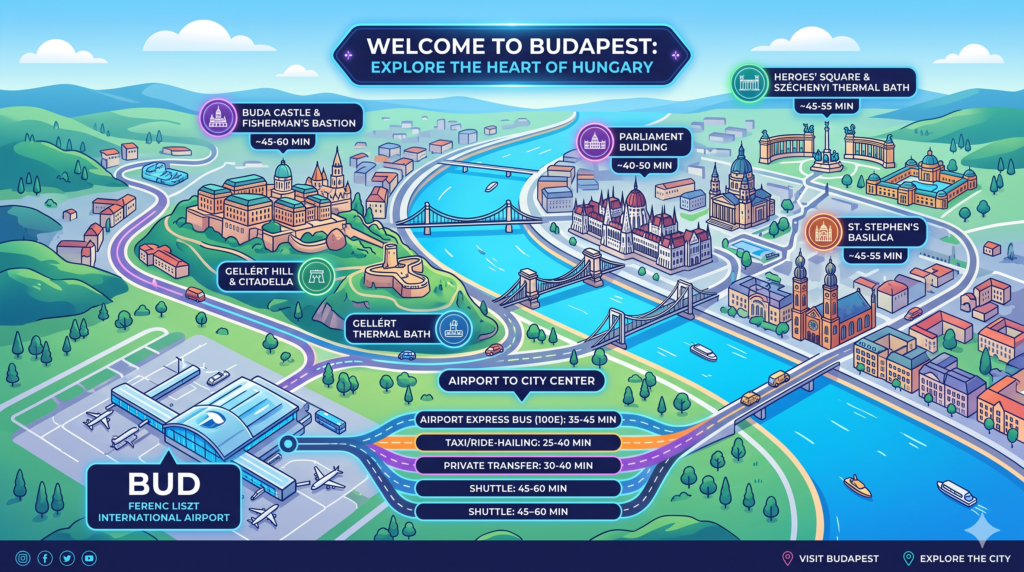
Getting from BUD to Budapest City Centre
| Option | Time | Cost | Notes |
|---|---|---|---|
| Pre-Booked Private Transfer Recommended | ~35 min | Fixed price, varies by provider | Driver meets you at arrivals and monitors your flight for delays — no queuing, no metered surprises. The most stress-free option, particularly for a tight layover where timing certainty matters more than saving a few euros. Pre-book Welcome Pickups → |
| Official Taxi (Főtaxi) | ~35 min | €28–35 (~10,800–13,500 HUF) | Metered and regulated, with an order stand at both arrival exits. A safe, simple option if you’d rather not pre-book. |
| Airport Express Bus (100E) | ~40 min | €5.55 (2,200 HUF) | Direct to Deák Ferenc tér, in the heart of the city, departing every 7-12 minutes. The best budget option — buy tickets at the BKK office in arrivals or the ticket machines near the bus stop. |
| Bus 200E + Metro | ~45-60 min | ~€1.35 per ticket (2 needed) | Standard public transit fare, but requires a transfer to Metro Line 3 at Kőbánya-Kispest — cheapest option but adds complexity for a tight layover. |
| Bolt (Rideshare) | ~35 min | Similar to taxi, app-based | Uber does not operate in Hungary, but Bolt fills the same role with transparent in-app pricing. Requires a live data connection. |
The Budapest Card bundles unlimited public transport with discounted entry to top attractions — including the thermal baths — plus free entry to 19 museums. If your itinerary includes Széchenyi and a museum stop, the card pays for itself quickly and removes the friction of buying individual tickets on a tight schedule.
The Centrepiece: Széchenyi Thermal Baths
Built between 1909 and 1913 by architect Győző Czigler in Neo-Baroque and Neo-Renaissance style, Széchenyi is the largest and most visited of Budapest’s thermal baths and one of the largest spa complexes in Europe — 18 pools across indoor and outdoor sections, fed by a well drilled 1,246 metres into the earth that produces water at 76°C, cooled to a bathing range of roughly 27-38°C in the outdoor pools and 18-38°C indoors. The water itself carries calcium, magnesium, sodium, sulfate, bicarbonate, and fluoride at concentrations sufficient for official medical certification — genuinely therapeutic, not just warm water with good marketing.
What you’ll actually see: a striking mustard-yellow palace built around three large outdoor pools and 15 indoor baths, sauna and steam facilities, and a domed central hall with mosaics depicting the Greek sun god Helios. The outdoor pools are the main event — and the most photographed feature of the whole complex is the floating chess games, a decades-old local tradition where regulars play on small wooden boards balanced at the pool’s edge while soaking. More than 4.5 million people visit annually, and the baths have hosted Michael Palin, Madonna, and Will Smith, along with film shoots for Red Heat and Gemini Man.
Getting there: 33 minutes by taxi, roughly 57 minutes via public transport (Metro Line 1, the yellow line, direct to Széchenyi Fürdő station). What to bring: swimsuit (essential — bring your own), towel and swim cap (rentable on-site, but bringing your own saves time and money). Time required: minimum 90 minutes, ideally 2+ hours — the hot water is, by every account, addictive, and rushing it defeats the purpose. Booking: pre-purchase skip-the-line tickets given the genuine queues, especially in high season.
Buda Castle and Fisherman’s Bastion
On the Buda side of the river, Castle Hill holds the Buda Castle complex and, just north of it, Fisherman’s Bastion — a Neo-Romanesque and Neo-Gothic terrace built in 1899-1902 purely for its panoramic view over the Danube and Pest’s skyline, including the Hungarian Parliament Building directly across the water. Free to view from outside; a small fee applies for the upper viewing terrace specifically. Reachable by funicular from the Danube embankment near the Chain Bridge, or by taxi directly.
The Danube Embankment and Chain Bridge
The Széchenyi Chain Bridge — Budapest’s oldest and most iconic bridge across the Danube, completed in 1849 — connects Buda and Pest at the foot of Castle Hill. Walking it at any time of day gives you the classic Budapest postcard view; at night, both the bridge and Buda Castle are illuminated. A short walk along the Pest-side embankment brings you to the Shoes on the Danube Bank Memorial, a sobering and powerful sculpture commemorating Jewish victims murdered on this exact spot in 1944-45.
Hungarian Parliament Building
One of the most photographed buildings in Europe, especially at night when fully illuminated — a vast Gothic Revival structure on the Pest embankment directly across from Castle Hill. Interior tours are available (book ahead; English-language slots fill quickly) but even the exterior view from across the river or from a Danube cruise is worth the stop on a tighter schedule.
The Jewish Quarter (District VII)
Home to the Dohány Street Synagogue — Europe’s largest synagogue — and Budapest’s famous “ruin bars”: informal, eclectically decorated bars built into the courtyards of crumbling old buildings, popular with both locals and visitors in the evening. A genuinely different atmosphere from the Castle Hill/river circuit, and the right choice if you want a slice of Budapest’s contemporary culture rather than only its historic architecture.
Fisherman’s Bastion — Parliament Across the Danube
From the upper terrace of Fisherman’s Bastion, the classic Budapest skyline shot looks directly across the river at the Hungarian Parliament Building, with the Danube and several bridges in between. Golden hour — roughly an hour before sunset — catches the Parliament’s stonework in warm light and, after dark, both buildings are lit for a dramatically different second shot if your timing allows both.
~1hr before sunset, or after dark for the illuminated version. Upper terrace, Fisherman’s Bastion, facing east across the river.
Széchenyi Baths — The Outdoor Pool and the Yellow Palace Facade
From the outdoor pool deck, shoot toward the main building’s ornate yellow facade with steam visibly rising off the water in cooler weather — a genuinely striking contrast between the historic architecture and the literal heat coming off the pool. If you’re comfortable asking, a respectful photo of the floating chess players (common in the late morning and early afternoon) captures the bath’s most distinctive cultural detail.
Morning for steam visibility in cooler months. From the outdoor pool deck facing the main facade.
The Budapest Layover Itinerary
Self-connect processing: 30-40 minutes. Taxi or pre-booked transfer directly to Széchenyi Baths: 33 minutes.
2+ hours soaking in the outdoor pools, exploring the indoor sections, and taking in the Neo-Baroque architecture. This is the centrepiece — don’t rush it.
A proper Hungarian meal — goulash or a langos stand — near the baths before heading toward the river. 45-60 minutes.
Taxi or Bolt to the river. Walk the Chain Bridge, see the Parliament exterior, and the Shoes on the Danube memorial. 60-75 minutes.
Taxi or transfer back, 35-40 minutes. Build in a 2-2.5 hour buffer for self-connect check-in and security given BUD’s structure.
35-40 minute transfer. Skip the baths entirely on this window — there isn’t a safe margin for both.
The panoramic viewpoint over the Danube and Pest skyline. 45-60 minutes.
45-60 minutes for the bridge walk and a coffee or light meal.
35-40 minute transfer. Build in the full self-connect departure buffer at the airport.
Budapest Layover Scenarios — Real Situations, Specific Solutions
Wizz Air and most BUD traffic treats every flight as point-to-point with no formal transit facilities, meaning you’ll typically need to collect bags, clear the terminal, and re-check in for your next flight — even if you booked both legs as one trip.
Assuming a 90-minute “layover” works like a same-terminal transfer at Frankfurt or Amsterdam means underestimating the real time required and potentially missing your second flight.
Treat any BUD connection as two fully separate flights. The recommended minimum is 90 minutes for a bare self-connect with no city visit; build significantly more buffer if you’re also planning to leave the airport. World Nomads missed-connection cover is a sensible backstop given BUD’s structure.
A swim cap is required in the lane-swimming pool specifically, and most visitors arriving straight from the airport haven’t packed bath gear.
Renting everything on-site adds a queue and a cost on a layover where time is the scarcest resource.
Pack a swimsuit and a packable microfibre towel in your carry-on before you fly — they take almost no space and skip the entire rental process. Flip-flops are worth packing too, for the wet changing-room floors.
Széchenyi is Budapest’s most-visited bath, drawing 4.5 million visitors annually, and ticket queues can be substantial during peak season and weekends.
A 20-30 minute queue on a tight layover eats directly into the time you came specifically to spend in the water.
Pre-purchase skip-the-line tickets online before you fly. This single decision protects the entire point of the detour on a time-constrained layover.
Hungary is in the EU but has not adopted the euro — the local currency is the Hungarian forint (HUF), and while some tourist-facing businesses accept euros, you’ll often get a poor exchange rate doing so.
Paying in euros at a forint-priced business typically costs you more than withdrawing local currency would.
Use a Wise or Revolut card at any city ATM for mid-market HUF rates, or simply tap your contactless card directly for transport and most purchases — cards are widely accepted in Budapest’s tourist areas.
BUD has free Wi-Fi but it isn’t always instant the moment you exit, and Uber doesn’t operate in Hungary — you’ll need Bolt specifically, which requires a live data connection to request and pay.
Without immediate data, requesting a ride or confirming the bus schedule stalls right when timing matters.
Activate an Airalo Hungary or Europe-regional eSIM before landing so Bolt and Maps work the instant you touch down.
If you’re self-connecting and have collected your bags, dragging a carry-on into a thermal bath complex is impractical — there are lockers on-site, but they add friction and cost.
Minor, but managing luggage at the baths takes time and attention away from the actual point of the visit.
Use Bounce storage near the airport or city centre to drop your bag before heading to Széchenyi, collecting it on your way back.
Food in Budapest
Goulash (Gulyás)
Hungarian goulash is a hearty paprika-spiced beef and vegetable soup-stew, distinct from the thicker “goulash” served elsewhere in Central Europe — the Hungarian version is brothier, with a more pronounced sweet paprika character. Found at virtually every traditional restaurant in the city; a good bowl with bread is a genuinely satisfying, filling layover meal.
Lángos
Deep-fried dough, traditionally topped with sour cream and grated cheese (and endless variations beyond that), sold from street stands across the city and particularly common near City Park and the baths. A specifically Hungarian street food — quick, cheap, and an essential taste of the local snack culture if your time is short.
Chimney Cake (Kürtőskalács)
A sweet, cinnamon-dusted pastry baked on a rotating spit until the outside caramelises, traditionally sold at markets and street stands. Distinctly textured — crisp outside, soft within — and a good portable sweet if you’re moving between sights rather than sitting down for dessert.
Ruin Bar Culture
If your timing allows an evening stop, the Jewish Quarter’s ruin bars — informal venues built into the courtyards of decaying old buildings, furnished with mismatched salvaged furniture — are a genuinely distinctive Budapest experience, less about specific food and more about the eclectic, lived-in atmosphere found nowhere else quite like this.
The well beneath Széchenyi runs 1,246 metres down, and the water that comes up at the other end of that depth is 76 degrees Celsius — hot enough to scald, cooled deliberately before it ever reaches a pool a human being could get into. It has been doing this, in some form, since the 1880s, when a mining engineer named Vilmos Zsigmondy went looking for something else entirely and found this instead. The Romans knew the city sat on something unusual two thousand years before Zsigmondy’s drill confirmed it scientifically. People have been getting into this water, in roughly this location, for the entire span of recorded history in this part of Europe — through empires, through a world war that split the building between Soviet soldiers on one side and Hungarian civilians on the other, through every government Hungary has had since 1913. The chess players floating on their little boards are doing something that would have looked entirely familiar to a bather in 1920, or 1950, or right now. Most people on a layover have no idea any of this is twenty minutes from their gate.
Gear, eSIM, and Connectivity
Hungary-specific data from $4.50 for 7 days, or a Europe-regional plan if your trip continues elsewhere in the Schengen area. Activate before landing — Bolt specifically requires it, since Uber doesn’t operate here.
Get an eSIM →BUD terminal Wi-Fi and city café networks are both open. Banking access on a public network in a new country — covered in under a minute.
Get NordVPN →Hungary uses the forint, not the euro. A Wise or Revolut card avoids poor exchange rates at tourist-facing businesses that “accept” euros.
Get Wise →Drop your bag before the baths or the Castle Hill circuit and collect it on return. Particularly useful if you’ve self-connected and are carrying checked luggage.
Find Storage →Tours and Experiences
Pre-purchased entry that eliminates the ticket queue entirely — the single highest-value booking on this whole guide for a time-constrained layover.
Book via GetYourGuide →A one-hour cruise past the Parliament, Castle Hill, and Chain Bridge — an efficient way to see the river’s major landmarks if your itinerary is tight and walking the whole embankment isn’t feasible.
Book via Klook →A guided walk through Buda Castle and Fisherman’s Bastion, with a guide explaining the area’s layered Habsburg, Ottoman, and Soviet-era history — context that meaningfully deepens a quick visit.
Book via GetYourGuide →Insurance and Hotels
Standard travel cover including missed-connection protection — particularly relevant given BUD’s self-connect structure and lack of airline-backed rebooking.
Get a Quote →Same-day activation medical cover for Hungary. Useful given the physical nature of the bath visit — slips on wet stone surfaces are the most common minor injury reported at the baths.
Get a Quote →Directly across from Terminal 2. The right choice for an overnight layover or early-morning departure without leaving the immediate airport area.
Check availability →For a longer overnight layover where the baths are the priority — walking distance to Széchenyi itself, 35-40 minutes from BUD.
Check availability →What’s your real Budapest window?
BUD’s self-connect structure means your effective layover window is shorter than the raw connection time suggests — enter your specifics for the real number.
Calculate My Time →Schengen Entry Requirements
Most Western nationalities are visa-free for up to 90 days. Verify your specific requirement before travel if uncertain.
Check Visa Requirements →Continuing to another European hub?
If your routing also touches Frankfurt, Amsterdam, or Copenhagen, our other European layover guides cover those cities’ very different transit logistics.
Amsterdam Layover Guide →Frequently Asked Questions
Yes, on a layover of 8+ hours. The baths are 33 minutes by taxi from the airport, and you need a minimum of 90 minutes inside to make the trip worthwhile — ideally 2+ hours. Combined with immigration processing, the transfer each way, and a departure buffer, an 8-hour window is comfortable; 6-7 hours is tight but possible if you skip everything else and go straight there and back.
Wizz Air, the airport’s dominant carrier, operates all its flights as point-to-point with no formal transit facilities, and Budapest generally is not optimised for intercontinental transfer traffic the way Frankfurt or Amsterdam are. This means most passengers connecting at BUD need to self-connect — collecting bags, clearing the terminal, and re-checking in — even on a single booked itinerary. The recommended minimum connection time is 90 minutes for this reason, and that’s before any city visit is factored in.
Not really — cards are widely accepted at the baths, major attractions, and most restaurants in tourist areas. However, Hungary uses the forint (HUF), not the euro, and paying in euros at forint-priced businesses typically costs more due to unfavourable on-the-spot exchange rates. A contactless card or a small amount of forint withdrawn via a fee-free provider like Wise covers most situations comfortably.
At 5-6 hours, skip the baths (they need the time investment to be worthwhile) and focus on the Danube and Castle Hill circuit instead — the Chain Bridge, Fisherman’s Bastion, and the Parliament exterior are all walkable from each other and deliver Budapest’s classic visual highlights in a compact loop. This is achievable in roughly 2-3 hours on the ground, leaving comfortable margin for the transfer and self-connect departure buffer.
Budapest Ferenc Liszt International Airport (BUD) — Official Resources
Flight information, terminal layout, and ground transport for Hungary’s busiest airport.
Official Schengen visa exemption and entry requirement information by nationality for travel to Hungary.
konzuliszolgalat.kormany.hu →Current hours, pricing, and skip-the-line ticket options for Budapest’s most famous thermal bath complex.
szechenyibath.hu →Official public transit schedules, ticket information, and route planning for buses, the metro, and the Airport Express.
bkk.hu →Official city tourism site for current museum hours, event calendars, and attraction information.
visitbudapest.travel →Single European emergency number, valid throughout Hungary including Budapest and the airport.
Semmelweis University Clinic and other major Budapest hospitals offer English-speaking emergency care for visitors.
Budapest Airport passenger services — terminal information, lost property, and connection assistance.
Most major embassies maintain consular services directly in Budapest. Find your embassy →
- Welcome Pickups / The Common Wanderer Budapest Airport Guides. BUD located 24km southeast of city centre, 35-40 min taxi/transfer, official taxi €28-35, Airport Express Bus 100E €5.55 (~40 min) to Deák Ferenc tér, Bolt operates in Hungary (Uber does not). April 2026.
- Airport Information BUD / Budapest Airport official site. 17.5M passengers 2024, 19.6M passengers 2025 (+11.7%), Wizz Air largest carrier with 60+ destinations and headquartered at BUD, point-to-point operating model with no transit facilities, recommended 90-minute minimum connection, Terminal 1 closed 2012 following Malév bankruptcy. 2026.
- Wikipedia / Headout / Szechenyi Bath official history. Built 1909-1913 by architect Győző Czigler, Neo-Baroque/Neo-Renaissance style, second well drilled 1936-38 to 1,256m producing 77°C water at 6,000 m³/day, 4.5M annual visitors, floating chess tradition, hippo enclosure at Budapest Zoo supplied by same thermal source.
- Sleeping in Airports Budapest Guides. Airport to Széchenyi: 33 min taxi / 57 min public transport; BUD terminals 2A (Schengen) and 2B (non-Schengen) connected by SkyCourt; four open-access lounges; free WiFi via bud:free network. 2026.
Disclaimer: Fares, transit times, and bath pricing verified June 2026 and subject to change. BUD’s self-connect requirements may vary by airline and ticket type — always verify your specific itinerary’s connection requirements with your airline before travel. Affiliate links may earn EpicLayover a commission at no additional cost to you.
