
9 Essential Manila Layover Tips for an Unforgettable Stopover
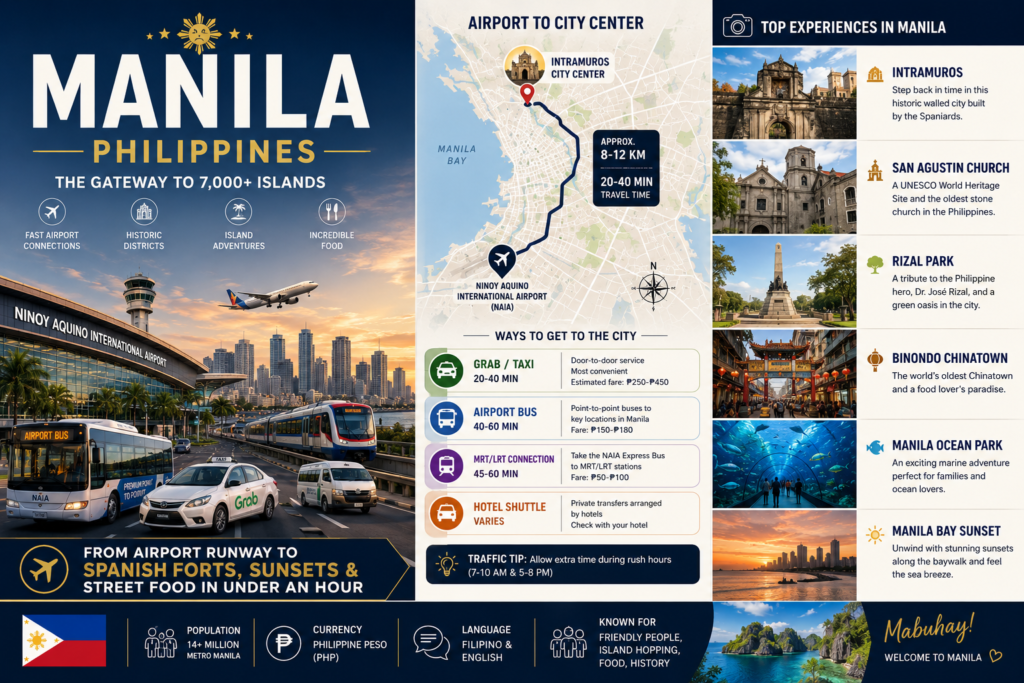
Binondo in Manila is the oldest Chinatown outside China, established in 1594 — 26 years before the Mayflower landed at Plymouth. Four terminals that are not connected. The most extraordinary 16th-century walled city in Southeast Asia. And traffic that makes Bangkok look organised.
Binondo exists because the Spanish colonial government in 1594 needed somewhere to put the Chinese merchant community — the Sangleys — who were essential to the economy but not welcome to live within the walled city of Intramuros. They built a settlement across the Pasig River. It became Binondo. Four centuries later it is still the centre of Filipino-Chinese commerce, still has the original street layout, and still has the best Chinese-Filipino food in the Philippines at prices that make the airport restaurant look extravagant. It is older than the United States by 182 years.
Intramuros — the 1571 walled city built by Miguel López de Legazpi on the mouth of the Pasig River — is the most complete Spanish colonial fortification remaining in Southeast Asia. Fort Santiago, where Filipino national hero José Rizal was imprisoned before his execution in 1896, is inside the walls. The San Agustín Church (completed 1607) is the oldest stone church in the Philippines and a UNESCO World Heritage Site.
Ninoy Aquino International Airport (NAIA, IATA: MNL) is the Philippines’ primary international gateway, handling 50.1 million passengers in 2024 — a record surpassing pre-pandemic levels by 5%. The airport has four terminals in Pasay and Parañaque cities, approximately 7km south of Manila’s CBD. The critical detail: the terminals are not connected internally and not within walking distance of each other. If your inbound and outbound flights use different terminals, allow at least 3 hours for any domestic-to-international or international-to-domestic connection at NAIA.
Terminal 1 handles most major foreign airlines — Singapore Airlines, Cathay Pacific, Emirates, Qatar Airways, Korean Air, Japan Airlines. Terminal 2 is dedicated to Philippine Airlines. Terminal 3 is the largest and most modern, handling Cebu Pacific, AirAsia, Delta, KLM, and Eva Air. Terminal 4 handles AirSWIFT domestic flights to El Nido and Coron.
Metro Manila has some of the worst traffic congestion in Southeast Asia. Peak hours are 7–10am and 4–8pm. A 25-minute journey at 11am can take 90 minutes at 6pm. The Grab pickup zone at NAIA is in the international parking structure, 500 metres from the terminal exits. Never plan a Manila layover return to NAIA between 4pm and 8pm without a 90-minute traffic buffer.
Most Western nationalities (US, UK, EU, Canada, Australia, Japan) enter the Philippines visa-free for 30 days. Your onward ticket is required. For visa assistance, use iVisa. Airside transit (staying in the secure zone) is available for same-ticket connections within 8 hours.
Eight hours minimum off-peak. Intramuros and Fort Santiago: 2–3 hours. Binondo: 1–2 hours. Traffic each way: 45–60 minutes. BGC is achievable in 5 hours as a simpler alternative.
T1: most foreign carriers (Singapore, Cathay, Emirates, Qatar, KAL, JAL). T2: Philippine Airlines only. T3: Cebu Pacific, AirAsia, Delta, KLM, Eva Air — newest. T4: AirSWIFT domestic to El Nido. Always verify your terminal on your boarding pass.
Grab is safest — walk 500m from the terminal exit to the Online Taxi Lounge in the parking structure. Official airport taxis at the pre-paid counter are the alternative. Do not accept rides from drivers soliciting inside the terminal.
Yes, during daytime. The main Ongpin and Salazar streets have high foot traffic all day. Standard city precautions apply: keep valuables in a front pocket, hold your phone rather than leaving it visible on a table. Fine until 6pm.
Should You Leave? The Manila Layover Gauge
NAIA immigration during peak arrivals runs 40–60 minutes. The Grab pickup zone is 500m from the terminal. Traffic to any worthwhile destination is 30–45 minutes off-peak. Under 5 hours, you cannot reach Intramuros and return comfortably. T3 has the best airport food court — use the time there.
Bonifacio Global City (BGC) is 30–45 minutes from NAIA off-peak and has excellent restaurants and the Bonifacio High Street retail district. More manageable than Intramuros on a shorter window. If arriving 4–8pm, traffic will consume the window — do not attempt the city during evening peak.
Intramuros and Fort Santiago in the morning (arrive by 9am), Binondo for lunch, BGC for the afternoon. With 12+ hours: add the National Museum of the Philippines on Padre Burgos Avenue — free entry, extraordinary pre-colonial gold collection, the Spoliarium painting by Juan Luna, and Filipino history from the 900 CE Laguna Copperplate Inscription. Return to NAIA 3 hours before your international departure.
Work out your Manila window precisely
Enter your MNL landing time and departure gate-close. The calculator returns your real city window after NAIA immigration, the Grab ride, and the 3-hour international departure buffer.
Getting from NAIA to Manila City Centre
| Option | Time | Cost | Best for |
|---|---|---|---|
| Grab / Gojek Recommended Walk 500m to Online Taxi Lounge in parking structure | 30–45 min to BGC; 45–60 min to Intramuros off-peak | ₱300–500 | Everyone with a working data connection. Activate Airalo eSIM before landing to request from the parking zone without queuing. |
| Official Airport Taxi Pre-paid counter inside arrivals hall | 35–60 min off-peak | ₱350–600 | When you don’t have data for Grab. Use only the official NAIA pre-paid counter — do not accept offers from drivers soliciting inside the terminal building. |
| Welcome Pickups Pre-booked fixed price | 35–55 min off-peak | Fixed from ₱900 | When your Palawan domestic connection is time-critical and variable pricing or wait times are unacceptable. Pre-book Welcome Pickups. |
| P2P Bus (UBE Express) | 45–90 min | ₱150 | Budget option to BGC or Makati. Direct, air-conditioned, reliable off-peak. Use Omio to compare bus routes and times. |
What to Do in Manila on a Layover
Intramuros — The 1571 Walled City
Intramuros (“within the walls”) was built by Miguel López de Legazpi in 1571 on the south bank of the Pasig River. The 4.5km walls and bastions enclose 0.67 square kilometres of Spanish colonial heritage. Fort Santiago, at the northern tip, is where José Rizal — the national hero whose execution in 1896 sparked the Philippine Revolution — was imprisoned before being shot at Luneta Park. His bronze footprints are cast in the path he walked to his execution. The Rizal Shrine inside Fort Santiago holds his coat, books, and last poem. Entry ₱75. The San Agustín Church (completed 1607) at the centre of Intramuros is the oldest stone building in the Philippines and a UNESCO World Heritage Site — its trompe-l’oeil ceiling survived the 1945 Battle of Manila.
Binondo — The World’s Oldest Chinatown (1594)
Binondo was established in 1594 as the designated district for the Chinese Sangley community that Spanish Manila depended on economically. It sits across the Pasig River from Intramuros via the Jones Bridge. Today it is 430 years old, still functions as the centre of Filipino-Chinese commerce, and has the highest concentration of tokwa’t baboy (fried tofu and pork), pansit (noodles), hopia (moon cakes), and congee per square metre of any neighbourhood in the Philippines. The food walk from Ongpin Street along Salazar Street to the Binondo Church (1596) and back covers the essentials in 90 minutes. Arrive hungry. Eng Bee Tin on Ongpin (since 1912) for hopia; any counter on Salazar for tokwa’t baboy.
Fort Santiago — The Pasig River Gate at Dawn
The Puerta de Santiago (Fort Santiago’s main gate) opens onto the Pasig River. At 7–8am, the light is soft and the gate is photographable without crowds. The stone arch frames the river beyond — the gate through which Rizal passed on his way to execution. Shoot from slightly inside the entrance, framing the arch against the river.
07:00–08:30 only. Inside Fort Santiago, facing north toward the Pasig River gate. Horizontal orientation.
Binondo — Ongpin Street at Midday
Chinese lanterns overhead, gold shops at street level, the Binondo Church campanile in the background. Midday gives the best light for the lanterns. Wide-angle from the middle of the road gets the full compression of the street into one frame. Portrait orientation for the lanterns-to-street composition.
11:00–13:00. Ongpin Street, Binondo. Wide or 28mm equivalent. Portrait for overhead lanterns.
Manila Layover Itineraries
Allow 40–50 minutes from landing to Grab pickup zone (immigration 20 min off-peak, walk 500m). Grab to BGC: 30–45 min, ₱300–400.
BGC’s pedestrianised retail and restaurant district. Manam (modern Filipino — lechon and sinigang), Wholesome Table, or international options. Budget ₱350–600 for lunch. 90 minutes food and walk.
Allow 45–60 minutes Grab back to NAIA. International departures require 3-hour pre-departure airport arrival. Book the return Grab as you finish lunch — peak hours add significantly to this window.
Grab from NAIA (45–60 min). Enter Fort Santiago by 09:00. Rizal Shrine, the Pasig River walls, the bastion views. 60–90 minutes before the tour groups arrive. ₱75 entrance.
UNESCO church with trompe-l’oeil ceiling. Rent a bamboo bike at ₱150/hour and cycle the quiet internal streets of Intramuros. 60 minutes.
5-minute Grab across Jones Bridge. Walk Ongpin Street, eat at any Chinese-Filipino counter (noodles, congee, hopia). Budget ₱200–400. 90 minutes exploring and eating.
Grab from Binondo to NAIA: 45–60 minutes. International check-in plus security adds another 60 minutes. Be at the airport 3 hours before your flight departure, no exceptions.
Manila Layover Scenarios — Real Situations, Specific Solutions
You cleared T1 immigration and need T3 for your Cebu Pacific flight to Puerto Princesa. The free inter-terminal shuttle takes 20–40 minutes including wait time.
2.5 hours minus 40 min shuttle, 20 min T3 security, and 30 min gate close leaves 80 minutes. NAIA customs at T1 can run 30–40 minutes at peak arrivals. The window collapses quickly.
Skip the free shuttle and take a Grab or official taxi between terminals — 10–15 minutes versus 40. Pre-book via Welcome Pickups if your Palawan timing is non-negotiable.
You finished lunch at BGC at 17:00 on a Friday. Grab shows 75–95 minutes to NAIA T3. You have 3.5 hours to gate close.
90-minute traffic + 20-minute terminal walk + 60-minute security and check-in = 170 minutes. Your gate closes in 210 minutes. That 40-minute buffer evaporates in exceptional congestion.
Leave BGC by 16:30 on Fridays. A pre-booked Welcome Pickups transfer with a fixed departure time means the driver arrives at 16:30 regardless of Grab surge pricing.
Your SIM hasn’t activated on Philippine networks. Drivers are soliciting at 3–4x the Grab price inside the terminal. The official pre-paid counter is safe but overpriced.
Without Grab, you have no price transparency. Unauthorised drivers at NAIA are both expensive and unpredictable. The official pre-paid counter is safe but charges a significant premium.
Activate an Airalo Philippines eSIM on the plane before landing. Plans from $3.50 for 7 days. Grab requests from the Online Taxi Lounge at ₱300–500 before any driver approaches you.
Fort Santiago’s interior paths are partially unpaved. Bamboo bike rental doesn’t accommodate large luggage. NAIA has no public left-luggage service landside.
Dragging a rolling bag over 430-year-old paving for 2 hours is possible and genuinely uncomfortable. It slows the visit and makes the bamboo bike option inaccessible.
Bounce has partner locations near Intramuros and BGC. Drop the bag before Fort Santiago, collect before your Grab back to NAIA.
Binondo’s street food counters and hopia shops operate in cash. NAIA ATMs add ₱200 per withdrawal on top of your bank’s foreign transaction fee.
On a ₱2,000 withdrawal, the surcharge plus a 3% foreign fee means losing 13% before you have bought anything.
Use a Wise card at any BDO or BPI ATM inside a Manila mall — mid-market PHP, small fixed fee, no surcharge. Withdraw ₱2,500–3,000 before the Binondo visit.
Manila in March–May is 35–38°C with high humidity. The exposed bastion walls of Intramuros have limited shade between the main entrance and the river bastions.
Heat exhaustion in Manila without travel medical cover means a private clinic visit starting at ₱2,000. Your regular health insurance does not cover the Philippines.
Visit Intramuros before 10am or after 4pm in summer. Have Visitors Coverage active before landing — same-day activation, covers Philippine medical treatment from the first peso.
Food in Manila
Lechon — The Philippine Centrepiece
Lechon is a whole roasted pig slow-turned over coals for 4–6 hours, producing crackling skin and juicy meat that is the centrepiece of every Filipino celebration. The best Manila versions: Rico’s Lechon in Malate (₱450/kg), and the lechon at Manam restaurant in BGC as part of a modern Filipino menu. The skin is the point — crisp and amber, it breaks audibly when you bite through it.
Sinigang and the Filipino Broth Tradition
Sinigang is the sour tamarind broth soup that is arguably more central to Filipino daily cooking than lechon. Made with pork, fish, or shrimp in a tart clear broth with water spinach, daikon, and long beans. At Manam in BGC, the sinigang na baboy defines the modern Filipino restaurant approach: proper sourness, proper depth. Budget ₱350–500 at a sit-down restaurant; street versions ₱80–120.
Binondo Street Food
The Filipino-Chinese street food of Binondo is its own culinary lineage. Arroz caldo (ginger rice porridge, ₱60–80), tokwa’t baboy (fried tofu and pork in vinegar-garlic sauce, ₱70–100), and hopia from Eng Bee Tin on Ongpin Street (since 1912) — flaky pastry filled with mung bean or ube, ₱15–25 each. These have been made in the same neighbourhood since the 17th century.
Fort Santiago’s parade ground is quiet at 7am in a way that Intramuros almost never is by 10. The bronze footprints start at a door in the Anda Street wall and walk to the gate where José Rizal passed on December 30, 1896, 35 years old, on his way to Luneta Park to be shot by Spanish colonial firing squad. He had a copy of Schopenhauer in his pocket. He had written a last poem — Mi último adiós — and hidden it inside a small oil lamp he gave to his sister at the prison gate. The footprints are slightly smaller than you expect. The door is low. The walk from the cell to the gate took less than five minutes. The Spanish colonial empire in the Philippines lasted another two years after his death.
Gear, eSIM, and Connectivity
Philippines plans from $3.50 for 7 days on Globe or Smart networks. Essential for Grab access — without data you cannot request from the NAIA Online Taxi Lounge. Activate on the plane before landing.
Get an eSIM →NAIA’s free Wi-Fi is unencrypted. Banking access and booking confirmations on an open terminal network in a high-traffic international airport should always go through a VPN.
Get NordVPN →NAIA ATMs add ₱200 surcharge. A Wise card at any BDO or BPI ATM inside a Manila mall gives mid-market PHP with a small fixed fee — significantly less than the airport ATM on any withdrawal above ₱3,000.
Get Wise →Asia-Pacific specialist with strong Manila and Philippine islands operator network. Intramuros tours, Binondo food walks, and El Nido day trips from MNL for longer layovers.
Browse Manila Tours →Hotels for an Overnight Manila Layover
Reference business hotel in BGC — 30–40 minutes from NAIA T3 off-peak, walking distance to Bonifacio High Street. Modern Manila with no traffic anxiety and excellent Sunday breakfast market.
Check availability →Closest hotel to Intramuros. Walking distance to Fort Santiago before the city wakes up — the best timing for the dawn visit. Practical and well-priced for a single layover night.
Check availability →5-minute drive from NAIA T2. Right for short layovers under 8 hours or pre-dawn departures. Dayuse half-day rates available.
Check availability →The landmark Manila Bay hotel — pool, beach club, sunset views. 20 minutes from NAIA via the Coastal Road. The correct choice when the sunset from the pool deck at Manila Bay is the actual goal of the layover.
Check availability →Tours and Experiences
Guided 2.5-hour tour covering Fort Santiago, the Rizal Shrine, San Agustín Church, and the city walls circuit. The guide provides the Philippine Revolution context that the monuments alone cannot convey — why Rizal’s execution mattered, what the 1898 independence declaration actually changed.
Book via GetYourGuide →Guided food walk through Binondo with 8–10 tastings: congee, tokwa’t baboy, hopia, fresh lumpia, and carioca. The guide covers the 1594 founding and the specific history of each street. For hosted local food experiences, also check Eatwith Manila options.
Book via Klook →Luggage Storage, Transfers, and Insurance
Manila city centre partner locations near Intramuros and BGC. Essential for the cobblestone walking circuit — a rolling suitcase on 430-year-old Intramuros paving ruins the morning.
Find Storage →Fixed-price transfers from Manila to NAIA. The only reliable option on Friday 4–8pm peak when Grab surge and congestion make the standard ride genuinely dangerous for your flight timing.
Pre-Book Transfer →Covers missed domestic connections at NAIA when your inter-terminal transfer runs short — the situation where the free shuttle makes you miss your Cebu Pacific Palawan departure.
Get a Quote →Rolling monthly medical cover for the Philippines and the broader Southeast Asia itinerary. More cost-efficient than per-leg single-trip policies when combining Manila with Palawan, Cebu, and Siargao.
Get a Quote →Same-day emergency medical cover for the Philippines. Private hospital care in Manila without cover starts at ₱2,000 per consultation. St. Luke’s BGC is the reference private hospital for international visitors.
Get a Quote →How much time do you actually have?
Manila distances and NAIA terminal complexity eat time differently from any other hub. Enter your landing and departure times to know exactly what is possible.
Calculate My Time →Philippines Visa Check
Most Western nationals are visa-free for 30 days at MNL immigration. The Philippines visa-free list is extensive but not universal — verify your specific nationality.
Check Visa Requirements →Manila is the gateway to Palawan
El Nido and Coron are accessible from MNL via Cebu Pacific and AirSWIFT domestic. Our Final Destinations guide covers the full MNL-PPS-ENI routing for Palawan.
Final Destinations Guide →Frequently Asked Questions
The four NAIA terminals were built at different times over several decades as separate projects. Between them, the airport authority built roads, taxi lanes, and bus routes. Retroactively connecting them would require demolishing or tunnelling under this infrastructure — a billion-dollar project repeatedly planned and postponed since the 1990s. The New Manila International Airport at Bulacan is designed as a single integrated complex. Until it opens, NAIA’s four terminals are a structural reality every Manila layover visitor must plan around.
Yes. Binondo’s main streets — Ongpin, Salazar, and the area around the Binondo Church — are safe for solo visitors throughout the day with high foot traffic and active commercial activity. Standard city precautions apply: keep valuables in a front pocket, hold your phone rather than leaving it visible on a market table. The neighbourhood is most active 8am–6pm; it is fine after dark but quieter and less interesting for a layover visit.
November through February is the dry season — 25–32°C with low humidity, the most comfortable for outdoor walking in Intramuros and Binondo. March through May is progressively hotter (32–38°C) and outdoor midday activity becomes genuinely tiring. June through October is typhoon season — Manila receives 4–6 typhoons per year on average, and while most layover visitors are not directly affected, flight disruptions are common. December through March is the safest window for weather reliability and outdoor comfort.
National emergency number for Metro Manila. English-speaking operators available.
Level 1 trauma, BGC campus. Reference private hospital for international visitors — 30 minutes from NAIA T3.
MIAA hotline for lost property, terminal information, and passenger assistance at all NAIA terminals.
- NAIA / MIAA. 50.1 million passengers 2024 — record year, surpassing 2023 by 10.43% and 2019 pre-pandemic levels by 5%. T1 foreign carriers, T2 PAL, T3 Cebu Pacific/AirAsia, T4 AirSWIFT.
- Secret Flying Manila Guide. NAIA four terminals not connected internally; free inter-terminal shuttle 20–40 minutes; Grab pickup 500m walk to Online Taxi Lounge; peak traffic 7–10am and 4–8pm. January 2026.
- National Historical Commission of the Philippines. Intramuros 1571 founding; Fort Santiago Rizal Shrine; San Agustín Church 1607 UNESCO World Heritage.
- Philippine Commission on Tourism / Academic sources. Binondo established 1594 as Chinese Sangley district under Spanish colonial administration — oldest continuously operating Chinatown outside China.
Disclaimer: Fares and traffic times verified June 2026, subject to change. NAIA terminal assignments shift periodically — always verify your terminal on your boarding pass before travel. Affiliate links may earn EpicLayover a commission at no additional cost to you.
