
Why a Nairobi Layover Is Unlike Anywhere Else on Earth
Nairobi National Park is the only national park on earth where you can photograph lions, giraffes, rhinos, and buffalo against the backdrop of a capital city’s office towers. It is 25 minutes from the airport gate. Nowhere else on the planet offers this.
The park was established in 1946, predating most of Nairobi’s modern development. Today, 117 square kilometres of unfenced savanna grassland sits directly south of the city — separated from the urban edge by nothing except a fence that the animals can move through to the south and west. The city’s skyline is visible from the park’s interior. Giraffes graze in the foreground of glass office buildings. Lions have been photographed with the JKIA approach lights visible behind them. This is not a curated wildlife encounter in a distant reserve — it is a functioning national park within Uber distance of an international airport.
Nairobi is also the primary East African hub for Kenya Airways (SkyTeam) and a significant intermediate point for flights between Europe and southern Africa, the Indian Ocean islands, and the Tanzanian safari circuit. A Nairobi layover is, frequently, the gateway to the Serengeti, Kilimanjaro, Zanzibar, or the Masai Mara — and the park next door to the airport means the wildlife starts the moment you land.
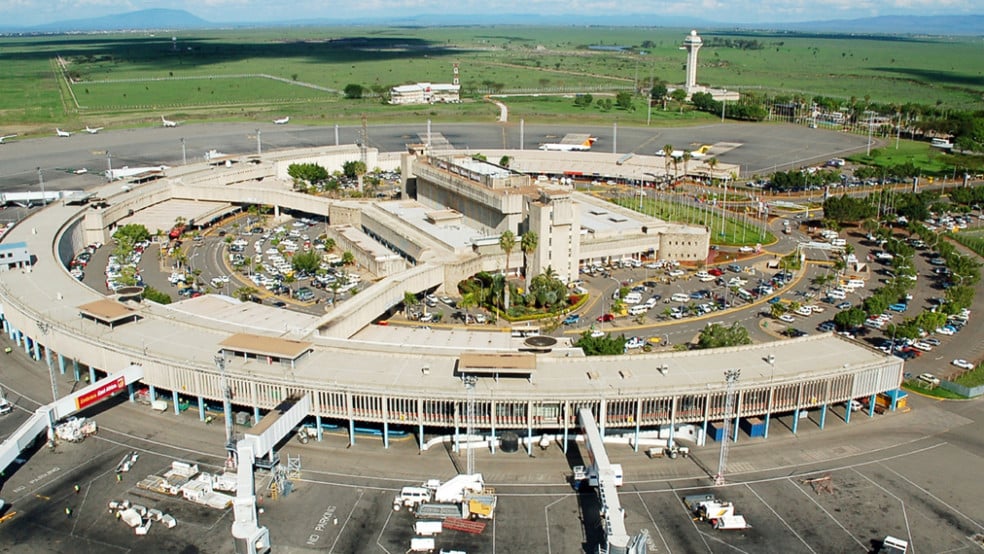
Jomo Kenyatta International Airport (JKIA / NBO) is Kenya’s primary international gateway and East Africa’s busiest hub, handling approximately 8.93 million passengers in 2025 — above its 7.5 million design capacity, which explains the congestion that characterises the arrivals process. The airport has five terminals designated T1A through T1E, all connected landside. Kenya Airways and most international carriers operate from the main international terminal. The airport is 15km southeast of the Nairobi CBD. Uber and Bolt both operate reliably from the designated rideshare zones; regulated taxis are available from the official taxi rank at arrivals exit.
Kenya requires an Electronic Travel Authorisation (e-TA) for all foreign visitors entering the country, including transit passengers who plan to clear immigration. Cost: USD 30. Processing time: typically 24–72 hours but can be longer. Apply at etakenya.go.ke before departure — do not arrive without one. The e-TA replaced the previous visa-on-arrival system in 2023. For assisted applications with processing tracking, use iVisa. Citizens of East African Community member states (Tanzania, Uganda, Rwanda, Burundi, South Sudan) do not require an e-TA. Airside transit passengers on the same ticket connecting within 24 hours without clearing immigration do not require an e-TA.
Yes — and it is the single best use of a Nairobi layover of 6 hours or more. The park gate is 25–30 minutes from JKIA. A 4-hour game drive costs approximately USD 80–120 per vehicle including a guide. You will see large mammals. The Big Five are all present in the park (lion, leopard, rhino, buffalo, elephant — elephant sightings are less common but occur). The city skyline in the background of every wildlife photograph is unique to Nairobi worldwide.
JKIA processes over 8.9 million passengers through a terminal designed for 7.5 million. Immigration during peak arrival windows (overnight flights from Europe and the Middle East landing 05:00–09:00) regularly runs 60–90 minutes. During off-peak hours, 30–45 minutes is typical. Having your e-TA pre-approved significantly speeds the counter interaction but does not change the queue length. E-gates have been introduced for some passport types — check signage on arrival.
In the tourist and business districts — Westlands, Karen, the Nairobi National Park perimeter, and Gigiri (UN Village area) — yes, with standard precautions. Do not walk with visible valuables, use app-based transport rather than flagging taxis, and stay in the areas above during a layover visit. The CBD (Central Business District) during business hours is manageable with a guide but less straightforward for an independent layover visitor. The park itself is entirely safe with an accredited guide and a vehicle.
Yes — it is the best. Kenya Airways connects NBO to Kilimanjaro (JRO), Zanzibar (ZNZ), Dar es Salaam (DAR), Mombasa (MBA), and the Masai Mara (KEK, MRE) with multiple daily flights. Nairobi Wilson Airport (WIL), 8km from JKIA, handles bush planes to Masai Mara camps, Amboseli, and Samburu — most safari operators route through Wilson. NBO is also the hub for Ethiopian Airlines connections to the entire African continent. If you are going on safari anywhere in East Africa, you are probably routing through Nairobi.
Kenya Airways and the East Africa Network
Kenya Airways operates Nairobi as its primary hub and serves more African destinations than any other carrier from NBO. SkyTeam membership means KQ miles and status connect with Delta, Air France, KLM, and other SkyTeam partners — the Delta partnership in particular creates a seamless routing from North America via Amsterdam or Paris to Nairobi for safari itineraries. Critically for layover visitors, Kenya Airways operates the most useful Tanzania connections from NBO: Kilimanjaro (JRO) for Serengeti access, Zanzibar (ZNZ) for the Indian Ocean, and Dar es Salaam (DAR) as a secondary Tanzania hub. Ethiopian Airlines also operates a competing hub at Addis Ababa (ADD) with extensive African connections, and maintains strong NBO frequency.
Daily NBO–ADD flights feeding Ethiopian’s continental network of 60+ African destinations. For connections to West Africa, North Africa, or southern Africa, the Ethiopian hub often has the best routing via Addis Ababa from Nairobi.
Daily direct services to Dubai and Doha. Primary connections for East Africa to Asia, Australia, and the Americas. Emirates A380 on the DXB–NBO route on select services.
Daily LHR–NBO, the primary UK route alongside Kenya Airways. BA One World connection from NBO — useful for AA frequent flyers routing through London to Nairobi.
Light aircraft charter and scheduled services from Wilson Airport (WIL, 8km from JKIA) to Masai Mara camps, Amboseli, and Samburu. The Wilson route is how most Masai Mara safari guests arrive and depart.
Should You Leave? The Nairobi Layover Gauge
JKIA immigration in peak arrival windows (05:00–09:00, when overnight European flights land simultaneously) runs 60–90 minutes. The e-TA must be pre-approved before landing — do not attempt to get one at the airport. The park is 25 minutes from the airport. With planning, Nairobi is one of the most rewarding layover cities on earth for the time invested.
Peak immigration takes 60–90 minutes. The park drive is 25 minutes. Add 30 minutes in the park (too short for meaningful wildlife), 25 minutes back, and 2.5 hours for international departure — under 5 hours you cannot do it. JKIA’s airside facilities are modest but functional. Use the time to process the safari ahead or debrief the one behind you.
With an off-peak arrival (not 05:00–09:00), a pre-approved e-TA, and a pre-booked vehicle from the park gate, a 2-hour game drive in Nairobi National Park is achievable on a 5–7 hour layover. The arithmetic is tight. Pre-book everything before landing: the Uber, the guide, the park entry via GetYourGuide. Do not attempt the CBD or Westlands on this window — the park is closer and more time-efficient per kilometre travelled.
Nairobi National Park in the morning (4-hour game drive, enter by 08:00 for the best lion and rhino sightings), then the Giraffe Centre in the Karen suburb for the Rothschild giraffe feeding platform (open 09:00–17:00, 20 minutes from the park), and the Karen Blixen Museum (the Out of Africa farmhouse, open 09:30–18:00). Return to JKIA via Uhuru Highway with a 2.5-hour departure buffer. With 12+ hours: add Westlands for lunch and the Nairobi Museum on State House Road.
Work out your Nairobi window precisely
Enter your NBO landing time and departure gate-close. The calculator accounts for peak immigration at JKIA, the park transit time, and the international departure buffer.
Getting from JKIA to Nairobi
| Option | Destination | Time | Cost | Notes |
|---|---|---|---|---|
| Uber / Bolt Recommended | CBD / Westlands | 25–45 min off-peak | KES 800–1,500 | Request from the designated rideshare zone outside arrivals. Requires live data — activate Airalo eSIM before landing. Do not take during 07:30–09:30 or 17:00–19:30 peak traffic. |
| Nairobi National Park | Park Gate (Langata) | 25–30 min from JKIA | KES 1,000–1,500 Uber | The park Main Gate is on Langata Road — closer to JKIA than central Nairobi. A pre-booked guide vehicle meets you at the gate. USD 60 conservation fee for non-residents, paid via KWS app or at the gate. |
| Welcome Pickups | Any Nairobi destination | 30–50 min | Fixed price confirmed pre-booking | Pre-booked, driver monitors your flight. Right choice when your safari connection at JKIA or Wilson Airport is time-critical. Pre-book Welcome Pickups → |
| Metered Taxi (Official) | CBD / Karen | 30–50 min off-peak | KES 2,000–3,500 | Official taxi rank outside arrivals. More expensive than Uber; use when app-based transport is unavailable. Agree total price before departure. Do not accept offers from drivers inside the terminal. |
Nairobi has some of the worst traffic congestion in Africa during peak hours. The Uhuru Highway and Mombasa Road corridor between JKIA and central Nairobi regularly seizes completely between 07:30–09:30 and 17:00–19:30. A journey that takes 25 minutes at 06:00 can take 90 minutes at 08:30. Plan all Nairobi layover itineraries around off-peak transit — enter the city before 07:00 or after 09:30, leave before 16:00 or after 19:30. Google Maps live traffic is reliable for Nairobi; check it before requesting every Uber. Use a live eSIM from the moment you land.
What to Do in Nairobi on a Layover
Nairobi National Park — Lions Against the Skyline
Nairobi National Park is the layover centrepiece and requires no further justification beyond the fact that nowhere else on earth offers it. The park covers 117km² of open savanna, riverine forest, and wetland habitat 7km from the city centre. Lions, leopards, cheetahs, rhinos (both black and white), buffalo, zebra, wildebeest, giraffe, and over 400 bird species are resident. The city skyline — office towers, construction cranes, the JKIA approach lights at night — is visible from throughout the park’s northern boundary.
Entry fees for non-residents: USD 60 adults, payable via the KWS (Kenya Wildlife Service) app or at the Main Gate on Langata Road. All visitors enter in a vehicle — self-drive is permitted (4WD not required for the main circuit roads), or hire a guide vehicle through the KWS desk at the gate. A 4-hour game drive covers the main circuit with lion territory in the western section and the Athi River marsh in the south where hippos are resident. The best wildlife hours are 06:00–10:00 before the heat pushes predators into cover. For a guided park game drive with transport from JKIA: GetYourGuide has operators who meet you at the arrivals exit.
Giraffe Centre — Karen
The African Fund for Endangered Wildlife’s Giraffe Centre in the Karen suburb (20 minutes from the national park gate) operates a Rothschild giraffe breeding programme and a raised wooden platform at which visitors can hand-feed and photograph the giraffes at eye level. The Rothschild giraffe is one of the most endangered giraffe subspecies, with fewer than 2,000 individuals remaining. The centre is one of the few places in the world where you are at giraffe eye level without a vehicle roof — the feeding platform puts your face at 5.5 metres. Open 09:00–17:00, KES 2,500 for non-resident adults.
Karen Blixen Museum
Karen Blixen (pen name Isak Dinesen) lived at the Karen Coffee Farm from 1917 to 1931, during which she wrote the memoir published as Out of Africa. The farmhouse is now a museum 20 minutes from central Nairobi, in the leafy Karen suburb named after her. The building is preserved largely as it was when she left — the verandah facing the Ngong Hills, the furniture she used, the small study. The Ngong Hills are visible from the garden in clear weather. For anyone who has read the book or seen the film, the museum is as specific and well-maintained as any literary house in Europe. Open 09:30–18:00, KES 1,200 non-residents.
Westlands — Food and Coffee
Westlands is Nairobi’s most international commercial and restaurant district — 35 minutes from JKIA via Uhuru Highway off-peak. The Sarit Centre and Westgate shopping malls anchor a neighbourhood of cafés, restaurants, and the Chandarana supermarket (one of the best stocked in East Africa for imported goods, useful for safari snacks). Java House, the Kenyan coffee chain with consistently good espresso and free Wi-Fi, has multiple Westlands branches. For a 10-hour layover where you need a comfortable working environment between the park in the morning and the airport in the afternoon, a Westlands Java House after the game drive is the practical solution.
Nairobi National Park — Giraffe with City Skyline
The shot that exists nowhere else: a Masai giraffe (or a pride of lions) in the foreground with the Nairobi CBD office tower cluster visible on the northern horizon behind them. The composition requires a long lens (200–400mm equivalent) to compress the distance and bring the skyline into the background of the animal. The best positions are in the northern section of the park circuit road nearest the city boundary, approximately 3km inside the Main Gate on the Athi Basin Road. Early morning, 07:00–09:00, before the haze builds.
200–400mm equivalent. Northern park boundary road. Morning light from the east illuminates both animal and skyline simultaneously.
Giraffe Centre — Eye-Level Feeding Platform
The raised wooden platform at the Giraffe Centre puts you at 5.5 metres — Rothschild giraffe eye level. The animals come to the platform for food pellets and make extended eye contact at close range. The shot is a portrait: giraffe face filling the frame, the distinctive Rothschild patterning (cream borders rather than orange-brown), and the long eyelashes that photograph beautifully in natural light. Shoot between 09:30–11:00 when the morning light is warm and before midday flatness. A 50–85mm equivalent focal length fills the frame correctly at 1–2 metres’ distance.
09:30–11:00. Eye-level on the feeding platform. Natural light only — flash disturbs the animals.
Nairobi Layover Itineraries
Off-peak immigration with pre-approved e-TA: 35–45 minutes. Uber to the Main Gate (Langata Road): 25 minutes. Total from touchdown: 75 minutes. The guide vehicle and driver are pre-booked and waiting at the gate. Pay KWS entry fee at the gate or via the app before arrival (USD 60).
The main circuit covers the western savanna (lion territory), the central plateau (zebra, wildebeest, giraffe, buffalo), and the Athi River marsh in the south (hippos, crocodiles, waterbuck). The guide directs the circuit based on recent sightings reported by the ranger network. Average 4-hour drive in 117km² of park: 2–4 large mammal species encountered, city skyline visible throughout the northern sections.
Uber from the Main Gate to JKIA: 25–30 minutes. At JKIA: 2.5-hour international departure buffer for check-in and security. Note the peak traffic window — if your departure falls 17:00–19:30, request the Uber 30 minutes earlier than this calculation suggests.
Enter the park at 07:00 for the best predator activity. Guide vehicle circuit: 3 hours covering lion territory and the Athi marsh. The skyline photograph is best 07:00–09:00 with low morning sun from the east illuminating both animal and city simultaneously.
20 minutes from the park gate. Feeding platform opens 09:00. Arrive at 10:30 — the morning school groups have departed and the platform is quieter. Hand-feed Rothschild giraffes at eye level, photograph at 50–85mm. 60 minutes.
5 minutes from the Giraffe Centre. Tour the farmhouse with the Ngong Hills visible from the verandah. The museum café serves light lunches in the garden. Allow 90 minutes total. Budget: KES 1,200 museum entry + KES 800–1,500 lunch.
Uber from Karen to JKIA: 30–40 minutes (avoid peak 17:00–19:30). At JKIA: 2.5-hour buffer for international departures. Karen is 18km from JKIA via the Southern Bypass — slightly longer than the city centre route but avoids the Mombasa Road congestion.
Nairobi Layover Scenarios
You land with a 9-hour layover, planning a 4-hour park drive. JKIA’s overnight arrivals from London and the Gulf all land between 05:30 and 07:00 — you are in the worst possible immigration queue. The 75-minute wait puts you at the park gate at 08:30 instead of 07:30. The lions are moving into shade cover by 10:00.
Missing the optimal predator activity window reduces the park drive from extraordinary to merely good. A 9-hour layover with a 75-minute immigration delay and a 30-minute transit still leaves 5 hours in the park — enough for a worthwhile game drive.
Pre-book the guide vehicle for 09:00 arrival (not 07:30) to account for realistic JKIA processing. Book via GetYourGuide — licensed operators adapt the start time when you message ahead and guides know which circuit areas hold predators after 10:00.
Kenya replaced visa-on-arrival with the e-TA system in 2023. You were not aware of this change. You are at the immigration counter with no e-TA. The officer directs you to a secondary processing area for manual assessment.
Manual e-TA processing at the airport takes 2–4 hours. On a 7-hour layover, this eliminates any possibility of leaving the terminal and may jeopardise your onward connection if the process runs long.
Apply the e-TA (USD 30) at etakenya.go.ke a minimum of 72 hours before any Nairobi routing. Use iVisa for assisted processing — they monitor application status and flag delays before your departure date.
You are returning from Westlands after an early park visit. It is 08:30. Uhuru Highway — the primary airport route — is at a standstill. Your Uber app shows 55 minutes to JKIA. Your gate closes in 2.5 hours. This is still enough time, but it now requires everything to go right.
Nairobi traffic jams are not predictable. A 55-minute estimate can become 75 minutes without warning. On an international departure, 2.5 hours minus 75-minute traffic means 55 minutes for check-in and security — tight.
Pre-book the return journey via Welcome Pickups and depart by 07:30 before peak traffic begins. Experienced Nairobi drivers also know the Southern Bypass alternate route — request it specifically when in Karen or the Langata area.
Uber in Nairobi costs KES 800–1,500 to the park. Without a data connection, you are negotiating with unlicensed drivers at the arrivals exit who know you have no app to compare their price against. KES 6,000 is 4× the correct fare.
Unlicensed taxis at JKIA are a documented source of overcharging. Without data, there is no fare reference and no ability to share your location or verify the driver’s identity.
Activate an Airalo Kenya eSIM on the plane. Kenya data plans from $3 for 7 days. Uber and Bolt both work from the JKIA arrivals zone — KES 800–1,200 to the park, verified driver, live tracking.
Wilson Airport (WIL) is 8km from JKIA. Your Safarilink or AirKenya charter to Masai Mara departs at 07:30. JKIA immigration runs 60 minutes. You have 45 minutes from clearing customs to boarding at Wilson.
Missing a Wilson charter is expensive — replacement charters cost USD 200–400 per seat and may not be available same-day. The safari camp has your arrival expected; the guide has your game drive scheduled.
Pre-book a fixed-price transfer via Welcome Pickups for the JKIA–WIL transfer. The driver monitors your JKIA landing, is at the arrivals exit when you clear, and knows the fastest route to Wilson. Cover the WIL connection with World Nomads missed connection insurance.
Kenya Wildlife Service park entry for non-residents costs USD 60. The gate has a card reader and a KWS mobile app payment option. In practice, the gate card reader at Nairobi National Park has intermittent connectivity and occasionally defaults to cash.
USD 60 in Kenyan shillings (KES 7,800 at current rates) is a meaningful cash requirement you may not have if you came straight from the terminal. Being turned away at the park gate on a 7-hour layover is a complete itinerary failure.
Pre-pay the KWS entry fee via the official KWS Activepay app before arriving. Withdraw KES 2,000 from the JKIA arrivals ATM using a Wise card as a cash backup. The guide tour booked via GetYourGuide often includes the park entry fee in the stated price — confirm when booking.
Food in Nairobi
Nyama Choma — Kenya’s National Grill
Nyama choma (roasted meat) is Kenya’s culinary identity: goat, beef, or chicken grilled over wood charcoal, served with ugali (maize porridge), kachumbari (tomato and onion salsa), and sukuma wiki (sautéed collard greens). The correct way to eat nyama choma is at a roadside grill where you select your cut from the display and agree a price per kilogram before it goes on the fire. Carnivore Restaurant on Langata Road (near the park) is the most famous version — established 1980, still operating, less authentic than the roadside versions but reliable for a layover visitor. The Karen Blixen Coffee Garden near the museum serves a more polished Kenyan-continental menu in the farmhouse garden. Budget KES 1,500–3,000 for a nyama choma meal with sides at a proper establishment.
Java House — Kenya Coffee
Java House is Kenya’s speciality coffee chain — founded in Nairobi in 1999, now across East Africa, serving Kenyan single-origin espresso and filter coffee at consistent quality. Kenya AA coffee (from the central highlands at 1,500–2,000m) is one of the most prized coffee origins in the world for its brightness and blackcurrant acidity. A flat white at Java House in Westlands: KES 450. For the best cup: ask for the Nyeri or Kirinyaga single-origin pourover if available. Java House locations in Westlands and the Sarit Centre have reliable Wi-Fi and comfortable seating for a working stopover between the park and the airport.
Habesha or Abyssinia Restaurant — East African Cuisine
Nairobi’s Ethiopian and Eritrean restaurant community in the Westlands and Parklands areas serves injera (the sourdough flatbread used as plate and utensil) with tibs (spiced sautéed meat), misir wat (spiced red lentils), and doro wat (chicken in berbere spice paste). This food is unavailable in most Western countries at authentic quality and represents East Africa’s culinary breadth beyond the Kenyan-specific nyama choma tradition. Habesha Restaurant on Westlands Road is the most cited Nairobi option. KES 900–1,500 for a full combination injera plate.
The giraffe appears between the acacias at the far end of the circuit road, 400 metres away, with the JKIA control tower visible above the city treeline behind it. The guide turns off the engine. The giraffe continues its slow diagonal walk, unhurried, each step covering three metres. The city is making noise in all directions — traffic, a distant siren, a plane banking over the park on approach — and none of it has any relevance to the animal moving through the grass. The park has been here since 1946. The city grew around it. The wildlife did not notice the city and the city largely pretends not to notice the wildlife. The arrangement works. In 25 minutes you will be back at the departure terminal. The giraffe will still be here.
Gear, eSIM, and Connectivity
Kenya data from $3 for 7 days. Essential from the moment you exit immigration — Uber, Google Maps traffic data (critical for Nairobi), and the KWS payment app all require a live connection. Safaricom network coverage is excellent in Nairobi and the park.
Get an eSIM →For itineraries combining Nairobi with Tanzania (Kilimanjaro, Zanzibar) or other East African countries. Roamless regional plans cover multiple African networks without per-country switching.
Get an eSIM →JKIA terminal Wi-Fi is unencrypted. Nairobi’s Java House cafés have open Wi-Fi used by hundreds of devices. Any sensitive activity — banking, booking, email — should go through a VPN in both environments.
Get NordVPN →Kenyan shillings (KES) from the JKIA arrivals ATM at mid-market rate. Withdraw KES 3,000 for a full layover day covering Uber fares, park backup cash, and food. The KWS park entry is ideally pre-paid via app — Wise covers the incidentals.
Get Wise →Hotels for an Overnight Nairobi Layover
The airport hotel. Shuttle from JKIA, reliable Wi-Fi, good breakfast, and a departure-morning transfer organised in advance. For overnight layovers where the priority is sleep and a reliable 05:30 park drive start, this is the right base. Dayuse available via Dayuse.
Check availability →Cottages in the Karen suburb garden — 20 minutes from the national park gate and adjacent to the Blixen Museum and Giraffe Centre. For overnight layovers where the morning itinerary anchors around the park, this puts you 20 minutes from the gate before JKIA traffic awakens.
Check availability →Well-positioned for Westlands and the city circuit on a longer layover. Pool, reliable restaurant, 35 minutes from JKIA. For 18+ hour layovers combining the park with Westlands and a business-district base.
Check availability →The boutique hotel where Rothschild giraffes visit the breakfast room windows. Only 12 rooms; books out months ahead. If you can secure a room, a single overnight stay here is one of the more extraordinary hotel experiences in Africa. 20 minutes from the national park, 35 minutes from JKIA.
Check availability →Tours and Experiences
A guided vehicle game drive through Nairobi National Park covering the main circuit — western savanna (lions, cheetah), central plateau (giraffe, zebra, buffalo), and southern marsh (hippo, waterbird). The guide uses the ranger sighting network to optimise the route for predator encounters. Transport from JKIA and return available through GetYourGuide operators.
Book via GetYourGuide →The complete Nairobi layover circuit in one guided package: park game drive from 07:00, Giraffe Centre feeding platform at 10:30, Karen Blixen Museum with garden lunch, return to JKIA by 14:00. Designed for 10–12 hour layovers. Available through Klook Nairobi day tour operators.
Book via Klook →A guided walk through the Westlands food scene — nyama choma grill selection, Kenya AA coffee at Java House, and an East African market tasting covering Kenyan, Ethiopian, and Swahili coastal cuisine. Available through Eatwith for hosted local dining experiences in Nairobi.
Book via GetYourGuide →Luggage Storage, Transfers, and Insurance
Partner storage locations in Nairobi Westlands and the CBD. Drop before the park drive — a full carry-on in an open-air game drive vehicle is cumbersome, and a laptop bag is not appropriate wildlife photography kit.
Find Storage →Fixed-price transfers for the JKIA–Park–Karen–JKIA circuit, and critically for the JKIA–Wilson Airport transfer when your Masai Mara charter cannot wait. Driver monitors your landing, confirmed price, live tracking.
Pre-Book Transfer →Nairobi to Mombasa by SGR (Standard Gauge Railway) — the new Chinese-built rail line covers the 480km in 4.5 hours. For 24+ hour layovers combining Nairobi with the Kenyan coast, Omio aggregates the SGR schedules and book with the Kenyan Railways portal.
Compare Routes →Safari activity cover (game drive vehicles, wildlife encounters) plus missed connection insurance for the Wilson Airport charter transfer. Standard travel insurance excludes many African safari activities — World Nomads covers them explicitly.
Get a Quote →Same-day emergency medical cover for Kenya. Nairobi Hospital and Aga Khan University Hospital are well-equipped, but uninsured international patients are billed at full private rates from the first consultation.
Get a Quote →How much time do you actually have?
JKIA peak immigration runs 60–90 minutes. The park is 25 minutes away. Enter your landing and gate-close times for your real Nairobi window.
Calculate My Time →Kenya e-TA — Apply 72 Hours Before
The e-TA is USD 30 and required before landing. Apply at etakenya.go.ke at least 72 hours ahead. iVisa handles processing with status monitoring.
Check Visa Requirements →NBO is the gateway to Serengeti and Kilimanjaro
Kenya Airways flies NBO–JRO (Kilimanjaro, 1h) and NBO–ZNZ (Zanzibar, 1h15min) daily. Our Final Destinations guide covers the full Tanzania routing from Nairobi.
Final Destinations Guide →Frequently Asked Questions
Yes — and unlike most wildlife destinations, Nairobi National Park’s proximity to the airport makes it viable on windows that would be too short for any other wildlife experience on earth. The park is 25 minutes from JKIA. The Big Five are all resident. You will almost certainly see large mammals on a 4-hour drive. The city skyline visible from within the park is a unique visual combination found nowhere else. If you have 6 usable hours after immigration and before check-in, this is the correct way to spend them.
The Electronic Travel Authorisation (e-TA) replaced Kenya’s previous visa-on-arrival system in January 2024. It is applied for online at etakenya.go.ke before travel, costs USD 30, and is processed digitally — no sticker or stamp is issued. On arrival at JKIA, the immigration officer scans your passport and verifies the e-TA electronically. Citizens of most Western countries (US, UK, EU, Canada, Australia) are eligible. East African Community nationals (Tanzania, Uganda, Rwanda, Burundi, South Sudan) are exempt. Apply a minimum of 72 hours before departure as processing can take up to that time — earlier is safer.
Yes — and it is the standard routing for Serengeti and Kilimanjaro itineraries originating in Europe or North America. Kenya Airways flies NBO–JRO (Kilimanjaro Airport, 1 hour) and NBO–ZNZ (Zanzibar, 1h 15min) multiple times daily. Kilimanjaro Airport is the entry point for Serengeti National Park, Ngorongoro Crater, and Mount Kilimanjaro climb itineraries. For a stopover extending beyond a single layover, Nairobi also connects to Mombasa (1h domestic, then possible road transfer south to Tanzania) and Dar es Salaam (1h 30min). The Nairobi layover naturally becomes the first night of a Tanzania safari itinerary for most international visitors.
Giraffe Manor is a 12-room boutique hotel in the Karen suburb where Rothschild giraffes from the adjacent African Fund for Endangered Wildlife breeding programme visit the building’s windows and doors at feeding times (morning and afternoon). It is one of the most photographed hotel experiences in Africa. Day visits to the hotel itself are not available — the giraffe experience is exclusive to hotel guests. However, the Giraffe Centre (same organisation, adjacent grounds) is open to the public from 09:00–17:00, KES 2,500 for non-residents, and provides the same eye-level giraffe feeding experience from its elevated wooden platform. The hotel and the centre share the same giraffe population.
JKIA Nairobi (NBO) — Official Resources
Flight information, terminal maps, and ground transport for Jomo Kenyatta International Airport.
Official Kenyan government Electronic Travel Authorisation portal. Apply before departure — minimum 72 hours processing. USD 30 per applicant.
etakenya.go.ke →Nairobi National Park entry fee pre-payment, park rules, and the KWS Activepay app. Non-resident entry: USD 60 adults. Self-drive and guided options available.
kws.go.ke →African Fund for Endangered Wildlife, Karen. Open 09:00–17:00 daily. Rothschild giraffe feeding platform. KES 2,500 non-residents. 20 minutes from the national park gate.
giraffecenter.org →Nairobi sits at 1,795m — temperate year-round, 18–25°C. Long rains: March–May. Short rains: October–November. Game drives are viable in rain but muddy tracks can limit access to some park sections.
meteo.go.ke →Police: 999. National emergency: 112. English-speaking operators available. Flying Squad (armed response): 999.
Nairobi’s primary private referral hospital. Upper Hill, 35 minutes from JKIA. English-speaking staff, international insurance accepted.
Kenya Airports Authority — JKIA terminal information, lost property, and passenger assistance.
Consular services in Nairobi. Major embassies are in the Gigiri and Upper Hill areas. Find your embassy →
Disclaimer: Entry requirements, park fees, and transport information are verified as of June 2026 and are subject to change. The Kenya e-TA is a government requirement — always verify current status at etakenya.go.ke before travel. Affiliate links may earn EpicLayover a commission at no additional cost to you.
- Kenya Airports Authority. JKIA 2025 annual passengers — 8.93 million, above 7.5 million design capacity. Terminal T1A–T1E, 15km southeast of Nairobi CBD.
- Kenya Wildlife Service. Nairobi National Park — 117km², established 1946, non-resident entry USD 60. Lions, leopard, rhino, buffalo, cheetah, 400+ bird species resident.
- Kenya Immigration. e-TA mandatory for all foreign visitors from January 2024 — replaces visa-on-arrival. USD 30, apply at etakenya.go.ke minimum 72 hours before arrival.
- African Fund for Endangered Wildlife. Giraffe Centre, Karen — Rothschild giraffe breeding programme, feeding platform open 09:00–17:00, KES 2,500 non-residents.
- Kenya Railways / SGR. Standard Gauge Railway Nairobi–Mombasa — 480km, 4.5 hours, daily departures from Nairobi Terminus.
