
9 Essential Copenhagen Layover Tips for a Perfect Stopover
Walt Disney visited Copenhagen in 1951 specifically to study Tivoli Gardens before designing Disneyland. Hans Christian Andersen wrote his most celebrated fairy tales three addresses from the harbour you will walk past. And the Øresund Bridge means you can stand in Sweden on a layover from Denmark.
Copenhagen is the only city in this series where the specific address where a single person lived explains why a billion people know the city’s name. Hans Christian Andersen lived at Nyhavn 18, Nyhavn 20, and Nyhavn 67 — the 17th-century harbour canal that is now Copenhagen’s most photographed street. The Little Mermaid statue at Langelinie is there because of Andersen. Tivoli Gardens opened in 1843, 108 years before Disney visited. In 1951, Walt Disney flew to Copenhagen, spent several days studying Tivoli’s design, and returned to California to build Disneyland. He said so directly in interviews. The lineage is documented and specific, and most people who stand in a Disney park have no idea the concept was reverse-engineered from a Danish garden 73 years earlier.
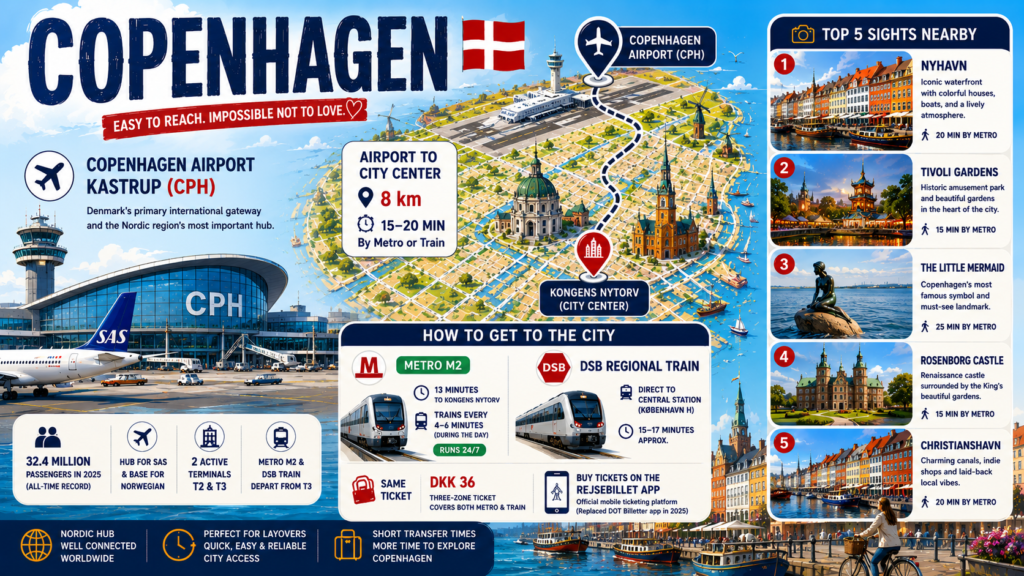
The Øresund Bridge connects Copenhagen to Malmö, Sweden in 35 minutes by train. The same DKK 36 Metro ticket from the airport connects you to Kongens Nytorv in 13 minutes. Everything in Copenhagen’s historic centre is within a 20-minute walk or two Metro stops. This is one of the most navigable layover cities on earth.
Copenhagen Airport (CPH), officially Kastrup, is Denmark’s primary international gateway and the Nordic region’s most important hub — it set an all-time passenger record in 2025 with 32.4 million passengers, and serves as the primary hub for Scandinavian Airlines (SAS) and an operating base for Norwegian Air Shuttle. The airport has two active terminals: T2 and T3. The Metro M2 line and the DSB regional train both depart from T3, making the airport-to-city journey one of the most straightforward in Europe. The M2 Metro runs directly to Kongens Nytorv in 13 minutes with trains every 4–6 minutes during the day, running 24/7. The same DKK 36 three-zone ticket covers both the Metro and the train, and the Rejsebillet app replaced the old DOT Billetter app at the end of 2025 as the official mobile ticketing platform.
For a layover city, Copenhagen has one characteristic that sets it apart from most European hubs: the entire historic centre is compact, flat, and walkable. Nyhavn, the Ny Carlsberg Glyptotek museum, Tivoli Gardens, Strøget (Europe’s longest pedestrian shopping street), and the Torvehallerne food market at Nørreport are all within a 15-minute walk of each other. You do not need a second transit connection once you arrive at Kongens Nytorv or Nørreport — you walk from there. That makes the arithmetic of a Copenhagen layover simpler than most cities: 13 minutes in, 13 minutes back, and everything worth seeing in between.
Denmark is a Schengen Area member. Most Western passport holders (EU, US, UK, Canada, Australia, Japan, New Zealand) enter visa-free for up to 90 days within any 180-day period. If you are connecting from outside the Schengen Area and plan to leave the airport, you will clear Danish immigration on arrival — budget 15–30 minutes for this during off-peak hours. For visa requirements specific to your nationality, check iVisa before booking.
Five hours minimum from landing to gate-close gives you 2.5–3 usable hours in the city — enough for Nyhavn, Torvehallerne, and a canal view. Eight hours is comfortable: add Tivoli Gardens or the Glyptotek museum. Twelve or more hours means you can do the full circuit including the Øresund train to Malmö.
A single 3-zone ticket from CPH to the city centre costs DKK 36 — approximately £4 or €4.80. Buy at the vending machines in T3 (card or coin, not notes). The Rejsebillet app also sells tickets. A City Pass (zones 1–4) costs DKK 100–340 depending on duration and covers unlimited Metro, train, and bus travel.
Yes — if you have 8+ hours and arrive between late April and late September (or during the Tivoli Christmas season, November–January). Entrance is 175 DKK. The gardens are 10 minutes’ walk from Central Station, the architecture and illuminations are genuinely beautiful, and the Nimb smørrebrød is one of the best lunches in the city. Rides are extra.
Yes. The Øresund train from Copenhagen Central Station to Malmö Central takes 35 minutes and costs approximately DKK 113 one way. Malmö is in Sweden — if you need a Schengen visa you only need one, as both countries are members. Allow 4 hours minimum for the return journey including Malmö itself.
SAS and Copenhagen’s Route Network
SAS operates Copenhagen as its primary international hub, connecting Scandinavia to major European cities, North American destinations (New York JFK, Chicago O’Hare, Los Angeles, Boston, Miami, Washington Dulles), and a handful of Asian routes. Star Alliance membership means connections through CPH count for United MileagePlus, Lufthansa Miles and More, and other Star Alliance programmes. SAS EuroBonus miles also transfer to Atlantic Airways for Faroe Islands connections — useful if Copenhagen is your hub for the Faroe Islands itinerary covered in our Final Destinations guide.
Norwegian’s largest base outside Oslo. Extensive European routes including London Gatwick, Amsterdam, Barcelona, Rome. Low fares, good connections for budget travellers.
Monopoly carrier from CPH to Faroe Islands (FAE). Multiple daily departures. If you are connecting to the Faroe Islands, you are on Atlantic Airways.
Budget connections across Europe. Ryanair operates from CPH to southern European destinations. easyJet covers London, Amsterdam, Geneva, and others.
Daily direct service to Dubai (EK) and Doha (QR). Primary connections for travellers routing Copenhagen as a hub to Asia, Australia, or Africa.
Should You Leave? The Copenhagen Layover Gauge
Before the gauge: Copenhagen immigration for non-Schengen arrivals is efficient — typically 15–25 minutes during off-peak hours, up to 40 minutes when multiple long-haul flights arrive simultaneously. Check your visa requirements before landing. The 13-minute Metro to Kongens Nytorv is as reliable as any transit in Europe.
The Metro round trip consumes 30 minutes, Schengen immigration adds 15–30 minutes, and your security buffer needs 90 minutes for an international departure. Under 4 hours, none of the city is actually reachable. CPH has good airside food options — the Lagkagehuset bakery in T2 does proper Danish pastries, and the gate area cafés are clean and functional. Use the time, not the city.
Nyhavn and Torvehallerne are achievable. Take the Metro to Nørreport (14 minutes), walk 8 minutes to Torvehallerne for a quick lunch, then 10 minutes to Nyhavn for the canal view and the Hans Christian Andersen addresses. Return from Kongens Nytorv station. Leave no later than 2.5 hours before your departure. Do not attempt Tivoli or the Glyptotek on this window — both require more time than you have.
Copenhagen is yours. Nyhavn at 9am before the boats fill up, Torvehallerne for lunch, Tivoli Gardens (April–September, November–January) or the Ny Carlsberg Glyptotek for the afternoon, a canal boat tour if time allows. With 10+ hours: add the Øresund train to Malmö for a two-country layover. Return on the Metro from Kongens Nytorv with a 90-minute airport buffer for international departures.
Work out your Copenhagen window precisely
Enter your CPH landing time and departure gate-close time. The calculator returns your usable city window after transit, immigration, and security buffer.
Getting from CPH to Copenhagen City Centre
| Option | Time | Cost | Hours | Best for |
|---|---|---|---|---|
| Metro M2 Recommended T3 platform, direct extension of terminal |
13–15 min to Kongens Nytorv | DKK 36 | 24/7 | Everyone. No connection required. Runs every 4–6 min daytime, 15–20 min at night. |
| DSB Regional Train T3 platform, same level as Metro |
13 min to Copenhagen Central Station | DKK 36 | 5am–midnight, every 10 min daytime | Travellers staying near Central Station or connecting to long-distance trains to Sweden or Germany. |
| Metered Taxi Taxi rank outside T3 arrivals |
20–30 min (no traffic) | DKK 250–350 | 24/7 | Groups of 3–4 splitting the cost, or night arrivals with heavy luggage when the Metro feels impractical. |
| Uber Designated pickup zone outside T3 |
25–35 min depending on traffic | DKK 200–300 | 24/7 | When you need a fixed price and can request before exiting. Requires a working data connection — activate your Airalo eSIM before landing. |
Denmark uses the Danish krone (DKK), not the euro. Denmark is EU but has a formal opt-out from the euro. Most shops, restaurants, and transport accept contactless card payment. The Metro ticket machines accept cards but not banknotes. For cash, the Forex Bank currency exchange inside T3 arrivals offers better rates than the airport’s own Travelex counters. A Wise card gives mid-market DKK at any ATM — the ATMs in T3 are at the staircase to the Metro and in the arrivals hall.
What to Do in Copenhagen on a Layover
Nyhavn — Hans Christian Andersen’s Harbour
Nyhavn is the 17th-century inner harbour canal at the eastern edge of the old city, lined with brightly painted merchant houses and moored sailing ships. Hans Christian Andersen lived here at three different addresses — numbers 18, 20, and 67 — at various periods of his life. The canal is now Copenhagen’s most photographed street, its coloured facades reflected in the water at most hours of the day. At 9am it is quiet enough to walk the quayside without navigating tourist crowds. By noon on a summer day it is full. Come early, walk both sides of the canal, and look for the Andersen memorial plaque before the boat tours start competing for the view.
Nyhavn is a 10-minute walk from Kongens Nytorv Metro station. The canal tour boats depart from the Nyhavn quayside — Stromma Canal Tours (109 DKK, 1 hour) and the cheaper Netto-Bådene (50 DKK, also 1 hour) both pass the Black Diamond library, the Opera House, the Little Mermaid from the water, and back through Christianshavn. The Little Mermaid statue at Langelinie is 1.5km northeast of Nyhavn on foot — reachable in 20 minutes, worth it only if you have 7+ hours.
Torvehallerne Food Market
Torvehallerne is Copenhagen’s covered food market at Israels Plads, one minute’s walk from Nørreport Metro station — directly between the airport Metro stop and Nyhavn. Two glass-and-steel halls house 60 stalls including Hallernes Smørrebrød (classic open-faced sandwiches), Ma Poule (French rotisserie), Coffee Collective (widely considered the best coffee in Copenhagen under any single roof), and a small Palægade outpost from the Noma school. This is the most time-efficient food stop in the city for a layover visitor — everything in one place, no reservation required, and it is directly on the Metro line between the airport and Nyhavn. Budget DKK 150–200 for lunch.
Tivoli Gardens — Where Disneyland Began
Tivoli opened in 1843, making it one of the oldest amusement parks still operating in the world. Walt Disney visited in 1951 and has described Tivoli as a direct inspiration for Disneyland’s design philosophy — the cleanliness, the pedestrian flow, the mixture of gardens, restaurants, and entertainment under a unified aesthetic. The park is 10 minutes’ walk from Copenhagen Central Station and 25 minutes from Nørreport by foot. Entrance is 175 DKK; rides are purchased separately or via a day pass.
For a layover visitor, Tivoli works best on the 8–12 hour window: arrive in the morning before the crowds build, walk the gardens, have smørrebrød at Fru Nimb (which serves a curated menu from a 100-year-old Louise Nimb cookbook), and leave by early afternoon. Tivoli is seasonal — open late April to late September, then a Halloween season in October and a celebrated Christmas market from mid-November to early January. Check tivoli.dk before planning your visit. It is closed in winter outside these periods.
Ny Carlsberg Glyptotek
The Glyptotek is a sculpture museum founded by Carl Jacobsen of the Carlsberg brewery family in 1897, located adjacent to Tivoli Gardens. It holds one of the best collections of Ancient Egyptian, Greek, and Roman sculpture outside the Mediterranean world, alongside a comprehensive Danish and French 19th-century painting collection that includes Gauguin works from his pre-Tahiti period. The building itself — a domed winter garden filled with palms and a café at the centre — is reason enough to visit even if you spend no time in the galleries. Admission is 125 DKK. Open Tuesday–Sunday, 11am–6pm. Free on Sundays.
Strøget and the City Centre
Strøget is the main pedestrian shopping street connecting Rådhuspladsen (City Hall Square, near Tivoli) to Kongens Nytorv — approximately 1.2km of shops, cafés, and the Royal Copenhagen porcelain shop that occupies a building on the street since 1911. It is not a destination in itself but the most natural route between Tivoli and Nyhavn, and the city’s energy concentrates here at midday. Royal Copenhagen has a café; Georg Jensen silver is three doors further; Illum department store has a rooftop café with the best view of the old city from street level. Walk it rather than detour around it.
Nyhavn Canal — The Classic Facade Shot
Stand at the near end of the Nyhavn canal (closest to Kongens Nytorv) and shoot toward the coloured houses with the canal reflected below. The best light is early morning (8–9am) before the boats begin moving and the water is still. The most saturated facades are on the north bank — stand on the south bank footpath for the classic composition. Avoid midday in summer when the tables and umbrellas of the outdoor restaurants cover the quayside entirely.
Shot early morning, south bank of Nyhavn, facing west. Horizontal 3:2 for the full canal width.
Tivoli Gardens at Dusk — The Illuminated Pantomime Theatre
The Pantomime Theatre inside Tivoli — a 19th-century peacock-tail stage canopy — is the most distinctive architectural set piece in the park. Photograph it from the central garden path at dusk when the warm illuminations fire before full dark. The peacock tail is lit from inside. Blue-hour timing (approximately 30 minutes after sunset) gives the best balance between the warm theatre light and the sky behind. The composition frames tightly — a 50mm equivalent focal length or slightly longer gives the correct perspective.
Blue hour only. Tivoli main garden, facing the Pantomime Theatre canopy. Portrait orientation for the full tail height.
Copenhagen Layover Itineraries
13–14 minutes on the M2 from CPH, plus the walk from landing to the platform (allow 25 minutes total from touchdown including immigration if you are Schengen or EU). Buy a 3-zone ticket from the machines in T3. DKK 36.
Two minutes’ walk from Nørreport station. Order smørrebrød from Hallernes Smørrebrød (DKK 65–90 per piece) and a filter coffee from Coffee Collective. Eat in the market. 30–45 minutes.
10-minute walk from Torvehallerne. Walk the south bank canal path. Find Andersen plaques at number 18 and 20. Take the early-morning photograph before the boat tours begin. 30–40 minutes.
3-minute walk from the far end of Nyhavn. M2 back to CPH: 13–14 minutes. At CPH: follow signs to your terminal (T2 or T3). Allow 90 minutes before gate close for international departures — arrive back at the airport 2.5 hours before your flight.
Arrive at Kongens Nytorv before 9:30am. The canal is quiet, the facades are catching morning light, and the Andersen addresses are readable without navigating crowds. Walk both banks. Allow 45 minutes.
Departs from the Nyhavn quayside every 30 minutes from 10am. 109 DKK for the 1-hour circuit past the Opera House, the Black Diamond, the Little Mermaid, and back. No pre-booking needed outside summer peak — buy at the dock. Netto-Bådene is 50 DKK if budget is a consideration.
20-minute walk from Nyhavn via Strøget and Rådhuspladsen, or 2 Metro stops to Vesterport. 125 DKK admission. Winter garden café in the domed atrium makes an excellent coffee stop. Allow 90 minutes for the Egyptian and Roman galleries plus the winter garden.
5-minute walk from the Glyptotek, directly across Tietgensgade. 175 DKK entrance. Walk the gardens, find the Pantomime Theatre, have the Nimb smørrebrød if hungry (DKK 160–220 for three pieces). Allow 90 minutes.
Tivoli exit faces Central Station directly. DSB train to CPH: 13 minutes, same DKK 36 ticket. At CPH: 90-minute buffer for international departures.
As the 8-hour itinerary above through the canal and the food market. Finish by 11am.
From Copenhagen Central Station. 35 minutes to Malmö Central. Single fare approximately DKK 113 (SEK 130). The train crosses the Øresund Bridge — 8km over open water, one of the most dramatic rail crossings in Europe. You are in Sweden when you arrive. Malmö is walkable: Stortorget (main square), the Form Design Centre, and the Malmöhus Castle gardens are all within 15 minutes. For onward rail into Sweden beyond Malmö, compare routes via Omio.
The small cobblestone square Lilla Torg in Malmö has outdoor restaurants in summer serving both Swedish and international food. A Swedish meatball lunch here is genuinely different from the IKEA version. Budget DKK 120–180 equivalent in SEK.
Malmö Central to Copenhagen Central: 35 minutes. Then DSB or Metro to CPH. Allow 2 hours total from Malmö departure to airport gate.
Copenhagen Layover Scenarios — Real Situations, Specific Solutions
It is a Saturday in August and you have an 8-hour layover. Tivoli Gardens at the gate has a 25-minute queue and the day pass for unlimited rides is sold out online. Entrance-only tickets are still available but at a 30-minute walk-up wait.
25 minutes queuing is a meaningful slice of an 8-hour layover once you account for the 30-minute round-trip Metro and your airport buffer. Buying the entrance ticket ahead removes the queue and the uncertainty.
Book a timed-entry Tivoli ticket through GetYourGuide before your flight. Priority entry, no queue, and free cancellation if your inbound is delayed.
You have a carry-on and want to take the 1-hour Stromma canal boat around Copenhagen. Boarding a boat with a rolling suitcase is possible but annoying for the other 40 passengers and the narrow gangway.
CPH’s airport lockers are in car park P4 — accessible before you leave but not near the city. The city centre Bounce locations are the better option.
Book a Bounce storage location near Nørreport or the city centre. Drop the bag before the boat, collect before the Metro home. DKK 50–70 for a half-day.
You have been in Copenhagen for 8 hours and are returning to CPH for the Atlantic Airways flight to the Faroe Islands. The M2 Metro shows a 20-minute delay due to a track inspection at Christianshavn. You have 90 minutes to gate close.
20-minute Metro delay plus normal journey time leaves 50 minutes from platform to gate — tight but doable for a domestic-style EU departure. Atlantic Airways does not codeshare with most carriers; missing FAE on a layover is an expensive problem.
Pre-book a return transfer via Welcome Pickups for any connection where the FAE flight cannot be missed. Fixed price, driver confirmed, no Metro variance.
You buy a coffee at Torvehallerne (DKK 45), three pieces of smørrebrød (DKK 220), a canal boat ticket (DKK 109), and a Tivoli entrance (DKK 175). Total: DKK 549. Your home bank adds a 2.5–3% foreign transaction fee on every DKK purchase.
On DKK 549, a 3% foreign fee is DKK 16.50 — about £1.70. Small on one layover. Across multiple European layovers per year, it is £40–80 in invisible fees.
Use a Wise card for every DKK payment. Mid-market rate, no foreign fee, and the ATM in CPH T3 gives DKK at the interbank rate if you need cash for market vendors.
You land at CPH at 22:30 and depart the next day at 13:00. Fourteen hours. The airport has good facilities but a full night in a terminal chair affects everything that follows. Copenhagen hotels near Central Station are 10 minutes from Tivoli and 13 minutes from the airport.
Full overnight hotel rates in Copenhagen near Central Station: DKK 1,200–2,200. A 14-hour stay where you sleep for 7 and need the room for 12 is expensive at full rate.
Dayuse has Copenhagen partner hotels offering late-arrival short-stay rates. Book a room from 23:00 to 09:00 at a fraction of the full night rate. Shower, sleep, leave for the airport with a morning buffer.
Denmark is EU but some mobile plans treat it differently from core EU markets for roaming. You need the Rejsebillet app or Google Maps to navigate Nørreport Station and find Torvehallerne on a 5-hour layover with no margin for wrong turns.
Without data, finding Torvehallerne from Nørreport (it is literally at the station exit, but the signs are in Danish) and timing the boat tour correctly requires printouts or local knowledge you may not have.
Activate an Airalo European eSIM before landing. European plans from £4.50 cover Denmark and 30+ countries. Active from the jet bridge before you reach the Metro platform.
Food in Copenhagen
Smørrebrød — The Danish Open Sandwich
Smørrebrød (pronounced approximately “smuurreh-bruuldt”) is the defining Danish lunch: a slice of dense dark rye bread (rugbrød), spread with salted butter, and topped with anything from pickled herring to roast beef with remoulade, hand-peeled shrimp with mayonnaise and egg, or duck confit with pickled red cabbage. It is served open-faced, eaten with a knife and fork, and typically ordered in sets of two or three pieces. At Hallernes Smørrebrød in Torvehallerne, three pieces cost approximately DKK 200. At Restaurant Schønnemann on Lavendelstræde (founded 1877), the same three pieces run DKK 250–320 and the quality is noticeably higher — worth it if you have time to sit down. Aamanns 1921 near Nørreport offers a modern take on the same tradition.
Wienerbrød — Danish Pastry
The pastry the world calls a “Danish” is called Wienerbrød in Denmark — literally “Viennese bread,” after the Austrian bakers who introduced laminated dough techniques to Copenhagen in the 19th century. The best versions in the city are at Lagkagehuset (multiple branches including CPH airport), Sankt Peders Bageri on Sankt Peders Stræde (the oldest bakery in Copenhagen, opened 1652), and the La Glace café near Strøget for elaborate layer cakes. At the airport: Lagkagehuset in T2 is the genuine article — not a travel-retail approximation.
New Nordic at Torvehallerne
Torvehallerne’s Coffee Collective counter is the fastest way to understand why Copenhagen became the centre of the global speciality coffee movement in the 2010s. Order a single-origin filter or an espresso at the counter. The queue at peak hours is 10 minutes, worth it. The market’s Ma Poule rotisserie serves proper French-style roast chicken with Dijon cream sauce — DKK 145 for a half chicken — which sits alongside the smørrebrød and pastry options as one of the market’s three anchors.
Inside Copenhagen Airport (CPH)
CPH operates as a single terminal campus across T2 and T3, connected landside. The airport is clean, well-lit, and relatively calm compared to hub airports of similar size. For a 6-hour-plus layover where you decide not to leave the airport, the options are genuine rather than apologetic.
The SAS Lounge in the gate area (SAS Gold Card or Business Class ticket, also purchasable day-pass for eligible cards) has showers, hot food, and a calm working environment far better than the main gate seating. The CPH Lounge adjacent is purchasable for non-status passengers and worth DKK 300–400 for a longer wait. The Lagkagehuset bakery in T2 arrivals is the best single food stop in the terminal — the cinnamon snegls and the Wienerbrød are the real versions, not airport imitations.
CPH has free Wi-Fi throughout (network: CPH Free WiFi, no registration required). The transit hall has self-service computing kiosks. Currency exchange: Forex Bank in T3 arrivals offers better rates than the airport’s own branded exchange counters. The ATM at the T3 Metro staircase is the quickest cash point for DKK. Left luggage: 116 lockers in car park P4 (accessible landside before departure or after arrival).
There is a specific quality to Copenhagen light in June — a northern light that arrives at an angle that cities closer to the equator never see, settling on the Nyhavn facades at 6pm and making them look painted rather than photographed. Hans Christian Andersen lived in one of those houses for years and could not afford to stay. The city rejected him repeatedly as a theatre writer and dancer before it understood what it had. The Little Mermaid gives up her voice to reach a world that was never designed for her. Andersen understood the metaphor better than most people who visit the statue do. The canal is still there. The light still comes at the right angle. It is the same city, improbably well-preserved, improbably beautiful.
Gear, eSIM, and Connectivity
European plans cover Denmark from DKK with data from £4.50 for 7 days. Activate on the plane before landing — the Rejsebillet transit app and Google Maps are live before you reach the Metro platform. Essential for the Nørreport station navigation.
Get an eSIM →Good regional coverage for multi-country Scandinavian itineraries — Denmark, Sweden (useful for the Malmö extension), Norway, Finland. If you are routing through multiple Nordic cities, a regional plan is more cost-efficient than country-by-country.
Get an eSIM →CPH Free WiFi is unencrypted. Connecting to banking apps, booking platforms, or email on an open airport network without a VPN is a straightforward way to expose credentials. NordVPN takes 30 seconds to activate.
Get NordVPN →Denmark uses DKK, not euros. Every payment at Torvehallerne, the canal boat, and Tivoli in DKK incurs a foreign transaction fee on a standard bank card. Wise converts at mid-market rate with no fee. Set up before the trip and use the CPH T3 ATM for any cash needed.
Get Wise →Hotels for an Overnight Copenhagen Layover
15 minutes from CPH on the M2. Walking distance to Tivoli and the Glyptotek. High floors have views over the Copenhagen roofline toward the harbour. Best choice for a straightforward overnight layover with good transit access in both directions.
Check availability →Connected to T3 via a walkway. The right choice when your layover is genuinely short (under 7 hours) and you need a hotel for a few hours’ sleep rather than a city base. Dayuse rates available via Dayuse.
Check availability →At the far end of the Nyhavn canal in a converted 19th-century warehouse. Waking up to a canal view before the tourist crowds arrive is one of the better Copenhagen hotel experiences. 15 minutes from CPH on the M2 to Kongens Nytorv, then 3-minute walk.
Check availability →The best-value option near the M2 Nørreport station — directly between the airport Metro stop and Nyhavn. Budget-friendly, good common areas, and the price makes a 1-night layover hotel economically sensible rather than extravagant.
Check availability →Tours and Experiences
The standard Copenhagen canal circuit from Nyhavn — past the Opera House, the Black Diamond library, the Little Mermaid, and back through Christianshavn. The boat puts you at water level for the harbour facades and is the most time-efficient way to see Copenhagen’s waterfront geography in 60 minutes.
Book via GetYourGuide →Guided walk from Nyhavn through the Latin Quarter, past Strøget, to the Round Tower (Rundetårn) — the 17th-century observatory tower with a spiral ramp rather than stairs, built by Christian IV in 1642. The Round Tower context requires a guide to make complete sense; on your own it is a brick cylinder with a good view.
Book via GetYourGuide →For 12-hour-plus layovers: a guided excursion combining the Øresund crossing to Malmö, Kronborg Castle (Elsinore — Shakespeare’s Hamlet is set here), and the university city of Lund. Covers two countries and three UNESCO or significant heritage sites in a single circuit.
Book via GetYourGuide →Luggage Storage, Transfers, and Insurance
City-centre partner locations near Nørreport and the old town. Drop your bag before the canal boat, collect before the Metro back to CPH. The Nyhavn walk is better with a day bag.
Find Storage →Alternative storage network with Copenhagen city centre locations. Particularly useful when Bounce locations near your specific destination are full.
Find Storage →Fixed-price return transfers from Copenhagen city centre to CPH. The right choice when your FAE or other onward connection has a hard departure and you cannot risk the Metro being slow.
Pre-Book Transfer →Covers missed connections on multi-leg Faroe Islands itineraries routed through CPH. If Copenhagen is your hub for a final destination trip, the connection risk is real enough to insure.
Get a Quote →Same-day emergency medical cover for international visitors in Denmark. Danish healthcare is excellent for residents; visiting uninsured means full private rates at Copenhagen clinics.
Get a Quote →How much time do you actually have?
Enter your CPH landing time and departure gate-close. Get your real usable window after transit, immigration, and security buffer.
Calculate My Time →Schengen, Faroe Islands, and Sweden
One Schengen visa covers Denmark, Sweden, and the transit through Copenhagen to the Faroe Islands. Confirm your specific nationality’s requirements before booking.
Check Visa Requirements →Copenhagen in any season
June–August is warm (20–25°C) but the Danes cycle in all weather — a light wind layer is worth carrying. October–March is 2–8°C and requires real winter kit. Tivoli Christmas operates in the cold; the warm glogg is part of the experience.
Packing Essentials →Frequently Asked Questions
If you are staying airside (not clearing immigration), no visa is required for passengers on a continuing ticket within 24 hours. If you plan to leave the airport and enter Denmark, most Western passport holders (EU, US, UK, Canada, Australia, Japan) enter Schengen visa-free for up to 90 days within any 180-day period. For other nationalities, check your requirements at iVisa before booking your trip. A Schengen visa covers Denmark, Sweden (for the Malmö extension), and the transit through Copenhagen to most European destinations.
Copenhagen consistently ranks among the safest capital cities in Europe. Pickpocketing is rare by international city standards. The Metro system is clean and monitored. Nyhavn in summer is crowded but not unsafe. The main practical concern for a solo layover visitor is time management rather than personal safety — the city is genuinely easy to navigate and English is spoken everywhere.
The Tivoli Christmas Market (mid-November to early January) is one of the most celebrated Christmas markets in Europe — heated stalls, mulled glogg (Nordic mulled wine with almonds and raisins), æbleskiver (Danish doughnut balls with jam), and the entire park lit with more than a million lights. It is genuinely magical and significantly less crowded than the summer season. Temperatures are 0–6°C in December — dress accordingly. The market is open daily including Christmas Day. It is worth visiting specifically for a winter Copenhagen layover.
Copenhagen (CPH) is the only hub from which Atlantic Airways operates the Faroe Islands (FAE) connection with consistent daily frequency year-round. Reykjavík (KEF) also has a connection but with lower frequency, particularly in winter. From CPH, you have the full Atlantic Airways schedule and the easiest connection logistics — both the incoming international flight and the Atlantic Airways FAE departure operate from the same terminal complex. SAS EuroBonus miles also apply to Atlantic Airways flights, making the CPH hub valuable for frequent flyer redemptions to the Faroe Islands. See our Final Destinations guide for the full Faroe Islands routing breakdown.
Copenhagen Airport (CPH) — Official Resources
Terminal maps, flight information, lounge access, and ground transport — all on the official CPH website.
Official Danish transit journey planner. Route the M2 Metro, DSB trains, and Movia buses from CPH to any destination in Greater Copenhagen.
rejseplanen.dk →Official ticketing app for the Copenhagen transit system (replaces DOT Billetter as of end 2025). City Pass and single tickets. Download before landing.
rejsebillet.dk →Seasonal opening calendar, ticket prices, and current programming. Check before visiting — Tivoli closes between seasons. Current adult entrance: 175 DKK.
tivoli.dk →DMI provides hour-by-hour forecasts for Copenhagen. Copenhagen weather is changeable — particularly relevant for the Nyhavn outdoor photography window.
dmi.dk →Police, fire, and ambulance. English-speaking operators. Works on any phone including phones without a SIM.
Denmark’s primary trauma centre. Blegdamsvej 9, Copenhagen. 15 minutes from CPH by taxi.
Lost property, terminal information, and passenger assistance. Available during airport operating hours.
Disclaimer: Fares, timetables, and entry requirements listed in this guide are verified as of June 2026 and are subject to change. Always check with CPH airport, DSB, and the relevant consular authority before travel. Affiliate links may earn EpicLayover a commission at no additional cost to you.
- Secret Flying / Copenhagen Airport Guide. CPH Terminals, Metro M2, and Ground Transport 2026 — T2 and T3 active, Metro M2 direct to Kongens Nytorv 13 min, DKK 36 3-zone ticket. January 2026.
- Copenhagen Tourism. Metro and Public Transport 2026 — M2 from CPH every 4–6 min daytime, Rejsebillet replaces DOT Billetter end 2025. April 2026.
- CPH Official. Copenhagen Airport all-time passenger record 32.4 million in 2025 — SAS primary hub, Norwegian Air Shuttle operating base.
- VisitDenmark. Tivoli Gardens — 4 million annual visitors, opened 1843; Walt Disney visit documented in published Disney corporate history and multiple interviews.
- Torvehallerne. 60 stalls, two glass-and-steel halls, Israels Plads adjacent to Nørreport station, opened 2011.
