
10 Incredible Frankfurt Layover Experiences You Can’t Miss
The “medieval” square most layover passengers photograph wasn’t finished until 2018. A church clock nearby was stopped at the exact minute the first bomb hit it in 1944, and deliberately left frozen at that time for ten years as a memorial — visible to this day.
On the night of 22 March 1944, more than 800 British bombers struck Frankfurt’s old town in one of the most devastating raids of the war, destroying what had been the largest collection of medieval half-timbered buildings in Germany. The first bomb hit St. Catherine’s Church at Hauptwache at exactly 9:43pm — and the tower clock’s hands stopped at that precise minute. For the next ten years, until the church’s reconstruction was finished in 1954, the clock remained frozen at 9:43, a silent record of the moment the old city burned. Roughly 90% of central Frankfurt’s apartments were rendered uninhabitable that night; the old town, once home to some 1,250 half-timbered buildings dating to the Middle Ages, was almost entirely gone.
What stands in the Römerberg today — the square every layover guide tells you to photograph — is largely reconstruction, and a surprising amount of it is recent. The Römer city hall itself was rebuilt in simplified form by 1955, its timber-frame mosaics depicting a phoenix, the symbol the city chose for its own postwar rebirth. But the “New Old Town” (Dom-Römer Quarter) immediately east of the square — the cluster of half-timbered houses between the Römer and the cathedral that most visitors assume has stood for centuries — wasn’t built until 2012 to 2018. It is, in places, younger than the smartphone in your pocket. This guide treats Frankfurt the way the city itself does: as a place that rebuilt deliberately, in full view of its own scars, rather than pretending nothing happened.
Frankfurt Airport (FRA) is Germany’s busiest airport and Lufthansa’s primary global hub, handling more direct long-haul destinations than almost any airport in the world. As of 2026, the airport is mid-transition: Terminal 2 closed for a multi-year renovation, and the brand-new Terminal 3 officially opened on 23 April 2026, absorbing 57 airlines that previously operated from T2 — including Emirates, Etihad, Qatar Airways, Korean Air, Cathay Pacific, and China Southern. Check your boarding pass for the correct terminal before every trip in 2026 — if you flew through FRA in 2025, the terminal your airline used has very likely changed.
Terminal 1 (the original, oldest terminal) is used primarily by the Lufthansa Group and Star Alliance partners — Air Canada, ANA, Ethiopian Airlines, United, plus Condor and El Al. Terminal 3, newly opened, now hosts the bulk of non-Lufthansa, non-Star-Alliance long-haul carriers that used to be in the now-closed Terminal 2. The free SkyLine automated train connects Terminal 1 and Terminal 3 in roughly 8 minutes, running around the clock — but any change between terminals requires a security re-screen at the other end, which is the part that actually eats your buffer, not the train ride itself.
Germany is part of the Schengen Area. EU/EEA/Swiss citizens enter freely. US, Canadian, Australian, and many other passport holders enter visa-free for up to 90 days within a 180-day period. If you’re arriving from outside Schengen and connecting to another non-Schengen flight without leaving the transit area, you typically do not need to clear German immigration at all. Use iVisa to verify your specific requirement if uncertain, particularly if your routing involves a Schengen-area entry.
5 hours minimum, 6+ comfortable. The S-Bahn to the city centre takes 15–20 minutes each way (round trip ~35–40 minutes including the platform wait and ticket purchase), and you’ll want to budget 30 minutes for international arrival processing and 45–60 minutes for departure security on the way back. At 5 hours you get roughly 2.5–3 hours in the Altstadt; at 7+ hours you can comfortably add a museum or a longer riverside walk.
Often, no. If both your inbound and outbound flights are international (non-Schengen) and you’re staying within the secure transit area, you typically don’t formally enter Germany. However, if you want to leave the airport to visit the city, you must clear immigration regardless of whether your final destination requires it — and re-clear security on the way back in.
Underestimating walking distances and terminal changes. FRA is enormous and “notorious for long walks” even within a single terminal — 20 minutes from gate to the central transit area is not unusual. Add a terminal change (Terminal 1 to Terminal 3 via SkyLine, including the re-screen at the other end) and a tight connection becomes genuinely risky. For international-to-international or any connection involving a terminal change, budget 90–120 minutes minimum, not the bare 45–60 minute airline-published figure.
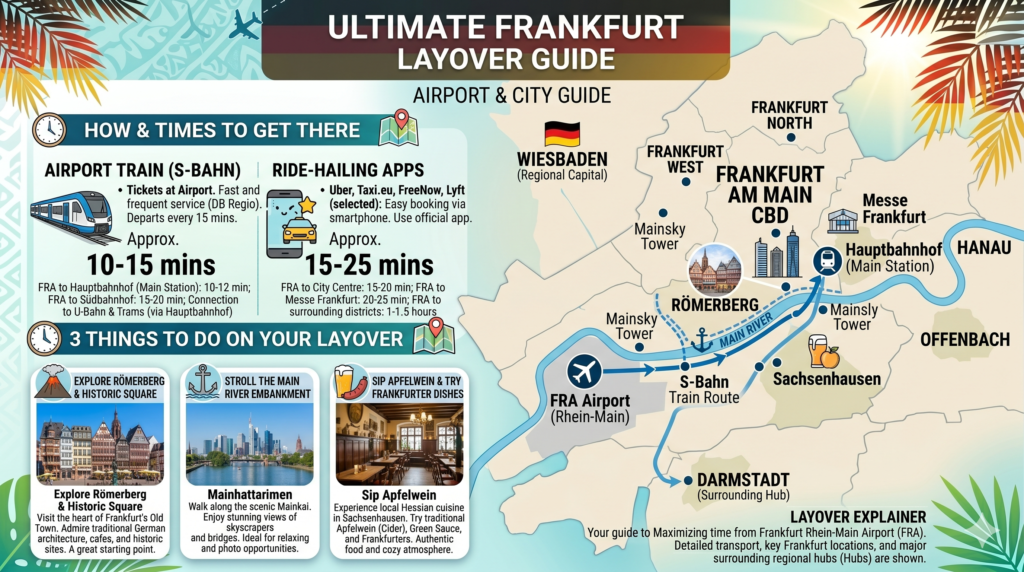
The S-Bahn (lines S8 or S9 from the Regionalbahnhof in Terminal 1’s basement) is faster, cheaper, and more predictable than a taxi given Frankfurt’s traffic — 15–20 minutes for €6.90, with self-service ticket kiosks taking card or cash and offering an English option. A taxi runs roughly 20–30 minutes depending on traffic and costs considerably more. Unless you have heavy luggage or a very specific destination, take the train.
Should You Leave? The Frankfurt Layover Gauge
Under 5 hours, especially if your connection involves a terminal change or crosses the Schengen boundary, you need every minute at the airport. FRA has genuinely excellent infrastructure for this: the Lufthansa lounge network if you qualify, Hausmann’s for a proper sit-down meal, the Airport City Mall landside in T1, and napcabs for a private rest. Use the time here rather than risk the connection.
Take the S-Bahn directly to Hauptwache or Konstablerwache, walk the Römerberg and the New Old Town, see the cathedral exterior, and head straight back. This is enough time for the essential photo stops and a coffee, but not enough for a museum visit on top — pick one or the other, not both.
With 7+ hours, add the Städel Museum (2–3 hours minimum to do it justice) or a riverside walk across the Eiserner Steg into Sachsenhausen for a proper Apfelwein and Frankfurter sausage lunch. With 10+ hours, both are genuinely achievable with a comfortable return buffer.
Work out your Frankfurt window precisely
Enter your FRA landing time and departure gate-close. If your connection involves a terminal change between T1 and T3, the calculator accounts for the security re-screen that catches most travellers off guard.
Frankfurt’s Connecting Flights and Airlines — What You Need to Know
| Connection Type | Minimum Time | Recommended Buffer | Notes |
|---|---|---|---|
| Schengen → Schengen | 30 min (OAG published) | 60 min | No passport control required. The easiest connection type at FRA — but still allow for FRA’s notoriously long walking distances within a single terminal. |
| Schengen → Non-Schengen | 60 min | 90 min | Requires passport control on the non-Schengen side. Add time if this also involves a terminal change. |
| Non-Schengen → Non-Schengen Watch this one | 90 min (OAG published) | 120 min+ | Two international flights. Even on a single protected itinerary, allow extra buffer — FRA’s size and the frequent need for a security re-screen between terminals make the published minimum genuinely tight. |
| Terminal 1 ↔ Terminal 3 Change | ~10 min by SkyLine | 25–45 min realistic | The SkyLine ride itself is only ~8 minutes and runs every 2–3 minutes, free, around the clock. What eats your buffer is the security re-screen at the destination terminal — Frankfurt Airport’s own guidance is explicit that connecting passengers may face a second screening when changing terminals. |
If your two flights are on one ticket with one confirmation number (a “protected” connection), the airline is responsible for rebooking you free of charge if you miss the connection due to a delay on the first leg — and if many passengers on a delayed inbound flight share the same connecting flight, that flight will sometimes wait. Self-transfer itineraries (two completely separate bookings) carry none of these protections: a delay is entirely your risk, baggage often needs manual collection and re-check, and you should budget significantly more buffer than the airline’s published minimum connection time.
Airlines and Hub Structure at FRA
Lufthansa operates from Terminal 1 and accounts for roughly 52% of all services at Frankfurt, the airline’s largest and most strategically important hub. As of June 2026, Lufthansa serves 14 domestic and 177 international destinations across 70 countries. Star Alliance partners sharing Terminal 1 include Air Canada, All Nippon Airways (ANA), Ethiopian Airlines, and United Airlines — along with Condor (a former Lufthansa subsidiary, not itself a Star Alliance member) and El Al, which uses Concourse C for security reasons specific to flights to Israel.
In February 2026, Lufthansa City Airlines — the group’s newer short-haul carrier, a permanent Star Alliance member since September 2025 — opened a dedicated operational base at Frankfurt, its first flight departing for Manchester on 9 February 2026. The Frankfurt fleet is expected to reach seven Airbus A320neo aircraft by September 2026, with new or expanded routes rolling out through summer 2026 including London Heathrow, Stockholm, Bilbao, Hamburg, Helsinki, Ibiza, Marseille, and Bucharest — meaningfully strengthening short-haul feeder options into Lufthansa’s long-haul network for travellers connecting through FRA from secondary European cities.
All three major Gulf carriers moved from the now-closed Terminal 2 to the new Terminal 3 in 2026. If you flew Emirates, Etihad, or Qatar through FRA before 2026, your terminal has changed — verify on your current boarding pass.
SkyTeam members relocated to Terminal 3 as part of the 2026 transition. Korean Air specifically is a key Asia connection point for FRA passengers.
Among the first 13 airlines to move into Terminal 3 when it opened on 23 April 2026 — the initial wave of the four-phase relocation from the closed Terminal 2.
Non-alliance carriers also relocated to Terminal 3 in the same 2026 transition window — part of the broader move of all 57 former Terminal 2 airlines.
Terminal 2 is fully closed for a multi-year renovation as of 2026 (expected to reopen around 2029, eventually merged with Terminal 1 into a single connected airside facility for Lufthansa and Star Alliance). All 57 airlines that previously operated from T2 have relocated to the new Terminal 3 across four phases completed by June 2026. If your itinerary or a saved boarding pass references Terminal 2, that information is now outdated — check Frankfurt Airport’s official site or your airline directly before travelling in 2026.
Getting from FRA to Frankfurt City Centre
| Option | Time | Cost | Notes |
|---|---|---|---|
| S-Bahn (S8/S9) Recommended | 15–20 min | €6.90 | Departs from the Regionalbahnhof in Terminal 1’s basement. Self-service ticket kiosks accept card or cash, with an English-language option. Get off at Konstablerwache for the Old Town circuit — not Hauptbahnhof, which is further from the Römerberg. |
| Taxi | 20–30 min (traffic-dependent) | €35–45 | Official taxi ranks outside both terminals. More expensive and less predictable than the train given Frankfurt’s traffic, but useful with heavy luggage or for direct hotel drop-off. |
| SkyLine (Terminal Transfer) | ~8 min ride, 25–45 min realistic | Free | Connects Terminal 1 and Terminal 3 around the clock, every 2–3 minutes. Only relevant if you’re switching terminals before heading into the city, or if your inbound/outbound flights use different terminals. |
| ICE Long-Distance Trains | 1–4 hrs to other German/European cities | Varies | The Fernbahnhof, one level above the Regionalbahnhof and connected via a covered walkway, puts Cologne an hour away, Munich two hours, Berlin under four — relevant if your “layover” is actually an opportunity to reach a different city entirely on a very long connection. |
What to Do in Frankfurt on a Layover
Römerberg and the New Old Town
The historic heart of the city, and the unavoidable starting point for any Frankfurt layover. The Römer — Frankfurt’s city hall for over 600 years — anchors the square, its three-peaked Gothic facade depicting four Holy Roman Emperors. What you’re looking at is largely a 1955 reconstruction in simplified form, following the building’s near-total destruction in the March 1944 bombing; the timber-frame mosaics worked into the rebuild depict a phoenix, deliberately chosen as the symbol of the city’s postwar rebirth. Immediately east, between the Römer and the cathedral, is the Dom-Römer Quarter — a cluster of half-timbered houses that look centuries old but were in fact built between 2012 and 2018, a genuine and still-debated attempt to recapture the pre-war old town’s character on its original footprint. Free to walk, always open, busiest with outdoor cafés and a Christmas market in December.
Frankfurt Cathedral (Kaiserdom)
St. Bartholomew’s Cathedral, the Gothic clock tower visible from across the Römerberg, served for roughly 300 years as the site of coronation for Holy Roman Emperors. Free to enter the main cathedral; a separate fee applies for the tower climb, with panoramic Altstadt views from the top. Open roughly 9am–6pm on weekdays with shorter weekend hours — verify the current schedule, especially for tower access, before planning a tight visit around it.
Städel Museum
Considered Frankfurt’s finest art museum and part of the Museumsufer (Museum Embankment), where more than 10 museums line the south bank of the Main. The Städel’s collection spans 700 years of European art, from early 14th-century works through Rembrandt, Monet, and Picasso, housed partly in a striking 2012 underground extension where natural light enters through a grid of circular skylights in the lawn above. Allow a genuine 2–3 hours minimum — most visitors report wishing they’d budgeted more. General admission roughly €16–18; free entry on the last Saturday of each month (expect larger crowds). A scenic 20–30 minute walk from the Römerberg along the river, or reachable by tram.
Eiserner Steg and Sachsenhausen
The Eiserner Steg is a pedestrian iron footbridge across the Main, originally built in 1868, destroyed in the war, and rebuilt afterward — now covered in thousands of padlocks left by visitors. Crossing it from the Römerberg side takes you into Sachsenhausen, Frankfurt’s historic district for Apfelwein (apple wine) culture: small traditional taverns serving the local cider-like drink alongside Handkäse mit Musik (a marinated cheese dish, the name translating roughly to “hand cheese with music” for its digestive effects) and Grüne Soße, a herb sauce served with boiled eggs and potatoes.
Main Tower
One of Frankfurt’s tallest buildings and the only skyscraper in the city centre with public observation deck access. An elevator covers the first 190 metres of the 200-metre climb; the final stretch is on foot. The view captures exactly the contrast that defines Frankfurt — the half-timbered Römerberg below alongside a genuine glass-and-steel skyline more associated with Singapore or Hong Kong than a European city centre. Open until roughly 9pm, making it a viable sunset stop if your timing allows.
Römerberg — The Römer Facade and Phoenix Mosaics
Stand at the centre of the square facing the Römer’s three-peaked Gothic facade. Morning light (before 10am) avoids the crowds that build through the day and catches the gilded details on the clock face and emperor figures cleanly. Look closely at the timber-frame sections for the phoenix mosaic motif — a detail most visitors miss entirely, and one that tells the entire postwar rebuilding story in a single image once you know what you’re looking at.
Before 10:00. Centre of Römerberg facing the Römer. Include the cathedral spire in the background for context.
Eiserner Steg at Sunset — Skyline Reflection
The classic Frankfurt skyline shot: shoot from the middle of the bridge looking toward the financial district skyscrapers, timed for sunset when the glass towers catch the colour and the Main river below picks up the reflection. The padlocks covering the railings make a strong foreground texture if you shoot low and angle upward toward the towers.
~30 min before sunset. Centre of the bridge, facing the skyline. Low angle to include the padlocks in foreground.
The Frankfurt Layover Itinerary
International arrival processing: roughly 30 minutes off-peak. S-Bahn from the Regionalbahnhof to Konstablerwache: 15–20 minutes, €6.90.
Walk the square, the Römer facade, and the Dom-Römer Quarter’s reconstructed half-timbered streets. 45–60 minutes.
A short walk from the Römerberg. Free entry to the main cathedral. 20–30 minutes.
A scenic 10-minute walk across the river. A proper Apfelwein and Frankfurter sausage lunch at a traditional tavern. 60 minutes.
€16–18 entry. 2–2.5 hours for a focused visit covering the highlights rather than the full 700-year collection.
S-Bahn back to the Regionalbahnhof: 15–20 minutes. International departures need a 2.5-hour minimum buffer given FRA’s size and walking distances — more if your departure is from a different terminal than arrival.
30 min immigration + 15–20 min train.
60–75 minutes covering the essential photo stops on foot.
30–45 minutes. Plenty of cafés directly on or near the Römerberg.
15–20 minutes. Build in the standard 2.5-hour departure buffer once back at the airport.
Frankfurt Layover Scenarios — Real Situations, Specific Solutions
Terminal 2 closed for renovation in 2026 and all 57 airlines that used to operate from it relocated to the brand-new Terminal 3 across a phased transition completed by June 2026. Old saved information, prior boarding passes, or outdated guides may still reference T2.
Heading to the wrong terminal building at an airport this large costs real time you may not have.
Always check your current boarding pass or airline app for the correct terminal before travelling in 2026, regardless of what terminal you used on a previous trip through FRA. Terminal 3 hosts the relocated Gulf carriers, several SkyTeam and oneworld members, and various unaffiliated airlines.
Self-transfer itineraries (separate bookings, even on the same airline) carry no rebooking protection if your first flight is delayed, and FRA’s size combined with the need for a possible terminal change makes tight self-transfer connections genuinely risky.
A delay on the inbound leg, with no protection, can mean missing the second flight entirely and bearing the full cost of rebooking yourself.
If your connection is under 2 hours and on separate tickets, strongly consider rebooking onto a single connected itinerary if possible, or build in a longer buffer. World Nomads travel insurance with missed-connection cover is a sensible backstop for self-transfer itineraries specifically.
FRA’s display boards behind security and passport control show the live walking time to your specific gate — and at this airport, 15–20 minute walks within a single terminal are genuinely common, not an exaggeration.
Browsing shops or stopping for food when the board shows a long walk time eats the exact margin you don’t have.
Trust the walking-time display over your own instinct about airport size. If it shows 15+ minutes, head straight to the gate area — Frankfurt’s own guidance is explicit that this number is what determines whether you have one minute or five to spare, not the raw connection time on your itinerary.
Leaving the airport to visit Frankfurt means formally clearing German immigration, even if your final onward destination doesn’t itself require entering Germany.
Some nationalities require a Schengen transit visa specifically to leave the secure area, even briefly — this is separate from whether you’d need a visa for your actual destination.
Verify your specific nationality’s requirement on the German Federal Foreign Office website or via iVisa before travel if there’s any doubt. If you can’t leave, the airport itself — lounges, the Airport City Mall, Hausmann’s — is a genuinely solid fallback.
If your baggage isn’t through-checked to your final destination, or you simply want to move freely, you’ll need to manage your carry-on through the cobbled Römerberg streets.
Minor, but rolling luggage on the Römerberg’s uneven historic paving is genuinely awkward and slows you down.
FRA has luggage storage facilities in Terminal 1 (Area B, Level 1) and Terminal 3. Drop your bag before heading into the city and collect it on return — particularly worthwhile if you’re also planning the Städel Museum, where bag policies can be restrictive anyway.
FRA’s free Wi-Fi exists but isn’t always instant or reliable the moment you clear the aircraft door, and roaming charges for non-EU SIMs can be steep in Germany.
Without immediate data, checking the S-Bahn schedule, confirming your gate change, or navigating the terminal transfer all stall right when timing matters most.
Activate an Airalo Germany or Europe-regional eSIM before landing so you have working data from the moment the plane touches down.
Food in Frankfurt
Apfelwein
Frankfurt’s signature drink — a dry, hard cider closer in character to wine than beer, traditionally served in a Bembel (a distinctive grey stoneware jug with blue accents) and poured into a ribbed glass called a Gerippte. Sachsenhausen, across the Eiserner Steg from the Römerberg, is the traditional district for it: small, often family-run Apfelwein taverns where it’s served alongside hearty regional dishes.
Frankfurter Würstchen
The original frankfurter — this is genuinely where the hot dog sausage gets its name — served here without a bun, typically alongside potato salad made without mayonnaise (a meaningful regional distinction from other German potato salad styles). Available at virtually any traditional restaurant around the Römerberg or in Sachsenhausen.
Handkäse mit Musik and Grüne Soße
Handkäse mit Musik is a marinated soft cheese dish, the “with music” in its name a wry reference to its digestive effects — a genuinely distinctive, slightly funky regional specialty worth trying once. Grüne Soße (“green sauce”) is a cold herb sauce — typically seven specific herbs — served over boiled eggs and potatoes, a Frankfurt specialty with its own dedicated annual festival. Both are found at traditional Sachsenhausen taverns.
Kleinmarkthalle
A covered indoor market near the Römerberg, open weekdays roughly 8am–6pm and Saturdays 8am–4pm (closed Sundays), with stalls selling fresh produce, cured meats, cheese, and prepared food — a good stop for a quick, high-quality bite if your timing falls within its hours, and a genuinely local alternative to the more tourist-oriented Römerberg cafés.
The clock on St. Catherine’s tower stopped at 9:43pm on 22 March 1944, the exact minute the first bomb struck, and stayed there — frozen, visible to everyone in the square below — for the next ten years while the city slowly rebuilt around it. Nobody fixed it sooner. The decision to leave it broken, deliberately, for a decade, while reconstruction happened everywhere else, was its own kind of statement: this is what happened, here, at this time, and we are not going to pretend otherwise while we put the rest of it back together. The Römer’s rebuilt facade carries a phoenix in its timber mosaics. The houses between it and the cathedral, finished in 2018, are built to look exactly like what stood there before 1944 — a choice that is still argued about today, decades later, by people who think a city should look forward rather than backward. Most layover visitors photograph the half-timbered buildings and never learn which ones are seventy years old and which are seven.
Gear, eSIM, and Connectivity
Germany-specific data from $4.50 for 7 days, or an Europe-regional plan if your trip continues elsewhere in the Schengen area. Activate before landing.
Get an eSIM →FRA terminal Wi-Fi and city café networks are both open. Banking access on a public network in a new country — covered in under a minute.
Get NordVPN →Germany uses the euro. A Wise or Revolut card avoids poor airport exchange-counter rates for any cash you need in the city.
Get Wise →In-terminal storage at Terminal 1 (Area B, Level 1) and Terminal 3. Drop your bag before the Römerberg circuit and collect on return.
Find Storage →Tours and Experiences
Guided 2-hour walk covering the Römerberg, the Gutenberg Monument, Goethe House, and the cathedral, with a guide explaining the WWII destruction and the genuinely contested 2012–2018 New Old Town reconstruction — context the square’s own signage doesn’t fully convey.
Book via GetYourGuide →A panorama cruise on the Main, viewing Frankfurt’s contrast of half-timbered Altstadt and glass skyline from the water — a genuinely different perspective on the city if your layover window allows the extra time.
Book via Klook →A guided tasting walk through Sachsenhausen’s traditional taverns, covering Apfelwein, Handkäse mit Musik, and Grüne Soße with a local explaining the dishes and the district’s specific drinking culture.
Book via Eatwith →Insurance and Hotels
Standard travel cover including missed-connection protection — particularly relevant for self-transfer itineraries through FRA’s terminal-change connections.
Get a Quote →Same-day activation medical cover for Germany. German healthcare is excellent but billed in full to uninsured non-EU visitors.
Get a Quote →Directly connected to Terminal 1. The right choice for an overnight layover or a tight connection requiring rest without leaving the secure area complex.
Check availability →For a longer overnight layover where the Old Town and Museumsufer are the priority. 15–20 minutes from FRA by S-Bahn.
Check availability →What’s your real Frankfurt window?
FRA’s terminal transitions in 2026 and notoriously long walking distances make the effective layover window different from the raw connection time — enter your specifics for the real number.
Calculate My Time →Schengen Entry Requirements
Most Western nationalities are visa-free for up to 90 days. Verify your specific requirement, especially if you plan to leave the transit area on a non-Schengen connection.
Check Visa Requirements →Continuing to another European hub?
If your routing also touches Amsterdam, London, or Copenhagen, our other European layover guides cover those cities’ very different transit logistics.
Amsterdam Layover Guide →Frequently Asked Questions
Frankfurt’s medieval Altstadt — once home to roughly 1,250 half-timbered buildings — was almost completely destroyed in Allied bombing raids in 1944, most devastatingly on the night of 22 March. Reconstruction after the war largely used 1950s architectural styles rather than recreating the original buildings, with only the most important structures around the Römerberg restored or rebuilt in period style. Between 2012 and 2018, a separate project called the Dom-Römer Quarter (or “New Old Town”) rebuilt a small section between the Römer and the cathedral specifically in pre-war architectural style — meaning some of the most “medieval-looking” buildings visitors photograph today are, in fact, only a few years old.
Terminal 2 closed for a multi-year renovation in 2026, and Terminal 3 officially opened on 23 April 2026, absorbing all 57 airlines that previously operated from T2 across a phased four-stage relocation completed by June 2026. This includes major carriers like Emirates, Etihad, Qatar Airways, Korean Air, Cathay Pacific, and China Southern. Terminal 1 continues to operate as before, primarily serving Lufthansa Group and Star Alliance partners. If you have any reference to Terminal 2 from a previous trip or outdated source, check your current boarding pass — that information no longer applies.
More than the published minimum. OAG’s official figures are 30 minutes for Schengen-to-Schengen, 60 minutes for Schengen-to-non-Schengen, and 90 minutes for non-Schengen-to-non-Schengen connections — but FRA is genuinely large, with 15–20 minute walks within a single terminal being common, and any terminal change between T1 and T3 adding a security re-screen on top of the free 8-minute SkyLine ride. Experienced travellers generally add 30–60 minutes on top of the published minimum, particularly for connections involving a terminal change or a self-transfer (separate-ticket) itinerary.
Yes, for most nationalities. US, Canadian, Australian, and many other passport holders can enter Germany visa-free for up to 90 days as part of the Schengen Area’s standard visa-exemption policy. You will need to clear German immigration to leave the secure transit area regardless of your final destination’s requirements. A small number of nationalities require a Schengen transit visa even to exit the airport briefly — verify your specific situation with the German Federal Foreign Office or via iVisa before travel if uncertain.
Frankfurt Airport (FRA) — Official Resources
Live terminal information, transfer guidance, and flight status for Germany’s busiest airport and Lufthansa’s primary global hub.
Official Schengen visa exemption and entry requirement information by nationality.
auswaertiges-amt.de →Official Frankfurt Airport guidance on terminal connections, SkyLine routes, and current terminal assignments by airline.
frankfurt-airport.com →Official tourism site for current museum hours, the Dom-Römer Quarter, and city event calendars.
visitfrankfurt.travel →Official regional transport authority for S-Bahn schedules and ticket information.
rmv.de →National emergency numbers for Germany, valid throughout Frankfurt and the airport.
A major university hospital in Frankfurt with English-speaking staff available.
Frankfurt Airport passenger services — terminal information, lost property, and connection assistance.
Many embassies maintain consular services in Frankfurt; primary diplomatic missions are in Berlin. Find your embassy →
- Going.com / ClaraTravels Frankfurt Airport Guides. S-Bahn 15–20 min to city centre, €6.90 fare, taxi 20–30 min traffic-dependent, 5-hour minimum recommended for a worthwhile city visit, 30 min international arrival processing, 45 min international departure security. 2026.
- Wikipedia / Airliners.net. Terminal 2 closed for multi-year renovation 2026, Terminal 3 opened 23 April 2026 absorbing 57 airlines across four relocation phases completed by June 2026, including Emirates, Etihad, Qatar Airways, Korean Air, Cathay Pacific, China Southern; Terminal 1 capacity ~50M pax/year primarily Lufthansa Group/Star Alliance.
- TravelVient / Frankfurt Airport official Transferring at FRA guidance. OAG minimum connection times: 30 min Schengen-Schengen, 60 min Schengen-non-Schengen, 90 min non-Schengen-non-Schengen; SkyLine ride ~2 min but terminal changes require security re-screen at destination. May 2026.
- Lufthansa Group Newsroom. Lufthansa City Airlines opened Frankfurt base 9 February 2026, first flight to Manchester, fleet expanding to seven A320neo by September 2026, Star Alliance member since September 2025, new 2026 routes including London Heathrow, Stockholm, Bilbao, Hamburg, Helsinki, Ibiza, Marseille, Bucharest.
- Wikipedia / Our Frankfurt Germany Mission Blog. 22 March 1944 bombing raid — 800+ bombers, St. Catherine’s Church tower clock stopped at 9:43pm and left frozen until 1954 reconstruction completed; ~90% of central apartments rendered uninhabitable; New Old Town (Dom-Römer Quarter) built 2012–2018.
Disclaimer: Terminal assignments, fares, and connection times verified June 2026 and subject to change, particularly given FRA’s ongoing 2026 terminal transition — always verify your specific terminal on your current boarding pass before travel. Affiliate links may earn EpicLayover a commission at no additional cost to you.
