
12-Hour Chiang Mai Layover: Temples, Street Food & Hidden Gems Between Flights
Thailand’s most sacred object lived inside a Chiang Mai temple for 77 years — until an earthquake split it open. The crack is still there. The statue ended up in Bangkok’s Grand Palace, and most visitors to Chiang Mai’s Old City have no idea the connection exists.
In 1468, King Tilokaraj installed the Emerald Buddha — Thailand’s most revered religious icon, carved from a single block of green jasper — inside the eastern niche of Wat Chedi Luang’s great chedi, a structure that had taken nearly a century to build and stood 82 metres tall, the largest building in the Lanna kingdom. For 77 years, the holiest object in the country sat inside this one building in what is now Chiang Mai’s Old City. Then, in 1545, an earthquake tore the upper 30 metres off the chedi. Six years later, the Emerald Buddha was moved out — first to Luang Prabang in Laos, then eventually to Vientiane, and finally, after centuries and multiple kingdoms, to Wat Phra Kaew inside Bangkok’s Grand Palace, where it remains today, the single most sacred Buddha image in Thailand.
Wat Chedi Luang was never rebuilt to its original height. The truncated chedi standing in the Old City today — sixty-some metres of brick where there was once eighty-two — is deliberately left unrestored above the earthquake line, a visible scar across seven centuries of history. A black jade replica of the Emerald Buddha sits in the original niche now, placed there in 1995 for the chedi’s 600th anniversary. Most layover visitors walk past it, snap a photo of the elephant carvings at the base, and move on without ever connecting this ruin to the golden statue inside Bangkok’s Grand Palace 700 kilometres south. This guide treats Chiang Mai the way a 12-hour layover deserves — fast, walkable, and built around the city’s single most underrated story.
Chiang Mai International Airport (CNX) sits just 4 kilometres from the Old City — one of the closest major airports to a historic city centre anywhere in the world. The airport opened in 1921 as a Royal Thai Air Force airstrip and now handles over 11 million passengers annually across a single, compact two-storey terminal split into Domestic and International zones. On descent, the golden spire of Wat Phra That Doi Suthep is visible on the mountainside above the city — a preview of the temple-dense culture you’re about to land in. Immigration is typically fast (under 30 minutes for most arrivals), baggage comes out quickly on one of just three or four carousels, and the taxi ride to the Old City takes 10 to 15 minutes under normal traffic. This is, geographically, one of the easiest layover cities in this entire series to actually use.
CNX is a domestic-to-international transit point, which means if you’re flying in internationally and connecting onward to a domestic Thai flight (Bangkok, Phuket, etc.), you must clear Thai immigration, collect baggage, clear customs, walk to the separate Domestic Terminal, check in again, and clear domestic security. Allow a minimum of 2.5–3 hours for this connection specifically — it is not a same-terminal transfer, and underestimating it is the single most common mistake travellers make at CNX. If your connection is under 3 hours, do not attempt to leave the airport for this layover guide; stay focused on making your next flight.
Most nationalities receive a 30-day visa exemption on arrival at CNX, including the US, UK, EU, Australia, and Canada. Have your passport, a completed arrival card (if provided on your flight), and proof of onward travel ready. A small number of nationalities require a visa in advance — check with iVisa if uncertain before travel.
Yes, comfortably. The Old City is a compact 1.6km × 1.6km moat-enclosed square, with the airport just 4km and 10–15 minutes away. After immigration (20–30 min) and the short taxi ride, you retain 10+ hours — enough for the four headline temples, a proper khao soi lunch, the Sunday or Saturday Walking Street if your timing lines up, and even a side trip up to Doi Suthep if you start early.
Khao soi — a Northern Thai coconut curry noodle soup with chicken, pork, or beef, hand-cut egg noodles submerged in the broth, and a tangle of deep-fried crispy noodles on top for texture. It does not exist in this specific form anywhere else in Thailand and is the dish locals and longtime visitors alike point to first when asked what to eat in Chiang Mai.
Bring cash. Credit and debit cards are not widely accepted around the Old City and at temple entrances and street food stalls specifically — withdraw Thai baht at an airport or city ATM (expect a ฿200 foreign card fee) and keep small bills handy, since temple ticket booths often can’t make change for large notes.
Yes, and many visitors do — Honda Click 125 rentals run ฿150–300/day from shops clustered on Moonmuang Road. But the Old City’s inner ring road around the moat is one-way (clockwise on the inside lane, anti-clockwise outside), and foreign riders mismatching the direction at a corner gate is the single most common scooter mistake here, carrying a ฿500 fine. If you’re not confident reading the traffic flow, walking or Grab is the lower-risk choice for a short layover.
Should You Leave? The Chiang Mai Layover Gauge
Under 4 hours, particularly if you’re connecting internationally to a domestic flight (which alone needs a 2.5–3 hour buffer), there isn’t enough margin to leave safely. CNX has decent food options inside the terminal, a post office, luggage storage, and SIM kiosks. Use the time here rather than risk missing your next flight.
Taxi straight to the Old City (10–15 min), focus on Wat Chedi Luang and Wat Phra Singh specifically — they’re an 8-minute walk apart — eat khao soi nearby, and head straight back. Skip Doi Suthep on this window; the round trip alone (taxi up the mountain, the 300 steps, taxi back) eats 2.5–3 hours you don’t have.
This is the comfortable zone. Walk or scooter the four headline temples (Wat Chedi Luang, Wat Phra Singh, Wat Chiang Man, Wat Phan Tao), eat at a proper khao soi restaurant rather than just a street stall, and browse Somphet or Chang Phuak market. With 10+ hours and an early start, add Doi Suthep — the golden temple on the mountain overlooking the city, genuinely one of the most important pilgrimage sites in Northern Thailand.
Work out your Chiang Mai window precisely
Enter your CNX landing time and departure gate-close. If you’re connecting domestically, the calculator accounts for the mandatory 2.5–3 hour terminal-transfer buffer.
Getting from CNX to the Old City
| Option | Time | Cost | Notes |
|---|---|---|---|
| Official Airport Taxi Recommended | 10–15 min | ฿150–200 fixed | Book at the official taxi counter inside the terminal, just before the exit doors. Tell them your hotel or destination, receive a printed ticket with a fixed fare — no meter disputes, no negotiation needed. |
| Grab | 10–15 min | ฿80–150 | Often cheaper than the official taxi. Open the app only after exiting the terminal — pickup points differ between Domestic and International arrivals. Requires a live data connection. |
| Songthaew (Red Truck) | 15–25 min | ฿80–120 per person | Shared covered-truck taxis. Agree the price with the driver before getting in — fares aren’t metered. Good value solo; a Grab or taxi is usually better value for groups. |
| Scooter Rental | Self-drive | ฿150–300/day | Rental counters at the airport, or shops on Moonmuang Road in the Old City. Bring an International Driving Permit. Remember the Old City moat ring road is one-way — mismatching direction at a corner gate is a ฿500 ticket. |
Cards are not widely accepted around temples and street food stalls. Withdraw Thai baht at an airport ATM (commission-free bank exchanges are also available, though city rates are often slightly better) — expect a roughly ฿200 fee for international cards. Keep a stock of small bills: temple entrance booths and street vendors frequently can’t break large notes, and trying to pay a ฿40 entrance fee with a ฿1,000 note is a common, avoidable friction point.
Navigating the Old City
Chiang Mai’s Old City is a 1.6km-by-1.6km moat-enclosed square, founded in 1296 by King Mangrai, with four named gates: Tha Phae to the east (the main entrance most visitors use), Chang Phueak to the north, Suan Dok to the west, and Chiang Mai Gate to the south. Inside the walls sit over 30 active temples in an area you can walk end-to-end in under 25 minutes. This compactness is the entire point — you genuinely do not need extensive transport planning once you’re inside.
If you rent a scooter, know this before you ride: the inner ring road around the moat runs one-way clockwise on the inside lane and anti-clockwise on the outside lane. Mismatching the direction at any of the four corner gates is the single most common foreign-rider mistake in the Old City and results in a ฿500 ticket from Royal Thai Police, who specifically watch for foreign-plated rentals at these intersections. Google Maps does not reliably flag the one-way direction in time to react. Plan your temple sequence either clockwise on the inside (Tha Phae Gate → Wat Phra Singh → Suan Dok Gate) or anti-clockwise on the outside — pick one and stick with it for the block.
On foot, navigation is simpler: the four headline temples (Wat Phra Singh, Wat Chedi Luang, Wat Chiang Man, Wat Phan Tao) sit within an 800-metre-to-1.4km radius of Tha Phae Gate, all walkable in well under 25 minutes between any two. Grab also operates inside the Old City for short hops if the heat becomes a factor.
The Four Temples Worth Your Time
Wat Chedi Luang — The Temple That Held the Emerald Buddha
The anchor temple of the Old City and the centrepiece of this guide’s hook. Construction began in 1391 under King Saen Muang Ma to hold his father’s ashes; it wasn’t finished until the mid-15th century under King Tilokaraj, eventually reaching 82 metres — the largest structure in the Lanna kingdom. The Emerald Buddha was installed here in 1468 and remained for 77 years until the 1545 earthquake collapsed the upper 30 metres of the chedi, after which the statue was moved to Luang Prabang and eventually, centuries later, to Bangkok’s Grand Palace, where it remains Thailand’s most sacred religious icon today. The chedi was deliberately never rebuilt to its original height — what you see is the genuine, unrestored scar of that earthquake, with a black jade replica of the Emerald Buddha (placed in 1995 for the 600th anniversary) sitting in the original niche. The grounds also hold the Inthakhin City Pillar shrine and host a Monk Chat programme, where resident monks converse informally with visitors about Buddhism and daily life — genuinely worth 15–20 minutes if the timing works out. Entry: ฿40 for foreigners. Hours: 6:00am–8:00pm (main hall closes ~6:00pm).
Wat Phra Singh — The Gold Temple
Founded in the 14th century and widely considered the Old City’s most visually stunning temple, sometimes called the Gold Temple for its gleaming chedi and classic Lanna architecture. The Viharn Lai Kham (completed 1345) houses the revered Phra Singh Buddha image and red-and-gold murals depicting the Sang Thong jataka alongside scenes of everyday medieval Chiang Mai life. The temple library is a delicate teak-and-stucco pavilion on stilts, decorated with bas-relief angels. Entry: ฿50 for the viharn (free for the wider grounds). Hours: 6:00am–5:00pm. Located at the end of Rachadamnoen Road, roughly 800 metres from Tha Phae Gate.
Wat Chiang Man — The Oldest Temple in the City
Established in 1296 by King Mangrai, the founder of Chiang Mai himself — making this the oldest temple in the city and one of the original structures from its founding. A stone inscription in front of the ordination hall records Chiang Mai’s founding date (12 April 1296 CE). The temple is known for its elephant-lined chedi base and houses both a Crystal Buddha and a Marble Buddha, both considered to hold protective power locally. Free entry. Hours: 8:00am–5:00pm.
Wat Phan Tao — The All-Teak Temple
Sharing a wall with Wat Chedi Luang, Wat Phan Tao is the rarest building type in the Old City: an entirely teakwood Lanna viharn, with carved peacock door reliefs and a 19th-century reconstruction of an older 14th-century structure. Quieter and less visited than its famous neighbour, it’s a genuine change of pace — the wood, rather than stone or stucco, gives the interior a completely different texture and warmth. Free entry.
Wat Chedi Luang — The Earthquake Scar at Golden Hour
Shoot the truncated chedi from the southeast corner of the courtyard, where the abrupt break between the original 15th-century brickwork and the 1990s restoration is most visible — the “scar line” that tells the entire earthquake story in a single frame. Late afternoon light (around 4–5pm) hits the brick at an angle that makes the texture and weathering genuinely dramatic. Include the elephant carvings at the chedi’s base in the foreground for scale.
16:00–17:00. Southeast corner of the courtyard. Include the elephant base carvings for scale.
Wat Phra Singh — Viharn Lai Kham Interior Murals
Inside the Viharn Lai Kham, the gold-on-red jataka murals along the upper walls photograph best with available light from the open doorways rather than flash, which is generally discouraged inside active worship halls. Stand near the centre of the hall facing the Phra Singh Buddha image, shoot wide to capture both the seated Buddha and the mural-lined walls in one frame. Morning visits (before 10am) have fewer visitors crossing your shot.
Before 10:00. Centre of Viharn Lai Kham facing the Buddha image. No flash — natural light from the doorways.
Tha Phae Gate — The Old City’s Eastern Entrance
The brick gate and reconstructed city wall at Tha Phae Gate is the classic Old City establishing shot, especially around sunset when the brick takes on a warm orange tone and the surrounding moat catches the colour. Pigeons gather in numbers near the gate in the late afternoon, giving the foreground some movement. This is also the starting point for the Sunday Walking Street if your timing lines up.
~30 min before sunset. Facing west into the gate from outside the moat. Wide angle for the full gate and wall.
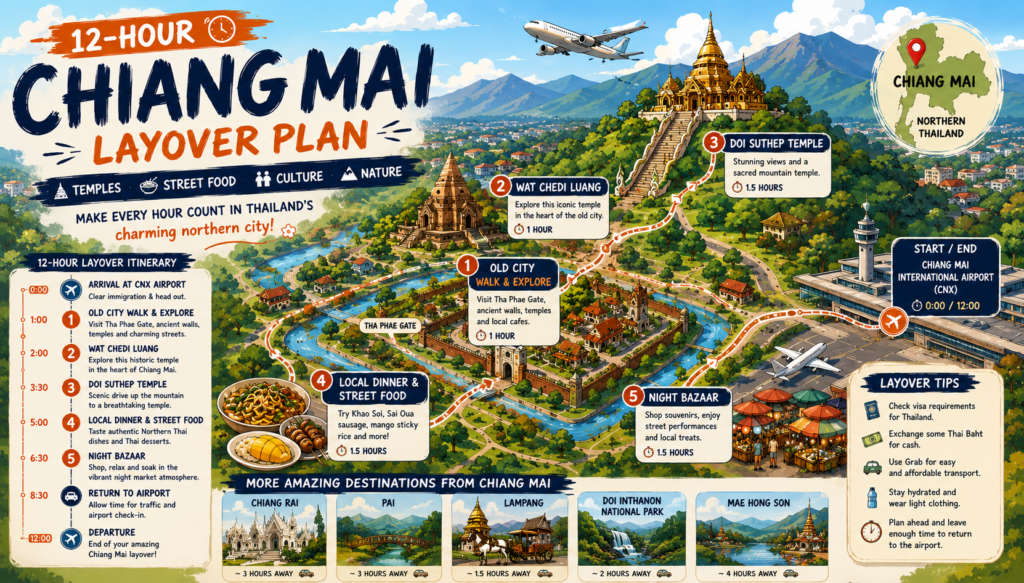
The 12-Hour Chiang Mai Layover Itinerary
Immigration off-peak: 20–30 minutes. Official taxi or Grab to Tha Phae Gate: 10–15 minutes, ฿80–200. Withdraw Thai baht from an airport ATM before leaving — cards aren’t reliably accepted in the Old City.
฿40 entry. The Emerald Buddha’s former home and the most dramatic single sight in the Old City — see the earthquake scar, the City Pillar shrine, and the Monk Chat programme if a session is running. 45–60 minutes.
8-minute walk from Chedi Luang. ฿50 for the viharn. The Old City’s most photogenic temple — the gold chedi and the Sang Thong jataka murals inside the Viharn Lai Kham. 30–45 minutes.
A proper sit-down khao soi at a local restaurant near the temples — Huen Phen for authentic Northern Thai dishes in a cosy setting, or any street vendor for the budget version. Budget ฿40–100. 45–60 minutes.
Both free entry, both close to each other. The city’s oldest temple (1296) and the all-teakwood viharn. 45 minutes combined.
Grab or taxi up the mountain (~30–40 min depending on traffic). ฿30 entry for tourists. 300 steps to the golden stupa, or take the funicular/tram alternative if available. The most important pilgrimage temple in Northern Thailand, with panoramic views over Chiang Mai. Allow 2–2.5 hours including transit.
If time allows, a quick stop at a night market for souvenirs; otherwise head directly back to CNX. International departures need a 3-hour buffer (check-in, immigration, security); domestic needs 1.5–2 hours.
Skip everything else and go directly to the highest-value stop. 10–15 minute taxi, ฿40 entry.
8-minute walk. ฿50 entry for the viharn. 30 minutes.
45 minutes. Don’t rush this — it’s the one meal worth specifically planning for.
10–15 minute taxi back. Build in the appropriate buffer for domestic vs international departure.
Chiang Mai Layover Scenarios — Real Situations, Specific Solutions
CNX is a domestic-to-international transit point, not a single connected terminal. International arrivals must clear immigration, collect baggage, clear customs, then physically walk to the separate Domestic Terminal and check in again.
Treating this like a 45-minute same-terminal connection, as you might at a major hub, risks missing the domestic flight entirely.
Allow a minimum of 2.5–3 hours for this specific connection. If your booked layover is shorter than this, do not attempt to leave the airport at all — head straight to the domestic check-in counter the moment you clear customs.
The Old City’s moat ring road runs one-way — clockwise inside, anti-clockwise outside — and Google Maps doesn’t reliably flag the direction in time for a first-time rider to react.
Royal Thai Police specifically watch foreign-plated rentals at the four corner gates, and this is the single most common ticket issued to visiting riders.
Plan your temple sequence in one consistent direction before you start riding — clockwise on the inside lane (Tha Phae → Wat Phra Singh → Suan Dok) or anti-clockwise on the outside — and don’t mix them mid-block. If you’re not confident, skip the scooter for a short layover; walking or Grab carries zero risk of this specific mistake.
A ฿40 Wat Chedi Luang entrance fee paid with a ฿1,000 note is a genuine, recurring friction point — small temple booths and street vendors frequently don’t carry enough change for large denominations.
Minor, but it costs you time and occasionally means walking away without paying or eating until you find change elsewhere.
Break large notes at a 7-Eleven (ubiquitous around the Old City) or a larger restaurant before heading to temple ticket booths and street stalls. Withdraw a mix at the airport ATM if possible, or ask for smaller denominations specifically when withdrawing.
Active temple interiors in Chiang Mai require shoulders and knees covered, and shoes off before entering — a rule enforced more strictly at the main viharns than the outer grounds.
Being turned away from the interior you specifically came to see, on a tight time budget, is avoidable.
Pack a light sarong or scarf in your bag before leaving the airport — it covers shoulders or knees in seconds and takes no space. Most major temples (including Wat Phra Singh) also rent sarongs at the entrance for a small fee or deposit if you arrive unprepared.
Northern Thailand’s “burning season” (roughly March–May) brings agricultural burning smoke that pushes PM2.5 levels routinely into the 150–300 µg/m³ range — well above healthy thresholds.
Extended outdoor walking and temple-hopping during burning season is genuinely uncomfortable and can aggravate respiratory conditions.
If you’re travelling in this window, prioritise the temple interiors (less outdoor walking) over the Doi Suthep round-trip, and consider a mask for outdoor stretches. November to February remains the better season for an outdoor-heavy itinerary, with cool, clear conditions (15–30°C).
CNX has free Wi-Fi but it’s limited and not always reliable the moment you exit. SIM kiosks (AIS and others) are available in the terminal, but queuing for one eats into a tight layover window.
Without data, confirming Grab pickup points, navigating temple sequencing, or checking the moat one-way direction all stall right when you need them most.
Activate an Airalo Thailand eSIM before landing so you have working data from the moment the plane touches down, skipping the terminal SIM kiosk queue entirely.
Food in Chiang Mai
Khao Soi
The dish Chiang Mai is known for above all others: egg noodles in a rich, coconut-curry broth, served with chicken, pork, or beef on the bone, topped with a tangle of deep-fried crispy noodles, and accompanied by shallots, pickled mustard greens, and a wedge of lime on the side. The broth’s flavour comes from a curry paste base mixed into coconut milk — distinct from anything found in Southern or Central Thai cuisine. Huen Phen is the most-cited authentic sit-down version near the Old City; Kanjana, in a less obvious side-alley, has a devoted local following. Street stalls serve it for as little as ฿30–40; restaurant versions run ฿60–100.
Sai Oua
A Northern Thai herb sausage — minced pork mixed with lemongrass, galangal, kaffir lime leaf, and chilli, grilled until the casing crisps. Distinctly more aromatic and herb-forward than Isaan or Central Thai sausages. Found at most night markets and street stalls around the Old City, typically ฿20–40 per portion.
Nam Prik Ong
A spicy tomato-based dip made with minced pork, tomatoes, and chillies, served with steamed vegetables and sticky rice for scooping. A genuine Northern Thai specialty rarely found outside the region, and a good order alongside khao soi if you want a fuller taste of Lanna cuisine in one sitting.
Markets Worth Knowing
Somphet Market on Moonmuang Road (open 4:00am–1:00pm, free entry) is the local fresh-produce market, with sai oua and khao soi breakfast stalls along the south edge for ฿40–60. Chang Phuak Night Market, just north of the Old City, is known specifically for its grilled meats on a stick and street food density. The Sunday Walking Street runs the length of Ratchadamnoen Road from Tha Phae Gate, 4:00pm–11:00pm, and has expanded to six sections with four dedicated food courts — if your 12-hour window happens to land on a Sunday evening, this is worth building the return trip around.
The break in the chedi runs at an angle, not a clean horizontal line — you can see exactly where the brickwork from 1475 stops and the restored section from the 1990s begins, a visible seam across five centuries. For seventy-seven years, the single most sacred object in Thailand sat inside that niche, carved from a block of green jasper, installed by a king who believed it would protect his kingdom. Then the ground moved, the top thirty metres came down, and six years later the statue left for good — first to Laos, then decades and kingdoms later, to a palace in Bangkok where it sits behind glass today, visited by millions, while the building that held it for nearly eight decades stands here, deliberately unrepaired above the fracture line, holding a jade copy in the same niche where the real one used to sit. Most people photograph the elephants at the base and never look up at the break itself.
Gear, eSIM, and Connectivity
Thailand data from $4.50 for 7 days on AIS or TrueMove networks. Activate before landing to skip the terminal SIM kiosk queue and have Grab/Maps working the instant you exit.
Get an eSIM →For itineraries combining Chiang Mai with Bangkok, Laos, or Myanmar — one plan covers the wider region without country-by-country switching.
Get an eSIM →CNX terminal Wi-Fi and Old City café networks are open. Banking access or booking confirmations on a public network in a new country — covered in under a minute.
Get NordVPN →CNX has in-terminal luggage storage and bag-wrapping services for travellers wanting to explore the Old City unburdened by carry-on bags.
Find Storage →Tours and Experiences
Guided visit to Wat Phra Singh, Wat Chedi Luang, Wat Chiang Man, and Wat Suan Dok, with a Monk Chat session included — a guide explains the Emerald Buddha story and the earthquake history in more depth than the temple signage provides.
Book via GetYourGuide →Round-trip transport to Doi Suthep with a guide, eliminating the need to negotiate Grab pricing for the mountain round-trip on a tight layover window.
Book via Klook →A guided walk through Somphet Market and the Old City food stalls covering khao soi, sai oua, and Northern Thai specialties, with a local explaining the dishes and ordering etiquette.
Book via Eatwith →Insurance and Hotels
Standard travel cover for the layover, with scooter and adventure activity options if your itinerary continues beyond Chiang Mai into the wider region.
Get a Quote →Same-day activation medical cover for Thailand. Particularly relevant if you’re riding a rental scooter — minor accidents are common among inexperienced foreign riders.
Get a Quote →TL Residence (20-minute walk from the airport) or Hotel Nobel Place, Airport Resident, and B2 Airport (all 5 minutes by car) — average ฿500/night. The right choice for an overnight layover with an early departure.
Check availability →A genuinely well-located base — 5-minute walk from Wat Chedi Luang, 10 minutes from Wat Phra Singh. The right choice for an overnight or extended layover where the Old City circuit is the priority.
Check availability →What’s your real Chiang Mai window?
If you’re connecting internationally to domestic, the 2.5–3 hour terminal-transfer buffer changes the maths significantly. Enter your specifics for the real number.
Calculate My Time →Thailand Entry Requirements
Most nationalities receive a 30-day visa exemption on arrival. Verify your specific requirement before travel if uncertain.
Check Visa Requirements →Connecting through Bangkok instead?
If your Thailand routing goes through Bangkok rather than Chiang Mai directly, our Bangkok layover guide covers that city’s very different transit logistics.
Bangkok Layover Guide →Frequently Asked Questions
The Emerald Buddha was installed at Wat Chedi Luang in 1468 and remained there for 77 years. A 1545 earthquake collapsed the upper 30 metres of the chedi, and in 1551 the statue was moved to Luang Prabang, then later to Vientiane, before eventually arriving in Bangkok, where it has been enshrined at Wat Phra Kaew inside the Grand Palace since the late 18th century. It remains Thailand’s most sacred Buddha image. A black jade replica was placed in the original Chedi Luang niche in 1995 to mark the temple’s 600th anniversary.
A minimum of 2.5–3 hours. CNX is a domestic-to-international transit point, not a single connected terminal — you must clear Thai immigration, collect baggage, clear customs, physically walk to the separate Domestic Terminal, check in again, and clear domestic security. This is not optional or skippable, and underestimating it is the most common mistake travellers make at this airport.
Yes, if you’re comfortable with the one-way moat ring road specifically — clockwise inside, anti-clockwise outside — and confident reading traffic flow at the four corner gates, where foreign-plated rentals are commonly ticketed (฿500) for going the wrong direction. If you’re not confident, walking the compact Old City or using Grab for short hops carries zero risk of this particular mistake and is the better choice on a time-constrained layover.
November to February offers the coolest, clearest conditions (15–30°C) and is the best window for an outdoor-heavy itinerary including Doi Suthep. Avoid March–May “burning season,” when agricultural burning across the region pushes PM2.5 air quality readings to 150–300 µg/m³ — well above healthy thresholds — making extended outdoor walking genuinely uncomfortable. Songkran (April 13–15) brings citywide water festivities that are fun but disruptive if you’re trying to move efficiently through the Old City on a tight layover.
Chiang Mai International Airport (CNX) — Official Resources
Flight information, terminal layout, and ground transport for Northern Thailand’s primary gateway.
Official visa exemption and entry requirement information by nationality for travel to Thailand.
immigration.go.th →Official temple opening hours, current entrance fees, and cultural event calendars for the Old City and surrounding region.
tourismthailand.org →Real-time PM2.5 air quality monitoring, particularly relevant during the March–May burning season when readings can spike significantly.
iqair.com →Current forecasts for Chiang Mai and Northern Thailand, useful for planning the Doi Suthep round-trip around clear conditions.
tmd.go.th →National emergency numbers for police and medical services throughout Thailand.
A leading private hospital in Chiang Mai with English-speaking staff and international insurance acceptance.
Chiang Mai International Airport passenger services — terminal information and connection assistance.
Consular services for all nationalities in Thailand (most are based in Bangkok). Find your embassy →
- CNX Local / Secret Flying Chiang Mai Airport Guide. Airport opened 1921, 11M+ annual passengers, 4km from Old City, two terminals (Domestic/International) under one roof, immigration typically under 30 minutes, official taxi ฿150–200 fixed fare, Grab ฿80–150. 2026.
- Aleenta Retreat / Trip.com Chiang Mai Airport Guides. Domestic-international transit connection requires 2.5–3 hours minimum; cards not widely accepted in Old City; ATM foreign card fee approximately ฿200.
- Wikipedia / Travel and History. Wat Chedi Luang construction 1391–1475 under King Saen Muang Ma and King Tilokaraj, Emerald Buddha installed 1468, 1545 earthquake collapsed upper 30m, statue moved to Luang Prabang 1551, eventual relocation to Bangkok’s Wat Phra Kaew.
- ByKlo Rent Chiang Mai Old City Guide. Old City is a 1.6km moat-enclosed square founded 1296 by King Mangrai; moat ring road one-way (clockwise inside, anti-clockwise outside); ฿500 fine for foreign-plated rental mismatches at corner gates; entrance fees: Wat Chedi Luang ฿40, Wat Phra Singh viharn ฿50, Wat Chiang Man and Wat Phan Tao free. 2026.
- WeSeekTravel Chiang Mai Old Town Guide. Over 300 temples in Chiang Mai, just over two dozen within Old City walls; Sunday Walking Street expanded to six sections and four food courts. 2026.
Disclaimer: Fares, entrance fees, and transit times verified June 2026 and subject to change. Air quality and seasonal conditions can vary significantly year to year — check current forecasts before travel. Affiliate links may earn EpicLayover a commission at no additional cost to you.
