
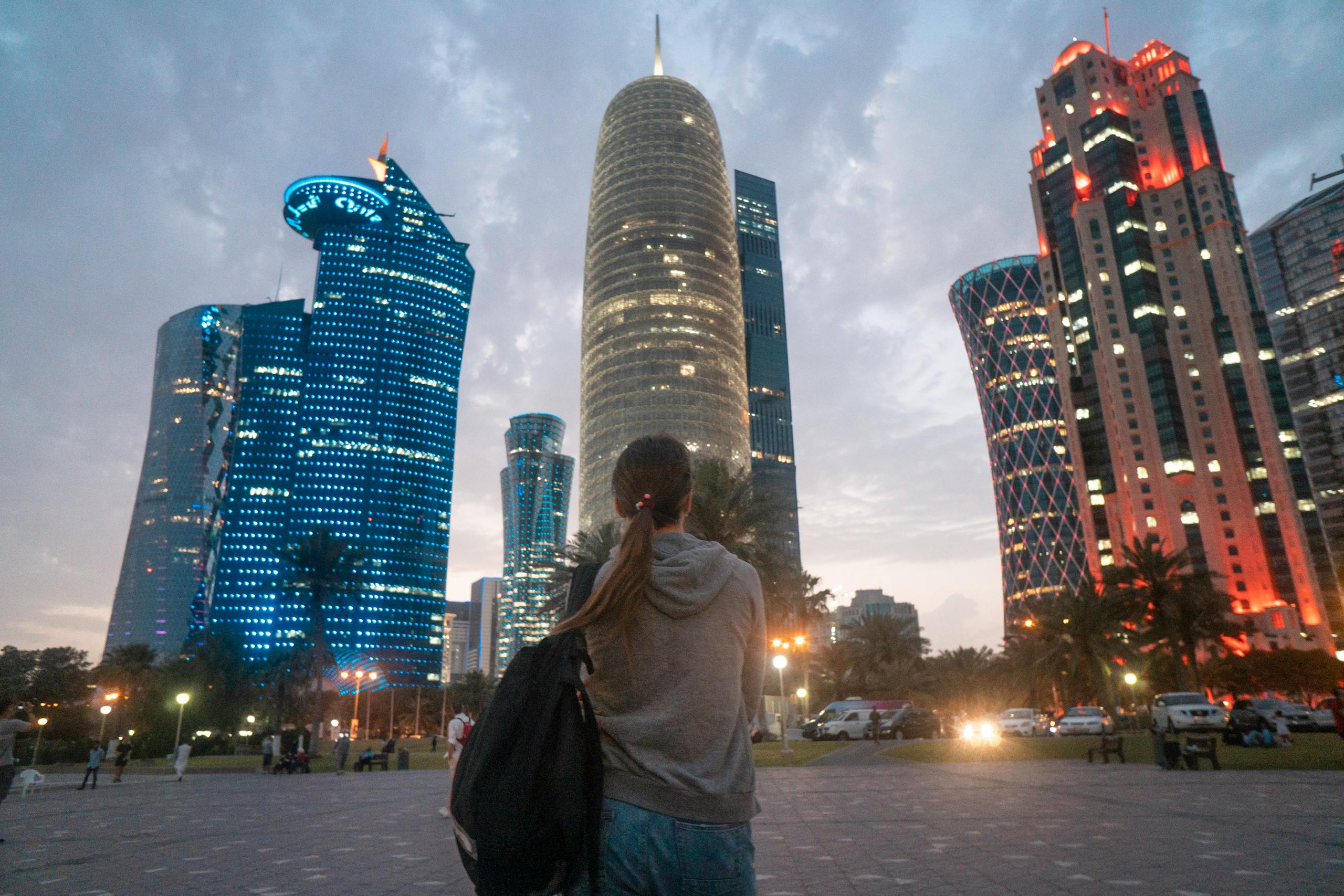
Doha Stopover Hack: How One Flight Becomes Two Destinations
One of the World’s Best Value Stopovers Just Got Better
Qatar Airways’ Doha stopover programme turns what is usually dead transit time into a genuine 1-to-4-night stay in one of the Arabian Gulf’s most fascinating cities — with 5-star hotels starting from $24 per person per night, and over 100 nationalities entering visa-free. This is not a consolation prize for a long connection. It is a deliberate, subsidised extra destination that can be added to almost any Qatar Airways itinerary for less than a coffee at the airport.
A stopover in Doha is different from any other transit city on the map. The distinction is not just about the Qatar Airways programme, though that is genuinely exceptional value. It is about what Doha actually is — a city that has spent the last two decades investing in becoming worth visiting. The Museum of Islamic Art, designed by I.M. Pei and housing 14 centuries of Islamic artistic tradition in one building, is one of the finest specialised museums anywhere in the world. Souq Waqif, a century-old marketplace restored rather than demolished, is one of the most alive traditional markets in the Gulf. The Pearl-Qatar, a man-made island of marina apartments and luxury restaurants, shows you the other end of the Doha spectrum. The city has enough for two full days, and enough variety to make those two days feel like two different destinations.
The practical case is equally strong. Hamad International Airport sits 15 minutes from the city centre. Qatar is visa-free for over 100 nationalities on arrival. The metro system is modern, clean, air-conditioned, and covers every major attraction. Qatar uses English widely — in signage, menus, and most hospitality interactions. And the subsidised hotel programme means the accommodation cost is the least surprising line on your travel budget.
This guide covers everything you need to plan a stopover in Doha: the programme tiers and how to book them, a practical visa guide, day-by-day itineraries for 1 to 3 nights, the best attractions by category, cultural etiquette that will make your visit significantly more comfortable, the heat reality by month, what food to seek out, and how to pack correctly when your checked bags are not coming with you.
A minimum of 12 hours transit time in Doha to qualify for the Qatar Airways Stopover Programme. For a meaningful experience, one full night is the minimum — two nights gives you time to see everything worth seeing without rushing.
The Standard tier (4-star) starts from $14 per person per night based on double occupancy. Premium 5-star hotels start from $24/person/night. These are government-subsidised rates — the same hotels cost $150–250+ booked independently.
Citizens of over 100 countries can enter Qatar visa-free on arrival, including the US, UK, EU, Canada, Australia, Japan, South Korea, UAE, India, and many more. Check visitqatar.com for the current full list — it has expanded significantly in recent years.
November through March is ideal — temperatures of 18–26°C make outdoor exploration genuinely pleasant. April and October are workable. May through September is brutal — 35–45°C+ heat means most outdoor activities move to early morning or evening only.
The Qatar Airways Stopover Programme — What You Actually Get
Qatar Airways runs what it calls the world’s best value stopover programme in partnership with Discover Qatar, its destination management division. If your transit time in Doha falls between 12 and 96 hours (1–4 nights), you are eligible. The programme does not require any special fare class to access — most confirmed Qatar Airways ticket holders qualify, though award tickets booked using Avios in saver classes are sometimes excluded. Book through qatarairways.com using the Stopover/Packages tab, or via discoverqatar.qa after purchasing your flight.
There are four tiers. Here is what each one actually includes:
- Room only basis
- 4-star branded hotels
- City and airport locations
- Good value starting point
- 5-star hotel quality
- IHG, Hyatt, Hilton, Accor
- Room only basis
- Recommended over Standard
- Beach access included
- Sunbed and towel
- Marriott, Dusit, Le Méridien
- Coastal hotel locations
- Breakfast included daily
- Top-tier hotel brands
- Fairmont, Westin, Rixos
- Premier locations
The jump from Standard (4-star, ~$14/night) to Premium (5-star, ~$24/night) is typically just $10 per person per night. On a 2-night stopover, that is $20 total per person for a meaningfully better hotel. There is almost never a reason to book Standard when Premium is available. Similarly, if you are visiting between October and April, the beach access tier ($31/night) adds Doha Sands Beach for $7 more — which is worth it on a warm-weather stopover in Doha.
How to Book Your Doha Stopover
Select “Stopover / Packages” in the flight search panel. Enter your origin, final destination, and how many nights you want in Doha.
Choose outbound and return or onward flights that include the Doha gap. You need at least 12 hours in Doha. Book at least 3 days before travel.
After booking your flight, go to discoverqatar.qa to select your hotel tier, specific property, excursions, and airport transfers.
For transits under 24 hours, your checked bags go straight to your final destination. Pack everything you need for Doha in your hand luggage.
This is the most important practical detail for a Doha stopover: if your transit is under 24 hours, your checked baggage travels directly to your final destination. It will not be available to you in Doha. Pack everything you need for your stopover — toiletries, a change of clothes, any medication — in your carry-on bag before boarding your first flight. If your stopover is 24 hours or more, you can collect your checked bags in Doha, but this must be arranged in advance with Qatar Airways.
Ready to add Doha to your journey?
Start with your flights on Qatar Airways, then book your hotel and experiences through Discover Qatar.
Visa and Entry — Who Can Stop Over in Doha
Qatar is one of the most open visa regimes in the Gulf. Over 100 nationalities can enter on arrival without a visa — no advance application, no pre-approval required. You collect your visa-on-arrival stamp at immigration in Hamad International Airport, present your onward ticket, and walk out into Doha. The process is fast, typically 10–20 minutes, and the airport is one of the most efficient international arrivals in the world.
| Category | Example Countries | Entry | Max Stay |
|---|---|---|---|
| Visa-Free on Arrival | US, UK, EU, Canada, Australia, New Zealand, Japan, South Korea, Singapore, India, Brazil, South Africa, Thailand, Malaysia, UAE, Saudi Arabia, and 80+ others | Visa-Free | Up to 30 days per visit |
| eVisa Required | Some nationalities not on the visa-free list — apply via Hayya platform before arrival. Fast processing, typically 24–48 hours. | eVisa | Up to 30 days |
| Visa Required in Advance | Small number of nationalities requiring a traditional visa. Check visitqatar.com for the current list. | Advance Visa | Varies |
For nationalities that require an eVisa, Qatar’s Hayya e-visa platform processes applications within 24–48 hours for most nationalities. Visit www.moi.gov.qa or the official Qatar e-visa portal. The Hayya system also allows you to skip manual queue processing and go through e-gates at Hamad International if you have a valid QR code — significantly faster than the standard arrival line.
Getting from Hamad International Airport to the City
Hamad International Airport is exceptionally well-connected to central Doha. The Doha Metro station is inside the arrivals terminal — follow signs for the Gold Line. Journey time to the main city attractions is 20–30 minutes by metro, or 15–20 minutes by taxi. Unlike many Middle Eastern cities, Doha’s public transport is genuinely excellent for a stopover traveller.
Station inside arrivals terminal. Buy a Karwa Smartcard from machines (reusable, QAR 10 card + credit). Clean, air-conditioned, modern. Connects to Souq Waqif, Museum of Islamic Art, Katara, and The Pearl. Runs daily 06:00–24:00, extended Friday hours.
RecommendedOnly Karwa taxis are authorised for airport pickups — they line up directly outside arrivals. Book via the Karwa app or hail from the taxi rank. Metered, reliable, and English-speaking drivers are common. Faster than metro for hotel check-in with luggage.
Uber operates in Doha and can be used for most city journeys once you have cleared arrivals. Not permitted for the airport pickup zone — use Karwa from the terminal then Uber for everything else in the city during your Doha stopover.
Buy a Karwa Smartcard immediately on exiting arrivals — it works on both the metro and Karwa taxis, and avoids the need for cash on every journey. Top up at any metro station machine. If your hotel is near Souq Waqif (the recommended base for a first-time Doha stopover), the metro drops you at Souq Waqif station on the Gold Line — a straight shot from the airport without any changes.
What to See in Doha — The Definitive Stopover Attractions
Doha is compact enough that a motivated stopover traveller can cover its main sites in 2 full days without feeling rushed. The southern cluster — Museum of Islamic Art, the Corniche, Souq Waqif, and the National Museum — is the cultural core and largely walkable or one metro stop apart. The northern cluster — Katara Cultural Village, The Pearl-Qatar, and Lusail — is 30–40 minutes further by metro or taxi and best saved for a second day.
I.M. Pei’s masterwork on a dedicated waterfront island. 14 centuries of Islamic art spanning metal, ceramic, glass, jewellery, and textiles. The building and the MIA Park around it are as worth your time as the collection inside. Closed Wednesdays. The Corniche view from the outdoor terrace is the best skyline photograph in Doha.
A century-old market restored in 2006 rather than demolished — Doha’s cultural and social heart. Spices, textiles, handicrafts, the Falcon Souq where you can handle a trained bird, and more restaurants per square metre than anywhere else in the city. Visit in the evening when the alleyways light up and locals come out. Open until late.
Jean Nouvel’s extraordinary desert rose building — interlocking disc shapes inspired by the natural gypsum formations found in Qatar’s desert. Inside, an immersive narrative of Qatar’s history from geological formation through the pearl diving era to the oil and gas transformation. One of the most thoughtfully designed national museums in the world. Allow 90 minutes minimum.
A 7-kilometre waterfront promenade wrapping around Doha Bay. The West Bay financial district skyline on one side, traditional dhow boats on the water in front, and the MIA visible to the south. Best walked in the early morning or after 4 p.m. to avoid peak heat. The dhow harbour at the northern end is the best place to photograph the traditional wooden boats with the modern skyline behind.
A man-made island development on Qatar’s former pearl diving beds — now luxury apartments, marina promenades, international restaurants, and high-end boutiques. The Porto Arabia marina area is the most photogenic section at evening, when the restaurant terraces are lit and superyachts are in dock. Take the metro to Mall of Qatar station then taxi or rideshare to The Pearl.
Qatar’s largest cultural project — a village-scale complex of theatres, galleries, mosques, an open-air amphitheatre, restaurants, and a semi-private beach. The architecture blends traditional Qatari and Islamic design in a way that feels deliberate rather than fake. The Katara Mosque’s gold dome is one of the most photographed buildings in Doha. Best visited afternoon into evening, when the light is soft and the restaurants open.
Museum of Islamic Art — The Corniche View from MIA Park
Walk around the south side of the MIA building and stand on the waterfront promenade in MIA Park, facing north-northeast. The West Bay skyline fills the background — towers of glass and steel reflected in the bay — and traditional dhow boats pass in the foreground. Shoot in the first two hours after sunrise for the flattest, most saturated light. The museum building itself photographs best from the water (the Dhow Harbour has boats that pass it at distance) — a wide shot with the building centred and the bay horizon visible is the defining Doha stopover photograph.
“14 centuries of art in one building. One of the best museums I’ve ever stood inside.” — #EpicLayover #DohaStopover #MuseumOfIslamicArt
Souq Waqif — The Golden Alleyways After Dark
Visit Souq Waqif after 7 p.m. The mud-rendered walls catch the warm LED lighting and the narrow alleys become golden corridors. Walk deep into the market until you find a junction where three or four alleyways converge — look for the spice section, which has the most ambient-lit stalls and the richest visual texture. The Golden Thumb statue by César Baldaccini in the heart of the Souq is worth finding and shooting with a wide frame. Vertical shots work best in the narrow alleyways; horizontal in the open plazas.
“Came for 10 minutes. Stayed for two hours.” — #EpicLayover #SouqWaqif #DohaStopover
Doha Stopover Itineraries — Day by Day
All itineraries assume you arrive in Doha in the evening or early morning on Day 1 and depart from Hamad International Airport at least 3 hours after your last activity ends. Adjust the timing based on your actual arrival and departure flights. Hotel check-in with the Qatar Airways Stopover Programme is flexible — you can check in at any time within your booking window.
The Museum of Islamic Art, the Corniche, and Souq Waqif by night — the essential first-day loop.
Collect your stopover voucher at the hotel desk in arrivals if applicable. Take the Gold Line metro or Karwa taxi to your hotel (20 min, QAR 2 metro or QAR 35 taxi). Check in, freshen up, and — critically — pack a small daypack from your carry-on with everything you need for the day. Your checked bags are in transit to your final destination.
Arrive at opening time (9 a.m. Saturday–Thursday) for the quietest experience. Allow 90 minutes inside the collection — the Islamic jewellery and metalwork on the upper floors, and the ground-floor ceramics and glass, are the highlights. Before you leave, walk the MIA Park around the building’s south side for the West Bay skyline view. The in-house IDAM restaurant, by Alain Ducasse, is excellent for lunch — book ahead if you want a specific table.
Walk north from the MIA along the Corniche waterfront promenade. The full 7km is too long in most weather — walk the stretch from MIA Park to the Dhow Harbour (about 2km), stopping at the Pearl Monument for photos. The West Bay towers are visible across the bay throughout. In summer, do this section by taxi and walk only the harbour area, which has shade. The traditional dhow boats — wooden, hand-built — are moored at the harbour and can sometimes be hired for short bay tours.
From May to September, the 1–4 p.m. window in Doha is genuinely dangerous heat — 40°C+ and high humidity. Return to your hotel for a rest or use the pool. From November to April, this is the ideal window for the National Museum of Qatar (Jean Nouvel’s desert rose building, QAR 50, 90 min). Either way, the key Doha stopover move is to save outdoor activities for the evening when the city comes alive.
Arrive at Souq Waqif after 6:30 p.m. The market transforms at night — lights, noise, crowds, and the smell of cardamom and grilled meat. Walk the alleyways before eating. For dinner: Parisa for ornate Persian dining inside mirrored walls; Al Mourjan or one of the Qatari restaurants along the main square for machbous (spiced rice with meat) and luqaimat (honey-drizzled dumplings). Finish with Arabic coffee (unsweetened, cardamom-laced, tiny cups) at one of the roadside cafes — it is one of the defining flavours of a Doha stopover.
Doha’s northern arc — the cultural village, the luxury island, and the marina at golden hour.
Qatar’s largest urban regeneration project — a walkable district of cafes, galleries, and modernised traditional Qatari architecture in the area once known as Old Doha. The Msheireb Museums (four preserved houses telling Qatar’s social history, QAR 55 combined) are worth 60 minutes if you want to understand how quickly the country changed from a pearl fishing village to a global economy. Walk south to Souq Waqif for coffee and breakfast — it is quieter and more photogenic in the morning than at night.
Take a taxi or rideshare north to Katara (25 min, QAR 25). Walk through the village complex — the Golden Mosque is the visual centrepiece, a traditional Qatari dome clad in actual gold tiles. The open-air amphitheatre overlooks the Gulf. The Katara Beach (between Katara and The Pearl) is a semi-private beach that is accessible to the public — good for a swim in cooler months. Several good restaurants line the waterfront here.
Short taxi from Katara to The Pearl’s Porto Arabia marina (5 min). Walk the promenade around the circular marina — superyachts, palm trees, luxury boutiques, and the skyline of Doha in the background. The Pearl is better in the afternoon as the light shifts west and falls on the marina buildings. Avoid the mall interior unless you need it — the outdoor waterfront walk is the experience.
The Pearl has excellent international dining — Nobu Doha (Japanese, premium), Boho Social (international casual, marina terrace), or one of the Italian trattorias on the promenade. For a more authentic Doha stopover dinner, head back to Souq Waqif by taxi (20 min) and explore the restaurants you did not try on Day 1. The Old Market’s Moroccan quarter has some of the best affordable food in the souq.
For a 3-night stopover — Qatar beyond the city. Dunes, camels, and the extraordinary Inland Sea.
Book through Discover Qatar when booking your stopover, or directly with GetYourGuide. Most half-day desert tours depart Doha at 8 or 9 a.m. and return by 1–2 p.m. A 4WD drive over the dunes in the desert south of Doha is the archetypal Qatar tourism experience — not a contrived theme park, but actual enormous sand dunes with vehicles that know them well. Camel riding and sandboarding are typically included. Best in cooler months — in summer, the desert heat is extreme even in a vehicle.
A shallow tidal inlet from the Persian Gulf that pushes deep into the Qatari desert on the Saudi border. The drive requires a 4WD across open dunes — book a full-day tour. The sea is a vivid blue-green surrounded by rolling sand dunes, creating a landscape that looks surreal. Swimming is possible in calm weather. This is genuinely one of the most extraordinary landscapes in the Gulf region and worth the full-day investment on a 3-night Doha stopover.
Return to Doha by early afternoon. Pool time at the hotel if you have beach or pool access (Premium Beach tier). Final evening at Souq Waqif — any restaurants or alleyways you missed. The market at 9–10 p.m. on a Thursday evening (Qatar’s equivalent of Friday night) is at its most alive. Allow 3 hours for the airport before your departure flight.
What to Eat on a Doha Stopover
Doha has one of the most diverse food scenes in the Gulf — every major international cuisine is represented at high quality in the hotel district, while Souq Waqif is the place for authentic Qatari and Gulf Arabic cooking. These are the six things worth prioritising during your Doha stopover.
Spiced rice slow-cooked with lamb or chicken, fragrant with loomi (dried lime), cardamom, and saffron. The Qatari equivalent of a national comfort dish. Order it at any traditional restaurant in Souq Waqif — Al Shurfa or Shaheen are reliable.
Qahwa — unsweetened Arabic coffee brewed with cardamom and sometimes saffron, served in tiny handleless cups with dates. Offered at almost every Qatari restaurant and many hotel lobbies. Refusing it is mildly impolite. This is the flavour of a Doha stopover, distilled.
Small fried dough balls drizzled with date syrup and sesame, sold from small stalls throughout Souq Waqif. Usually QAR 5–10 for a cup. Hot, sweet, and slightly crispy — the best street food moment in Doha. Look for the stalls near the Souq’s main entrance.
Qatar’s most prized local fish — a grouper species from the Gulf. Grilled whole or in fillets at the seafood restaurants around Souq Waqif and the Corniche. Sweet, firm white flesh. The fishing industry is still active in Qatar and the fish is genuinely fresh.
Doha has excellent shawarma at Levantine and Egyptian-owned restaurants throughout the city. The shawarma near Souq Waqif Metro station is a favourite of Doha regulars — chicken or lamb, wrapped with pickles, garlic sauce, and tomato. QAR 5–10. One of the great value meals in the Gulf.
Doha has accumulated a significant number of internationally acclaimed restaurants in its hotel and marina district. Nobu Doha, IDAM by Alain Ducasse (at the MIA), Zuma, and Hakkasan are the standouts. Prices are comparable to London and Dubai — budget QAR 200–350 ($55–95) per head before drinks.
Alcohol is available in Qatar but strictly regulated. It is served in licensed hotel bars and restaurants — not in public spaces, supermarkets, or unlicensed venues. You cannot bring alcohol into the country. At Souq Waqif and most Qatari restaurants, alcohol is not served. Plan dining accordingly — the non-alcoholic drinks culture (Arabic coffee, mint lemonade, fresh fruit juices) is excellent in its own right during a Doha stopover.
Cultural Etiquette for a Doha Stopover
Qatar is a Muslim majority country with its own cultural norms. Doha is more tolerant and internationally oriented than many Gulf cities — you will not be harassed for minor infractions, and the city is genuinely welcoming to international visitors. But a few specifics make a meaningful difference to the quality of your Doha stopover experience.
Cover knees, midriff, and shoulders in public spaces — souqs, mosques, museums, and streets. Shoulders and knees must be covered inside Souq Waqif and all mosques. At hotel pools, beach resorts, and international restaurants, Western dress is fine. Tank tops and shorts are acceptable at the hotel pool; not in the market alleys.
Do not photograph Qatari nationals — particularly women — without explicit permission. Photographing mosques from outside is generally fine; check signs inside. Photographing military installations, government buildings, and airports is prohibited. The MIA, Souq Waqif, the Corniche, and The Pearl are all freely photographed.
During Ramadan (dates shift annually — check in advance), eating, drinking, and smoking in public during daylight hours is prohibited by law. Hotels continue to serve food in designated areas. Most tourist restaurants remain open. Souq Waqif is actually at its most atmospheric during Ramadan evenings, when it becomes the social hub of the city after iftar (breaking of fast).
Arab greetings are warm but follow protocol. Do not extend your hand to a Qatari woman unless she extends hers first. “As-salamu alaykum” (peace be upon you) is the universal greeting and always appreciated from visitors. Qatar is genuinely hospitable — asking directions, striking up conversations in the souq, and accepting tea offered by a shopkeeper are all part of the Doha stopover experience.
When to Visit — The Doha Temperature Reality
Qatar’s climate is extreme and the decision about when to book your stopover in Doha matters more than for almost any other destination. The ideal months for outdoor exploration are November through March. Everything else requires planning around the heat.
If your stopover falls in the summer months (May–September), adjust your Doha itinerary accordingly: all outdoor activity before 10 a.m. or after 5 p.m., aggressive use of air-conditioned venues (the National Museum, the Mall of Qatar, hotel restaurants) during midday, and lean into the excellent hotel pool facilities included in the Premium and Luxury tiers. The souq, the Pearl, and the museums are all fully enjoyable in summer if you time them correctly.
How to Pack for a Doha Stopover
The most important packing decision for a Doha stopover is understanding the bag restriction: for transits under 24 hours, your checked luggage travels directly to your final destination. Everything you need for your time in Doha must fit in your carry-on allowance. Here is how to divide it:
Souq Waqif is most frequently described by first-time visitors as the thing they did not expect to find in Qatar — a genuine 19th-century market that was restored rather than demolished, with mud-daubed walls, working spice stalls, a Falcon Souq where trained birds of prey are bought and sold, and restaurants that operate until the early hours. The market’s early mornings, before the heat arrives and before the tourist flow begins, are consistently cited in travel accounts as one of the quieter and more atmospheric periods to walk it. Doha’s stopover programme has been running since 2013 and the $14-per-night Standard tier has been independently verified by multiple travel publications including One Mile at a Time and The Points Guy as a genuine government-subsidised rate — not a promotional price, but a standing offer available on confirmed Qatar Airways itineraries with a minimum 12-hour transit window.
Connectivity and Gear for a Doha Stopover
Qatar has excellent mobile coverage and fast LTE/5G across Doha. Free Wi-Fi is available in most hotels, Hamad International Airport, and many public spaces. For navigation, Google Maps works reliably in Qatar — unlike China or some other Gulf states, there are no significant internet restrictions in Qatar beyond content filtering. An international eSIM or local data plan is recommended if your home roaming rates are high.
Qatar data eSIM activated before boarding — navigation, ride-hailing, and payments all work from the moment you land. A Middle East regional plan covers Qatar and any connecting countries on your itinerary. Activate on the Airalo app before you fly.
Get an eSIM →No plan commitment — pay only for the data you use during your Doha stopover. Covers Qatar and connects seamlessly to your home network context. Good for travellers with unpredictable data use.
Get an eSIM →Google Maps, Uber/Karwa rideshare, Karwa Smartcard app, your hotel QR code, and your camera use your phone all day. Qatar’s heat also drains batteries faster than temperate climates. Keep a power bank in your daypack throughout your Doha stopover.
View on Amazon →Qatar has some content filtering on its networks — certain social platforms and news sites may require a VPN. Hamad International Airport and hotel Wi-Fi are also public networks. Set up before landing if you need access to any filtered content during your Doha stopover.
Get NordVPN →Travel Insurance for a Doha Stopover
Qatar’s healthcare system is excellent but private medical care is expensive for non-residents. If you book the stopover programme through Qatar Airways Holidays, your flights are covered by QA’s standard terms — but any activities you do independently, any medical incidents in the city, and any trip interruption or cancellation needs are your own responsibility. A single-day or short-stay policy from InsureMyTrip or World Nomads costs a few dollars and covers the gap.
Book Your Doha Stopover Hotel
The Qatar Airways Stopover Programme offers the lowest rates available on Doha hotels — subsidised by the Qatari government specifically for transit passengers. If you qualify, always book through discoverqatar.qa first. For independent bookings, comparison shopping between Booking.com and Agoda will give you the best picture of available rates outside the programme. Hotels near Souq Waqif and the Museum of Islamic Art offer the best balance of location and value for a short Doha stopover.
Book Tours and Activities for Your Doha Stopover
Doha’s main attractions — the Museum of Islamic Art, National Museum of Qatar, and Souq Waqif — do not require advance booking. But the desert safari, a dhow cruise on the bay, and Discover Qatar’s official city tour are all better booked ahead, particularly on weekends and during Ramadan evenings when demand peaks. Klook and GetYourGuide both carry verified Doha tour options with airport pickup available on transit-focused packages. Welcome Pickups covers the airport-to-hotel transfer with fixed pricing and no surge rates.
More From EpicLayover
Stopover Time Budget Calculator
How many nights in Doha do you actually have? Enter your flights and get a day-by-day plan.
Calculate Now →Best Airline Stopover Programmes
Qatar is one of several airlines with official stopover programmes. See how it compares to Emirates, Turkish, and Singapore Airlines.
Compare Programmes →Stopover Packing Essentials
The carry-on system for stopover travellers — how to pack for 1–3 nights when your checked bag goes ahead.
Read the Guide →Frequently Asked Questions — Stopover in Doha
Any confirmed Qatar Airways ticket holder with a minimum transit time of 12 hours in Doha qualifies for the stopover hotel rates. This includes most fare classes on paid tickets. Award tickets booked using Avios in saver fare classes (X in economy, U in business, Z in first) are excluded from the subsidised hotel programme, but you can still book through Discover Qatar at slightly higher rates. The programme allows a maximum of 4 nights (96 hours) per stopover. Book at least 72 hours before your arrival.
Potentially, yes. Qatar Airways’ STPC (Stopover Paid by Carrier) programme offers complimentary hotel accommodation for passengers with a transit of 8–24 hours who are on qualifying paid fares (N and above in economy, J/C/D/I/P in business) with a ticket value of at least $400. This is separate from the standard Stopover Programme and applies automatically if you qualify — ask at the Qatar Airways transfer desk in arrivals. Award tickets in saver classes do not qualify. If you want to extend deliberately, use the standard Stopover Programme through Discover Qatar instead.
Yes — Qatar is one of the safest countries in the world for solo female travellers, including at night. Violent crime is extremely rare. The main considerations are cultural: modest dress (covering shoulders and knees in public) is respectful and makes navigation through Souq Waqif and museums more comfortable. Harassment is uncommon — the local culture values discretion. The metro has a designated women-only cabin on each train. Uber and Karwa apps are the safest way to move around after dark. Most international hotel areas are completely relaxed in terms of dress and behaviour.
For the best balance of location and value in the Premium tier, the Alwadi Hotel (MGallery by Accor), Hampton by Hilton Old Town, and the Souq Waqif Boutique Hotels (a collection of intimate traditional properties inside the Souq itself) are all excellent choices. They put you within walking distance of Souq Waqif, the Corniche, and the National Museum. For luxury-tier guests, the Sheraton Doha and InterContinental Doha combine prime Corniche locations with the breakfast inclusion. The Grand Hyatt and Mondrian at The Pearl are the right choice if you are prioritising the northern arc of the city on Day 2.
Both are excellent stopovers with official airline programmes (Qatar Airways in Doha, Emirates in Dubai). The key differences: Doha’s subsidised hotels are significantly cheaper than Dubai’s; Doha is a smaller, more compact city that is easier to navigate in 1–2 days; Dubai has more large-scale entertainment (the Burj Khalifa, malls, beaches) and a more established international tourism infrastructure. Doha is more culturally authentic and less overtly commercial — the Museum of Islamic Art and Souq Waqif are world-class without being theme-parked. If you want the full Gulf luxury experience at scale, Dubai. If you want cultural depth and exceptional value, Doha wins the stopover comparison.
Yes, on a half-day basis. Most desert safari tours depart Doha at 8–9 a.m. and return by early afternoon. On a 1-night stopover where you arrive in the evening, spend the next morning on a half-day desert tour, and then use the afternoon for Souq Waqif before heading back to the airport, the timing works. You will miss the Museum of Islamic Art and some of the city’s cultural depth, but you will have experienced Qatar beyond the city limits. Book through Discover Qatar or GetYourGuide before arrival. Best from October to April — summer desert tours run in extreme heat.
Qatar uses the Qatari Riyal (QAR). 1 USD is approximately 3.64 QAR (the Riyal is pegged to the dollar at this rate and rarely fluctuates). Qatar is largely card-friendly — Visa and Mastercard are accepted at virtually all hotels, restaurants, and shops. The metro Karwa Smartcard is purchased and topped up with cash or card. Small market stalls and some traditional restaurants in Souq Waqif may be cash-only — carry QAR 50–100 in cash for these. ATMs are widely available throughout Doha and in the airport arrivals hall.
Yes — unambiguously. Even on a tight 1-night Doha stopover, you can arrive in the evening, spend the following morning at the Museum of Islamic Art and Corniche, have lunch at Souq Waqif, and return to the airport in the early afternoon. That is 5–6 hours of genuinely world-class cultural experience for a hotel cost that starts at $14 per person per night. The question is not whether 1 night is worth it — it clearly is — but whether you want 2 nights to do the city properly. Two nights covers everything in this guide at a comfortable pace. One night covers the essentials. Both are better than sitting in the Hamad International departure hall for 18 hours.
