Travel safety in 2026 looks meaningfully different than it did even three years ago. AI-driven scams now target families of travelers from a base of three seconds of public audio. eSIMs have replaced physical SIM swaps as the default cellular setup, which changes the cybersecurity threat model. Schengen Area entry/exit will be biometric-only by the end of the year. Consular services have been pushed online, which makes them faster but also more dependent on you having backups of your own documents. The fundamentals — don’t flash valuables, watch your drink, trust your gut — haven’t changed. Almost everything else has.
This is the umbrella guide. It covers what’s new for 2026, the pre-trip checklist that quietly prevents 80% of common problems, the threat-tier framework for thinking about destination risk, and links out to six in-depth spoke reports covering the full categories of travel safety: scams, theft, digital security, solo travel, legal trouble, and medical emergencies. Each spoke goes deeper than this overview can. Read this guide first to see the whole map; then drill into the specific category that matters to your trip.
A safe trip isn’t a lucky trip — it’s a prepared trip. Most “bad luck” abroad turns out, on examination, to be a missing piece of preparation. The good news: most of that preparation is free and takes less than an hour.
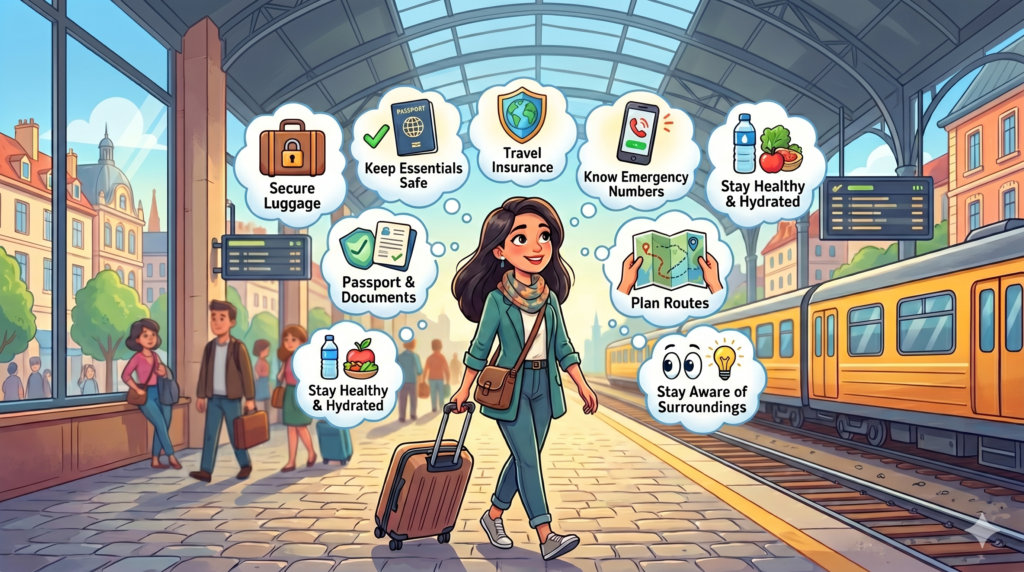
The four-piece foundation of travel safety in 2026: a comprehensive travel insurance policy, a digital backup of your passport and ID, a travel-grade VPN on every public Wi-Fi network, and a family safe word for verifying emergency phone calls. Add the country-specific layers (vaccinations, visa, advisory check) on top of that base.
Government foundation: Register with your home country’s traveler program (STEP for U.S. citizens, ROAM for U.K., Smartraveller for Australia). Check the official advisory at travel.state.gov or the government advisory directory within 7 days of departure.
What’s New for 2026
If you haven’t traveled internationally since 2024, several things have meaningfully changed. None are catastrophic, all are worth knowing.
Voice clone fraud reaches scale
The threshold for realistic voice clones has dropped to about three seconds of source audio. Family safe words have moved from paranoid to standard advice — see our dedicated setup guide.
Schengen biometric system rollout
The EU’s Entry/Exit System (EES) is being deployed across Schengen borders during 2026, replacing passport stamps with biometric records. Build extra time into first-entry crossings.
eSIM as default
Most modern phones are eSIM-only or eSIM-preferred. International data is now bought as a download, not a SIM card. See global connectivity for the cybersecurity implications.
Tighter coverage on AI-related fraud
Most major insurers now explicitly cover voice-clone and deepfake fraud losses up to a stated limit. Read the policy — coverage limits vary widely.
Updated CDC vaccine guidance
2025 saw revised CDC recommendations on dengue, chikungunya, and measles for travelers to specific regions. Check CDC Travelers’ Health 4–6 weeks before departure.
Faster digital passport replacement
U.S. and most Western embassies have streamlined emergency passport issuance. Most major posts now issue emergency documents within 24 hours when there’s verified urgent travel — see our replacement guide.
The Pre-Trip Safety Checklist
Run this checklist 7–14 days before any international trip. Almost every “bad luck abroad” story traces back to a missing item on a list like this.
Two weeks out
- Check your passport expiration — most countries require 6+ months of validity beyond your trip dates
- Confirm visa requirements for every country (including transit countries) on the official embassy site
- Check the government travel advisory for each destination
- Buy comprehensive travel insurance — not the airline’s optional checkbox
- Schedule any required vaccinations (some need 4–6 weeks lead time)
- Photograph passport, ID, credit cards (front + back), insurance documents — store in encrypted cloud and email to yourself
- Set up a family safe word for verifying emergency phone calls
One week out
- Notify banks of travel dates and destinations (in-app or by phone)
- Register with your home country’s traveler program (STEP, ROAM, Smartraveller)
- Install your VPN on phone and laptop
- Save the international collect-call numbers for every credit/debit card you’re carrying
- Save your embassy’s address and phone for each destination country
- Buy local-currency cash for arrival ground transport
- Confirm a local emergency contact at your destination (hotel, friend, tour operator)
Day before
- Charge a backup power bank (the Anker Nano is the standard)
- Update your phone OS and key apps (banking, messaging, navigation)
- Print one paper copy of itinerary, hotel addresses, and key phone numbers
- Tell two people back home your full itinerary and emergency contacts
- Check the destination weather and pack accordingly
The Threat-Tier Framework
Not all risks are equal, and not all destinations require the same level of preparation. A useful mental model: most travel risks fall into three tiers. Recognize which tier applies to your trip and prepare accordingly.
Pickpocketing, opportunistic scams, minor theft
The vast majority of bad-luck travel events. Mostly preventable with awareness. Most cities, including Paris, Rome, and Barcelona. Defense: situational awareness, anti-theft bags, hotel safes, money diversification.
Targeted fraud, sophisticated scams, digital compromise
Voice clone scams, hotel Wi-Fi attacks, ATM skimming, taxi scams, dating-app extortion. Defense: VPN, family safe word, careful Wi-Fi hygiene, two-factor everywhere, emergency cash plan.
Civil unrest, natural disasters, serious medical events, legal trouble
Rare but high-impact. Defense: comprehensive insurance, government registration, embassy proximity awareness, evacuation plan, satellite communicator for remote travel.
The Six Spoke Categories
Each link below opens a full deep-dive guide. Read this overview first; click into the specific guide that matches your concern.
Travel Scams in 2026
Voice clones, romance scams, fake police, taxi overcharging, ATM skimming, dating app extortion. The full taxonomy with defensive playbooks for each.
Read full guide →Theft and Pickpocket Defense
Money diversification, anti-theft bags, the wallet decoy strategy, hotel safe vs in-room concealment, when to file a police report and how.
Read full guide →Travel Cybersecurity
VPN setup, eSIM-first cybersecurity, public Wi-Fi rules, two-factor without SMS, password managers, banking abroad, the antivirus question.
Read full guide →Solo Travel Safety
Solo female travel safety, accommodation choice rules, social verification, dating-while-traveling, check-in protocols, when alone is fine and when alone is not.
Read full guide →Legal Trouble Abroad
Getting arrested abroad, laws that surprise tourists, drug enforcement, photography restrictions, alcohol rules, embassy intervention realities.
Read full guide →Medical Emergencies Abroad
What insurance actually covers, IAMAT clinics, evacuation thresholds, prescription drugs at borders, hospital admission process, what travel-medicine kit really needs.
Read full guide →The Insurance Question
Travel insurance is the single most cost-effective piece of preparation for almost any trip. The reason is asymmetric: a comprehensive policy costs roughly 4–10% of trip cost and covers tens of thousands of dollars of potential medical, evacuation, and trip-disruption losses. The maximum downside without it can be life-altering.
There are three main insurance tiers worth understanding:
Tier 1: Trip protection
Cancellation, interruption, lost baggage, delays. Cheapest tier, often bundled by airlines. Useful for expensive prepaid trips. Look at InsureMyTrip for comparisons.
Tier 2: Travel medical
Covers medical bills abroad — your domestic health insurance often doesn’t. Includes hospital admission, ambulance, basic emergency care. World Nomads bundles this with adventure-activity coverage.
Tier 3: Comprehensive + evacuation
Adds emergency medical evacuation, repatriation of remains, and high-limit medical coverage. Critical for remote travel, adventure activities, and anywhere far from a Western-standard hospital. EKTA Traveling specializes in this tier.
Compare comprehensive policies
The cheapest policy is rarely the best policy. Comparison platforms let you filter by coverage limits, evacuation amounts, and the specific exclusions that matter for your trip — adventure activities, pre-existing conditions, electronics, rental car coverage.
Compare on InsureMyTrip →Digital Backup: The Hour That Saves Days
If only one thing on this entire page gets done, make it this. Spend one hour before your trip building a digital safety net and most of the worst-case travel scenarios become same-day fixes instead of multi-day ordeals.
What to back up
- Passport bio page (photographed, both sides if applicable)
- Driver’s license (front and back)
- Birth certificate or other citizenship proof
- Travel insurance policy and emergency phone number
- All credit and debit cards (front and back)
- Emergency contact list
- Prescription medication list with generic names
- Vaccination records
Where to store it
Two redundant locations: (1) encrypted cloud storage you can access from any device — Google Drive, iCloud, Dropbox — protected by two-factor authentication; (2) as an attachment in your own email drafts or sent-to-yourself folder, accessible from any browser without your phone.
Always access these documents over a VPN, not raw hotel or airport Wi-Fi. NordVPN and similar services are essentially insurance for the moment you’re standing at an embassy desk needing to retrieve a passport photo and the only available network is the airport guest Wi-Fi.
When Things Go Wrong: The Decision Tree
Passport, wallet, phone, or bag
File a police report immediately. Notify your bank and freeze all cards. Replace one item at a time, prioritizing passport (embassy), then phone (insurance), then cards. See lost passport guide and stolen card guide.
Illness or injury
Call your travel insurance’s 24/7 line first — they’ll direct you to in-network hospitals and may pay the hospital directly. For minor issues, IAMAT (iamat.org) lists vetted English-speaking doctors worldwide.
Arrest, civil unrest, major emergency
Contact your embassy immediately. Your home country’s foreign ministry has 24/7 emergency lines (U.S.: +1-202-501-4444). For arrests, request consular notification under the Vienna Convention.
Embassies can issue replacement documents, contact your family, recommend local lawyers and doctors, and provide moral support. They cannot pay for your hotel, get you out of jail, override foreign law, or fly you home for free. The “your country will rescue you” assumption is the source of more bad outcomes than almost any other piece of misinformation. Insurance is what rescues you. Embassies are administrative.
Stats: The 2026 Risk Landscape
FAQ: The Big Questions
Do I really need travel insurance for a short trip?
For an international trip of any length, yes. The medical and evacuation costs alone justify it — a basic ambulance ride in some countries is $5,000+, an air evacuation $50,000+. Domestic trip insurance (within your home country) is often less essential because your existing health and auto insurance may cover most scenarios.
What’s more dangerous — my home city or a major foreign capital?
For most U.S. and European travelers, statistically, home is more dangerous. Tourist crime in places like Paris, London, or Tokyo is overwhelmingly nonviolent and survivable. The exceptions are countries with active conflict, organized crime hotspots, or specific health risks — check the official advisory.
Do I need to register with my embassy before traveling?
Not required, but strongly recommended. The U.S. STEP program lets the embassy reach you in an emergency (natural disaster, civil unrest, family emergency at home). It’s free, takes five minutes, and works similarly for most Western countries.
What’s the single most important safety habit?
Photograph everything important and store it redundantly. Passport, ID, cards, insurance, prescriptions. Most catastrophic travel scenarios become routine ones when the document trail is reproducible from a phone.
Can I rely on my U.S. health insurance abroad?
Almost never for full coverage. Most U.S. domestic plans cover little or nothing internationally. Medicare covers nothing outside the U.S. Some PPO plans pay reduced rates abroad. Check the specific policy and assume gaps until proven otherwise.
Are travel advisories accurate?
They’re conservative — designed to err toward caution and protect the issuing government from liability. A “Level 3 — Reconsider Travel” doesn’t mean travel is impossible, but does mean you should read the specific reasons and weigh them. Cross-reference multiple countries’ advisories (U.S., U.K., Australian, Canadian) for a fuller picture.
Is solo travel safe in 2026?
For most destinations, yes — with the same preparation as any other trip plus a few specific habits (check-in protocols, accommodation choice rules, social verification). See our solo travel safety guide for the full framework.
What’s one thing most travelers still get wrong?
Carrying everything in one bag. Diversifying across cards, cash, and locations is the single most under-used safety habit. One stolen wallet shouldn’t be a trip-ender. Spread cash, keep a backup card in a separate location, and store one form of ID separate from your passport.
Verified Resources & Authorities
- U.S. State Department — Travel.State.Gov
- Smart Traveler Enrollment Program (STEP)
- UK Foreign Travel Advice
- Smartraveller (Australia)
- Travel.gc.ca (Canada)
- CDC Travelers’ Health
- World Health Organization Travel Advice
- IAMAT — International Travel Medicine Directory
- Government Travel Advisory Directory
- U.S. Overseas Security Advisory Council (OSAC)