
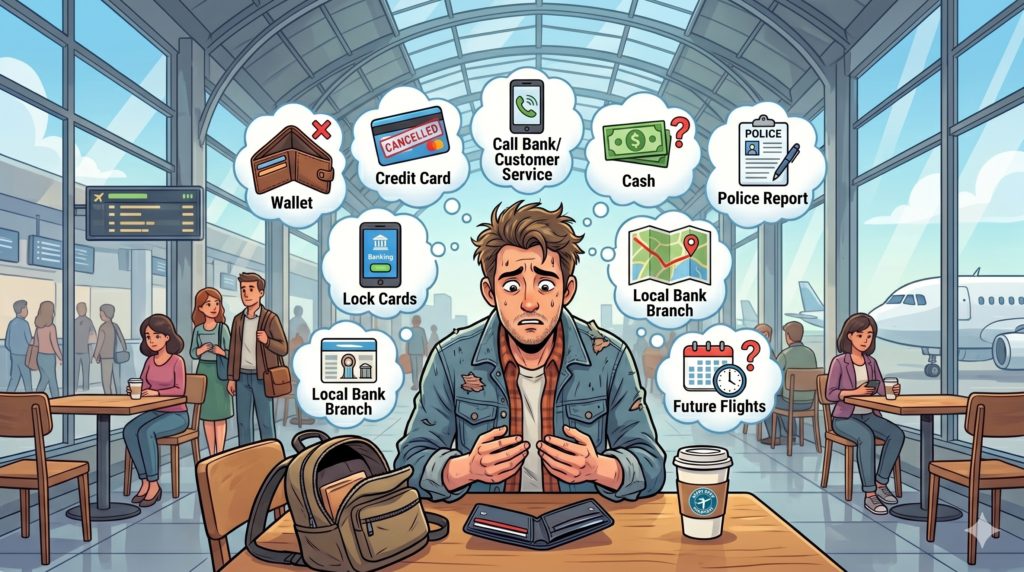
Your card is missing. You’re three time zones from your bank’s call center, your phone signal is patchy, and every minute that passes is a minute someone could be draining your account at a card-present terminal in another city. The good news: you no longer need to find a phone, navigate a hold queue, or remember a PIN. Modern banking apps freeze cards in roughly the time it takes to open them, and most issuers reverse fraudulent transactions before you even land back home.
This guide walks through the exact 60-second protocol for stopping a stolen card, the in-app freeze paths for the major issuers, the international collect-call numbers that work when an app won’t load, and the order in which to file fraud reports so you don’t get stuck holding the bill. We’ll also cover what to do when a card is “lost” but might just be misplaced, how to handle compromised debit cards differently from credit cards, and the reporting steps that protect your liability ceiling under federal law.
A frozen card is reversible. A drained checking account is not. The single most important variable here is speed.
Freeze first, then call. Open your card issuer’s mobile app and toggle the “lock” or “freeze” switch — this stops new transactions in seconds. Wise and Revolut freeze in roughly 10 seconds. Chase, Amex, and Capital One all have one-tap freeze inside the app. Once the card is locked, call the issuer using the number on your statement (not Google) to formally report fraud and trigger a chargeback for any unauthorized transactions.
Federal liability cap: Under the U.S. Fair Credit Billing Act, you’re liable for at most $50 on credit card fraud, and $0 if you report before charges post. Debit cards have a 60-day window before liability becomes unlimited.
The 60-Second Protocol
Run this sequence the moment you realize a card is missing or compromised. Steps 1–3 take under a minute on any modern banking app. Steps 4–6 happen later, often after you’re back at the hotel.
Lock the card in-app (10–15 seconds)
Open your bank’s app. Find the card. Toggle Lock Card, Freeze, or Stop Transactions. This is reversible — if you find the card, you can unlock it. Apple Pay and Google Pay tokens often keep working, which is why Step 2 matters.
Disable digital wallets and recurring charges
In most apps this is one screen deeper than the freeze toggle. Look for Manage digital wallets or Tokens. Suspend Apple Pay/Google Pay and revoke any merchant-stored card credentials.
Check transactions for the last 72 hours
Scroll your transaction list. Flag anything unfamiliar — even small amounts. Card thieves often run a $1 test charge to verify the card works before draining it. Screenshot anything suspicious; you’ll need this for the fraud report.
Call the issuer to report fraud
Use the international collect-call number on the back of your card or printed on your bank statement. Do not Google a customer service number — fraud spoofing of bank phone numbers is common. Tell them: card lost/stolen, freeze permanently, dispute these specific charges, ship a replacement.
File a police report (only if needed)
Most banks don’t require one for fraud disputes, but travel insurance often does. If your wallet was stolen — not just the card — get a report number from local police. In tourist-heavy cities, hotel concierges usually know which station handles English-speaking visitors.
Submit your fraud claim and chargeback
Within 60 days of the statement closing, submit a written dispute for any fraudulent charges. Most banks now do this through the app. Keep your case number and the agent’s name. Federal law gives the bank 30–90 days to investigate.
Why Speed Matters
In-App Freeze: Step-by-Step by Issuer
Every major issuer has consolidated freeze functionality into their main app over the last three years. Here’s exactly where to find it.
Wise (formerly TransferWise)
Open the Wise app → tap your card → tap Freeze card. Done. The freeze is instant and reversible. Wise also lets you generate a one-time virtual card for new transactions while the physical card is locked.
Get Wise →Revolut
Open the Revolut app → tap the Cards tile → select your card → tap the freeze toggle. Revolut also auto-detects unusual locations and offers to freeze proactively.
Get Revolut →Chase
Chase Mobile app → tap the card → Lock & limit → Lock card. Toggles transactions off without canceling the card. Recurring auto-pays continue unless you specifically disable them.
Chase customer service →American Express
Amex app → tap the card → Account services → Manage card → Freeze card. Amex also lets you replace a card with same-day delivery in major U.S. cities.
Amex customer service →Capital One
Capital One Mobile → tap the card → Lock card toggle at top of screen. Reversible in the same place. Capital One’s fraud detection auto-freezes when it sees suspicious patterns.
Capital One customer service →Bank of America
BofA Mobile Banking → Manage card settings → Lock or unlock debit card. Credit card freeze is in a separate menu under Card on/off.
BofA customer service →Card freezes do not stop pre-authorized recurring transactions in most cases. Subscriptions, rental car holds, and gym memberships will continue to bill the locked card. To stop those, you have to cancel each one with the merchant or contact your bank to add a stop-payment order.
International Collect-Call Numbers
When you’re abroad and the app won’t load, every major U.S. card issuer maintains a 24/7 international collect-call number. Save these in your phone before you leave home.
| Issuer | International Collect Number |
|---|---|
| Visa Global Customer Assistance | +1-303-967-1096 |
| Mastercard Global Service | +1-636-722-7111 |
| American Express | +1-336-393-1111 |
| Discover | +1-801-902-3100 |
| Chase | +1-302-594-8200 |
| Capital One | +1-804-934-2001 |
| Bank of America (debit) | +1-315-724-4022 |
| Citi | +1-210-677-0065 |
If you can’t reach a phone, most U.S. embassies will let you use theirs to make a fraud report call. The U.S. State Department also operates the Overseas Citizens Services line at +1-202-501-4444 if you’re stuck without any way to contact your bank.
Debit Cards Are Different — and Worse
A stolen credit card is a billing dispute. A stolen debit card is your actual money missing from your actual checking account, and the protections under federal law are dramatically weaker.
Federal liability windows
- Credit cards (Fair Credit Billing Act): $50 maximum liability, almost always waived to $0 by the issuer.
- Debit cards (Electronic Fund Transfer Act): $50 if reported within 2 business days, up to $500 if reported within 60 days, unlimited after 60 days.
This is why most travel finance writers — and most banks’ own security teams — recommend using credit cards for everyday travel spending and reserving debit cards for ATM withdrawals. The two-day reporting window on debit fraud is unforgiving.
If your debit card is compromised, lock it instantly and call the bank within hours. Don’t wait until you’re home. For ATM-heavy travel, consider a fee-free travel checking account like Charles Schwab High Yield Investor Checking — they refund all foreign ATM fees and have strong fraud protection workflows.
Travel-Specific Scenarios
Card skimmed at an ATM or gas pump
Skimmer fraud is the most common card compromise scenario abroad. The card is still in your wallet but the data has been cloned. You’ll see charges from cities you’ve never visited. Lock the card immediately, dispute every charge that wasn’t yours, and request a new card with a different number.
Card detained by an ATM
If a foreign ATM eats your card, treat it as compromised even if the bank says they have it. Lock the card. There have been documented cases of cards “swallowed” by ATMs being skimmed and re-cloned before return. It’s safer to cancel and replace than to recover.
Pickpocketed wallet
Lock every card in the wallet, not just the obvious one. Then disable digital wallets — thieves often try Apple Pay tokens before the physical card. If your driver’s license or passport was also taken, report those separately (see our guide to replacing a lost passport abroad).
Suspicious charge while card is in your possession
This is usually data breach fraud — the card was never physically taken; the number was stolen from a merchant. Lock the card, dispute the charge, request a new card. The bank will issue you a fresh number while keeping your account open.
Travel Insurance and Identity Monitoring
Most comprehensive travel insurance policies include identity theft assistance and fraud resolution as covered benefits — useful when the financial damage extends beyond a single card. InsureMyTrip and World Nomads both offer policies with this coverage built in.
For longer trips or for travelers who’ve already been compromised once, ongoing identity monitoring catches downstream issues — new accounts opened in your name, dark web data appearances, credit pulls you didn’t authorize. Read our full identity theft recovery guide for the complete recovery workflow.
A VPN like NordVPN won’t stop physical card theft, but it will stop card data interception over the hotel and airport Wi-Fi networks where session hijacking still routinely happens.
FAQ: Frozen Cards and Fraud Recovery
If I freeze my card, can I unfreeze it later?
Yes. App-based freezes are reversible — you can lock and unlock as many times as needed. This is different from reporting the card “lost or stolen,” which permanently cancels the number and ships a replacement.
Will freezing a card affect my credit score?
No. A card freeze is invisible to credit bureaus. Closing a card or reporting it lost may eventually trigger a new account number, but neither affects your score.
How fast will I get a replacement card abroad?
Most major U.S. issuers offer emergency international card replacement within 24–72 hours. Visa and Mastercard both run global emergency card services that ship a temporary card to the nearest hotel or embassy. Amex Platinum and most premium travel cards include free expedited international replacement as a benefit.
What if the bank denies my fraud claim?
Escalate. File a complaint with the Consumer Financial Protection Bureau (CFPB) — banks usually reverse denials within 30 days of a CFPB complaint. You can also file with your state attorney general’s office or your state banking commissioner.
Do I need a police report for a fraud dispute?
For most U.S. card issuers, no. The fraud dispute process is internal. You’ll need a police report if (a) your travel insurance is reimbursing you for theft, (b) the bank specifically requests one, or (c) the fraud involves identity theft beyond a single card.
Can I freeze a card I’ve added to Apple Pay or Google Pay?
Yes, but freezing the physical card may not stop the digital token. Most banks now sync wallet tokens with the card freeze — but to be safe, also remove the card from Apple Wallet (Settings → Wallet & Apple Pay → tap card → Remove This Card) or Google Pay.
What’s the difference between “lost,” “stolen,” and “compromised”?
Lost: You can’t find it but no fraud has occurred. A freeze is enough; you can unfreeze if you find it. Stolen: You know it was taken. Cancel and replace. Compromised: Card is in your possession but the number was used fraudulently. Cancel and replace; the data is in circulation.
Should I file an FTC report for stolen cards?
Only if the theft involves your personal information beyond just a card — a stolen ID, social security number, or signs that someone is opening accounts in your name. For pure card fraud, the bank’s dispute process is the right channel. IdentityTheft.gov is for full identity compromise.
Verified Resources & Authorities