
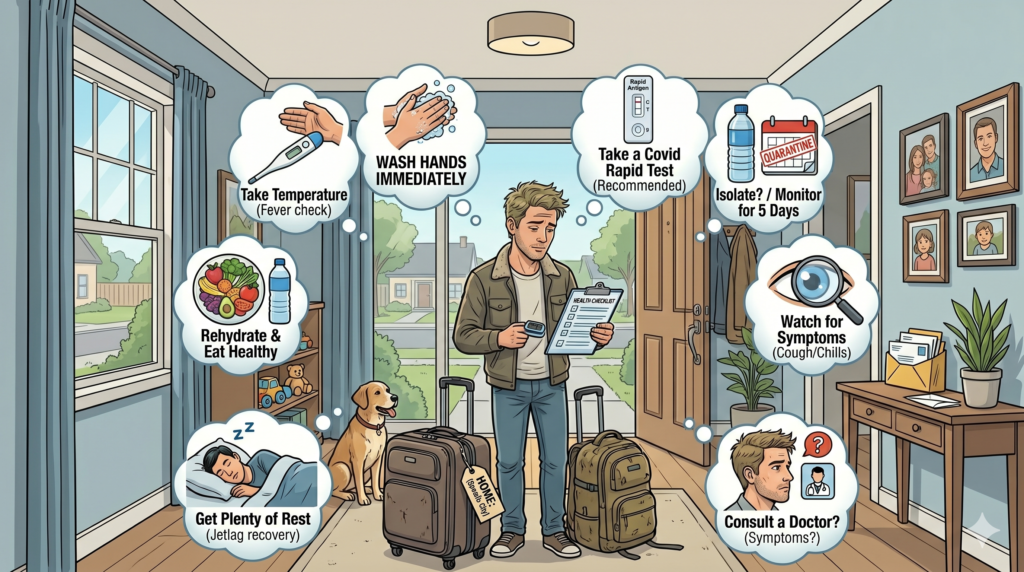
You came home from a great trip. A week later you’ve got a low fever that won’t quite break, your stomach still hasn’t settled, and you keep waking up exhausted at 3 a.m. for reasons that aren’t jet lag anymore. Most travel-related illness shows up after the trip ends, often days or weeks after the exposure that caused it. The CDC estimates that a meaningful share of international travelers experience some health problem during or after their trip — and many of those problems aren’t recognized as travel-related because the timing feels disconnected from the destination.
This guide is the post-trip triage map: which symptoms warrant a same-day ER visit, which need a travel medicine consult within a few days, which can be watched at home, and which destinations make specific symptoms more concerning. We’ll walk through the major travel-acquired infections by incubation period, the questions a travel medicine doctor will ask (so you arrive prepared), how to find a travel medicine specialist near you, and what to tell your regular GP if a specialist isn’t accessible.
Most post-trip symptoms turn out to be nothing serious. The minority that are serious benefit enormously from being caught early. The point of this guide is to help you tell which is which.
See a doctor right away if you have any of these post-trip: fever above 101°F (38.3°C), persistent diarrhea more than 3–5 days, blood in stool, jaundice (yellowing of skin/eyes), severe abdominal pain, an unexplained rash, or any neurological symptoms (confusion, severe headache, stiff neck). For tropical destinations especially, fever within 30 days of return is a malaria evaluation until proven otherwise.
Tell your doctor where you went. Always — even months after the trip. Many travel diseases have long incubation periods or relapse, and the destination context dramatically changes the differential diagnosis.
The Triage Map
Use these three tiers to decide how urgently to act. Anything in the top tier is a same-day call to a doctor or ER visit.
Severe symptoms — go to the emergency room
High fever (over 103°F / 39.4°C), severe abdominal pain, blood in stool or vomit, jaundice, severe shortness of breath, confusion or altered mental status, stiff neck with fever, severe headache with fever, signs of shock (rapid pulse, low blood pressure, fainting). Tell ER staff your travel history immediately.
Concerning symptoms — schedule an appointment within 1–3 days
Fever 100.4–103°F (38–39.4°C), persistent diarrhea over 3 days, persistent vomiting, unexplained rash, persistent fatigue beyond expected jet lag, unexplained weight loss, persistent cough over 2 weeks, joint or muscle pain that won’t resolve.
Mild symptoms — monitor and self-care
Mild traveler’s diarrhea resolving within 1–3 days, jet lag fatigue improving over a week, minor headaches, mild congestion. If anything escalates or doesn’t improve on the expected timeline, move up to the next tier.
Incubation Periods: When Symptoms Appear
Travel illnesses don’t always strike during the trip. Many appear days, weeks, or months after exposure. Knowing the incubation periods helps you and your doctor connect dots that might otherwise stay disconnected.
| Disease | Incubation Period | Common Regions |
|---|---|---|
| Traveler’s Diarrhea (E. coli) | 1–3 days | Worldwide, esp. Latin America, S/SE Asia, Africa |
| Dengue | 4–10 days | Tropical Asia, Latin America, Caribbean, Africa |
| Chikungunya | 3–7 days | Caribbean, S Asia, sub-Saharan Africa |
| Zika | 3–14 days | Latin America, Caribbean, parts of Asia/Africa |
| Malaria (P. falciparum) | 9–30 days | Sub-Saharan Africa, parts of Asia, Latin America |
| Typhoid | 6–30 days | South Asia esp., parts of Africa, Latin America |
| Hepatitis A | 15–50 days | Worldwide, esp. countries with limited sanitation |
| Hepatitis B | 30–180 days | Worldwide; higher prevalence in parts of Asia/Africa |
| Schistosomiasis | 2–8 weeks | Sub-Saharan Africa, parts of South America/Asia |
| Tuberculosis (active) | Weeks to years | Worldwide; higher prevalence in many low-income regions |
For more detailed incubation and symptom information, the CDC’s Yellow Book post-travel evaluation chapter is the authoritative reference clinicians use.
Symptoms That Warrant a Travel Medicine Consult
A travel medicine specialist is a physician with additional training in tropical and geographic medicine. They know what to look for that a standard primary care doctor might miss. The symptoms below particularly benefit from their expertise.
Fever after tropical travel
Any fever within 30 days of return from a malaria-endemic region needs evaluation. Malaria is treatable but can become life-threatening within 24–48 hours of symptom onset. Don’t wait.
Persistent diarrhea (over 7 days)
Standard traveler’s diarrhea resolves in 1–5 days. Anything longer — especially with weight loss, blood, or recurring fevers — may indicate parasitic infection (Giardia, Cryptosporidium, amoebic infections) and needs stool testing.
Unexplained rash
Some travel-acquired rashes (dengue, rickettsial diseases, schistosomiasis) have specific patterns. Photograph the rash with timestamps; the appearance changes over hours and days, which helps diagnosis.
Severe fatigue beyond jet lag
Jet lag improves day-over-day. Persistent debilitating fatigue beyond two weeks, especially with low-grade fever, joint pain, or weight loss, can indicate viral or parasitic infection.
Skin lesions or sores
Tropical skin issues — cutaneous larva migrans, leishmaniasis, myiasis, fungal infections — often need specialist diagnosis. If a lesion isn’t healing, isn’t normal for you, or appeared shortly after travel, get it evaluated.
Respiratory symptoms persisting over 2 weeks
Persistent cough, especially with night sweats, weight loss, or fever, can indicate tuberculosis or other less common infections. CDC recommends evaluation for any traveler with TB-suggestive symptoms after travel to high-prevalence areas.
Any fever within 30 days after travel to sub-Saharan Africa is treated as malaria until proven otherwise. P. falciparum malaria can progress from “feeling unwell” to severe disease within 24 hours. If you’ve been to a malaria-endemic region and develop fever, go to an ER and tell them your travel history. Don’t wait for a regular appointment.
The Post-Trip Health Checklist
Run this check 7–14 days after returning. Most post-trip illness is identifiable by then if it’s going to appear.
Self-check items
- Take your temperature — anything above 100.4°F (38°C) needs attention
- Check for unexplained rashes, especially on torso and limbs
- Note any GI symptoms — diarrhea, blood in stool, persistent abdominal pain
- Track sleep — sustained insomnia or unexplained 3 a.m. waking can indicate infection
- Check skin for unusual lesions, bites, or non-healing sores
- Note any unusual fatigue persisting beyond expected jet lag
- Watch for jaundice — yellowing of the eyes is the earliest sign of hepatitis
- Track weight — unintentional loss of more than a few pounds warrants evaluation
- Note any new joint or muscle pain
- Check for swollen lymph nodes (neck, armpit, groin)
What to Tell Your Doctor
Travel context dramatically changes what a doctor considers. Arrive at the appointment with this information ready.
- Every country you visited — including transit stops longer than a few hours
- Dates of travel — exact return date, since incubation period is calculated from there
- Activities — freshwater swimming, hiking, animal contact, food markets, sexual activity, blood exposure (medical procedures, dental work, tattoos)
- What you ate and drank — tap water, ice, raw vegetables, undercooked meat, unpasteurized dairy, street food
- Insect bites — when, where on the body, how many
- Vaccinations and prophylaxis — what you got pre-trip, did you take antimalarials as prescribed, did you complete the course
- Symptoms timeline — when did each symptom start, how has it progressed, what makes it better or worse
- Other travelers — anyone you traveled with experiencing similar symptoms
Finding a Travel Medicine Doctor
In the U.S.
The International Society of Travel Medicine (ISTM) clinic directory lists certified travel medicine specialists worldwide. Many academic medical centers have dedicated travel medicine clinics. The CDC also maintains a find-a-clinic tool for U.S. travelers.
Internationally
The International Association for Medical Assistance to Travellers (IAMAT) maintains a global directory of vetted English-speaking doctors. Free membership; the directory is the most reliable resource for finding qualified care abroad.
When you can’t find a specialist
Most large hospitals have an infectious disease (ID) department, and ID physicians are well-equipped to handle travel-acquired illness even without travel medicine certification. Ask for a referral. Your primary care doctor can also call the CDC’s clinician hotline for guidance on suspected travel-acquired illness.
Insurance and Post-Trip Coverage
Most travel insurance policies cover medical evaluation and treatment of conditions diagnosed during the trip — but the coverage often extends only a limited window after return. Check your policy carefully:
- Some policies cover post-trip diagnosis if symptoms began during the trip, even if diagnosed at home
- Some policies have a strict cutoff (e.g., 30 days post-trip)
- Some policies cover only emergency care abroad and stop entirely at return
If you bought insurance through InsureMyTrip or World Nomads, file the claim with the post-trip diagnosis as soon as the doctor confirms it’s travel-related. Save all receipts and the doctor’s note specifying the cause.
For travelers without travel-specific coverage, your domestic health insurance covers post-trip treatment the same way it would any other illness — but specialty travel medicine clinics may be out-of-network, so check coverage before booking.
Stats and Reality
FAQ: Post-Trip Health
How long does jet lag really last?
Roughly one day per time zone crossed for full recovery, with the first 2–3 days being the most disruptive. If you’re still completely exhausted two weeks after a 6-hour time difference, jet lag is no longer the explanation. Talk to a doctor.
I had mild diarrhea for a few days after coming home — should I worry?
Probably not. Most traveler’s diarrhea is self-limiting and resolves within 1–5 days, even after return. Stay hydrated, eat blandly, and watch for warning signs: fever, blood, severe pain, or duration over 5–7 days. Any of those means see a doctor.
Should I get tested for malaria as a precaution if I just had a fever?
If you’ve been to a malaria-endemic region in the last 30 days and develop a fever — yes, malaria testing should be part of the evaluation. Don’t request it as a “just-in-case.” Have the fever evaluated, mention the travel history, and let the clinician decide on testing.
How long before symptoms can no longer be travel-related?
Most travel infections show up within 30 days. Some — typhoid, hepatitis A, malaria — can appear up to 60 days after return. A few — hepatitis B, tuberculosis, leishmaniasis, schistosomiasis — can show up months to years later. Always mention recent international travel even if it doesn’t feel recent.
What if I don’t have insurance and can’t afford a specialist?
Your local public health department often offers travel-acquired illness evaluation at low or no cost. Many community health centers also handle post-travel cases. The CDC’s travelers’ health pages include resources for low-cost care.
I had unprotected sex on the trip. What do I need to test for?
A standard STI panel: HIV (with confirmation testing at 3 and 6 months), syphilis, gonorrhea, chlamydia, hepatitis B and C. Some travel-acquired exposures may also warrant testing for less common infections depending on region. This is a no-judgment medical conversation — be honest with your doctor; it changes what they look for.
Do I need to disclose travel for routine appointments?
Yes — for at least 6 months post-trip and longer for high-risk destinations. Many travel-acquired illnesses present with vague symptoms that look like ordinary illnesses. Telling your doctor “I was in Southeast Asia three months ago” can change the entire diagnostic approach.
What about long COVID or post-viral syndromes after travel?
Persistent fatigue, brain fog, and exercise intolerance after a travel-acquired viral infection (including COVID-19) are increasingly recognized. If symptoms persist beyond 4–8 weeks after a febrile illness on a trip, talk to a doctor about post-viral evaluation.