

A Traveler’s Guide to VPNs: Why One Size Doesn’t Fit All
Whether you’re sipping espresso in a Paris café, navigating airport Wi-Fi in Bangkok, or catching up on Netflix from your Tokyo hotel room, your digital safety and access shouldn’t be left to chance. Virtual Private Networks (VPNs) are now essential travel companions—but not all VPNs are created equal. Some excel at streaming, others prioritize privacy, and many fail under strict censorship or throttled networks abroad. This guide debunks the myth that one VPN fits all and helps you choose the perfect VPN tailored to your travel needs worldwide.
Quick Takeaways
- VPNs vary significantly in terms of performance, privacy, and access.
- Western VPNs may fail in Asia due to firewalls and DPI (Deep Packet Inspection).
- Features such as split tunneling, obfuscation, and no-logs audits are crucial for travelers.
- NordVPN, ExpressVPN, and Proton VPN lead in security, streaming, and privacy.
- VPNs are essential for securing public Wi-Fi, accessing content, and evading censorship.
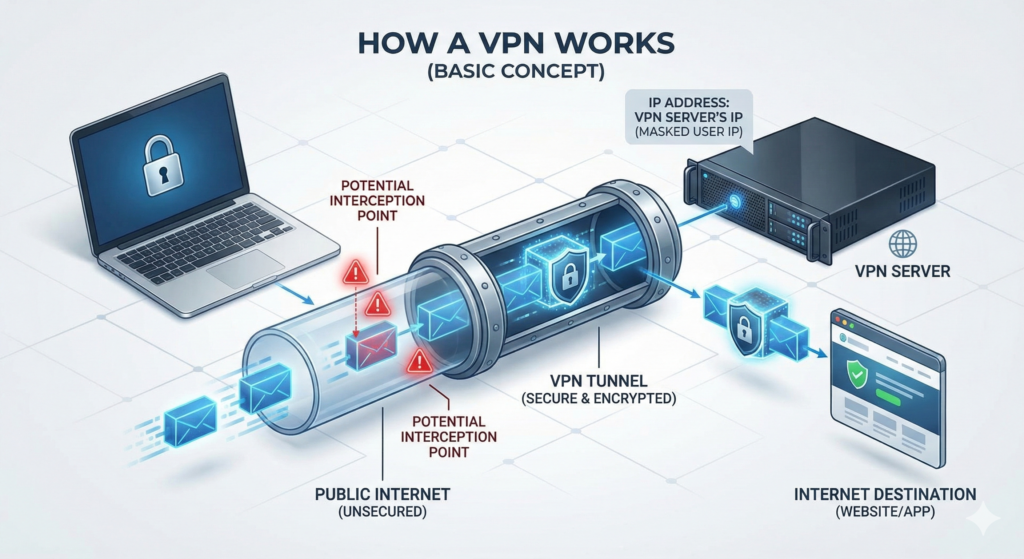
Choosing the Right VPN Based on Travel Destination
U.S. and Europe vs. Asia: A Tale of Two Firewalls
VPNs that perform well in the United States or Europe may be entirely ineffective in countries like China, Iran, or Russia, where firewalls are more aggressive and detection techniques such as DPI are actively employed. In such places, stealth protocols become non-negotiable.
Your VPN must hide in plain sight, or it won’t work at all in countries like China or Iran.” — Privacy International.
What Works Where
| Region | VPN Needs |
|---|---|
| China, UAE | Obfuscation protocols, stealth features, high-level encryption |
| Europe, USA | Streaming access, strong server network, no-logs policies |
| Russia, Iran | Stealth VPNs, Shadowsocks, V2Ray, jurisdiction outside 14-Eyes Alliance |
Regional VPN Match Examples
| Travel Destination | VPN Recommended | Why It’s Ideal |
|---|---|---|
| Vietnam | NordVPN | Obfuscation and server obfuscation are needed for VOIP/apps access |
| China | ExpressVPN, Proton VPN | Stealth protocols defeat censorship and DPI |
| UAE | ExpressVPN | Obfuscation and server obfuscation needed for VOIP/apps access |
| Russia | Proton VPN | Obfuscation and server obfuscation are needed for VOIP/apps access |
| India | Surfshark | Good for streaming + privacy, avoids India-based data collection laws |
| South Korea | NordVPN, CyberGhost | High-speed access for gaming and streaming |
| Turkey | Proton VPN | Jurisdictional safety, Secure Core, and stealth technology |
| United States | Surfshark, NordVPN | Unlimited connections, fast speeds, optimized streaming |
| United Kingdom | ExpressVPN, CyberGhost | Netflix, BBC iPlayer access, no-logs jurisdiction advantage |
| Iran | Proton VPN | Stealth access, strong encryption in high-risk zones |
A digital nomad visiting Vietnam may want NordVPN for streaming and privacy, but someone heading into China must prioritize obfuscation features like those found in ExpressVPN or ProtonVPN.
Top 6 VPNs for Global Travelers (based on user feedback)
Comparison Table
| VPN Name | Avg. Speed Loss | Obfuscation Tech | No-Logs Audited | Split Tunneling | Kill Switch | Best For |
|---|---|---|---|---|---|---|
| NordVPN | 3% | NordWhisper | Yes | Android | Yes | Streaming + Security |
| ExpressVPN | 18% | Lightway + Shuffle IP | Yes | Win/Android | Yes | Censorship Evasion + Speed |
| Proton VPN | 16% | Stealth + Tor Over VPN | Yes | Yes | Yes | Privacy Activists, Censored Countries |
| Surfshark | 21% | Rotating IP, Multihop | Yes | MacOS | Yes | Budget + Unlimited Devices |
| CyberGhost | Varies (15–42%) | Optimized Servers | Yes | Yes | Yes | Ease of Use + Beginners |
| Bitdefender VPN | ~20% | Auto-Connect + Anti-tracker | Partial | No | Yes | Security Suite Users + Beginners |
Countries with Internet Censorship or VPN Restrictions
Travelers should be aware of countries that restrict VPN usage, block access to foreign media, or monitor online activity. Below is a list of high-surveillance or restrictive regimes:
| Country | VPN Legal Status | Common Restrictions/Monitoring Tactics |
|---|---|---|
| China | Legal for approved providers only | Great Firewall, DPI, VPN blocks, content filtering |
| Russia | Restricted (only state-approved) | Website blacklists, ISP surveillance, VPN app bans |
| Iran | Illegal for personal use | Deep surveillance, VoIP bans, news/media blocks |
| UAE | Legal with limits | VOIP bans, fines for unauthorized VPN use |
| Turkey | Heavily monitored | Social media throttling, website bans, surveillance |
| India | Legal, but recent surveillance expansions | Mandatory logging laws, potential censorship |
| North Korea | Illegal | Total internet isolation, only intranet access |
| Egypt | Monitored and throttled | VPN service slowdowns, messaging app blocks |
| Pakistan | Restricted | Content filtering, VPN blocks |
Pro Tip: Always check VPN legality before arrival. Utilize stealth-capable VPNs, such as Proton VPN or ExpressVPN, in these environments.
Governments worldwide impose censorship or filter data using sophisticated mechanisms to control the flow of information, limit free expression, and monitor citizens’ online activity. These strategies can include keyword filtering, blocking news or social platforms, enforcing ISP-level surveillance, and using advanced Deep Packet Inspection (DPI) to detect and restrict VPN traffic. For travelers, this means that accessing even basic services, such as WhatsApp, Gmail, or news outlets, can become difficult or risky, especially in regions with authoritarian controls or heavy digital surveillance. Here’s how VPNs help bypass them:
| Censorship Type | VPN Countermeasure |
|---|---|
| Website or app bans | IP masking, Split tunneling |
| DPI (Deep Packet Inspection) | Stealth protocols, Shadowsocks, V2Ray |
| Social media restrictions | Obfuscated servers, Domain fronting |
| Government surveillance | Tor Over VPN, Secure Core, RAM-only servers |
Real-World Scenarios: How Travelers Use VPNs on the Road
Whether you’re working remotely, watching geo-blocked shows, or simply trying to check your bank account securely, VPNs solve problems most travelers don’t anticipate until it’s too late. Below is a curated table of real-world travel scenarios where the right VPN features make the difference between getting blocked and staying connected.
Imagine arriving at an airport café in Istanbul and connecting to the free Wi-Fi, only to realize it’s a fake “evil twin” network set up by hackers. Or staying in a hotel in Dubai, where WhatsApp calls and FaceTime are completely disabled. Maybe you’re in Tokyo and want to stream Hulu, only to hit a geo-restriction wall. These are not rare edge cases—they’re everyday problems travelers face globally.
To help you navigate them, this table matches common travel issues with the specific VPN features designed to overcome them.
| Scenario | Problem | VPN Feature to Use |
|---|---|---|
| Airport Wi-Fi in Istanbul | Evil twin networks can trick users into connecting to rogue hotspots | Kill Switch + Always-On VPN for automatic protection |
| Netflix Japan from Mexico | Checking a U.S. bank abroad | Tokyo VPN server with low latency and unblocked IPs |
| Google Workspace, Zoom, and Slack may be throttled or blocked | Bank systems detect foreign logins, flag suspicious activity | Split tunneling for banking apps + consistent IP use |
| Traveling to China | VPNs blocked via DPI, state monitoring of encrypted connections | Obfuscation/Stealth VPN (ExpressVPN, Proton VPN) |
| Remote work in restrictive regions | The government blocks independent journalism and news sources | WireGuard protocol for speed + VPN with global nodes |
| VoIP calls in the UAE or Egypt | WhatsApp, FaceTime, Zoom calls blocked or degraded | VPN with stealth features + local server masking |
| Accessing censored news in Russia | U.S. streaming platforms are restricted abroad | Tor over VPN or Secure Core + RAM-only servers |
| Streaming Hulu while in Europe | U.S. streaming platforms restricted abroad | U.S.-based servers + Smart DNS or dedicated IP VPN |
Stay Connected Anywhere: Grab an eSIM + Travel Router Combo
Don’t just rely on public Wi-Fi. Whether you’re catching a red-eye to Tokyo, working remotely from a beach café in Lisbon, or navigating layovers in Istanbul, you need a secure, fast, and reliable internet connection wherever you are.
Instant Access Matters — Especially When You Land
Imagine stepping off a 13-hour flight, only to find:
- The airport Wi-Fi isn’t working or requires a local phone number to access.
- Your physical SIM hasn’t activated yet, or doesn’t work with your unlocked phone.
- You can’t message your Airbnb host, rideshare driver, or travel buddy.
With an eSIM pre-installed and a portable router in your bag, you avoid these headaches. You’ll have instant data on arrival—no hunting for SIM cards or begging for Wi-Fi passwords—and can immediately open WhatsApp, LINE, Google Maps, or your rideshare app the moment the plane lands.
Why You Need an eSIM and Portable Router:
| Tool | Benefit | Families, teams, and privacy-conscious travelers |
|---|---|---|
| eSIM (Airalo, Nomad, or Holafly) | Activate data instantly in any country | Remote workers, frequent flyers |
| Portable Travel Router (like GL.iNet) | Creates a secure private network, even from hotel or café Wi-Fi | Families, teams, privacy-conscious travelers |
Use Case Examples:
- Message your driver or tour guide on WhatsApp or LINE as soon as you land.
- Share one eSIM across your phone, laptop, and tablet via your own Wi-Fi hotspot.
- Stream Netflix securely on hotel Wi-Fi without exposing your data.
- Work remotely from anywhere without relying on slow or untrusted public networks.
Recommended Devices:
Airalo eSIM + RoamWiFi 5G Hotspot
- Airalo eSIM – instant mobile data in 200+ countries for your phone
- RoamWiFi 5G Hotspot – private WiFi for laptops, tablets, and multiple devices
- Works anywhere: airports, hotels, trains, and layovers
- Safer and more reliable than public airport WiFi
Simple strategy:
Airalo powers your phone. RoamWiFi powers everything else.
Get connected before you land
- Airalo eSIM – Check data plans
- RoamWiFi 5G Hotspot – View device
Staying Connected While Traveling
A VPN protects your data, but you still need internet access first. Learn how travelers stay connected worldwide using eSIMs, mobile hotspots, and airport WiFi.
Read the Global Connectivity Guide →
VPN Feature Comparison Table (✔/✘)
With so many VPN providers claiming top-tier protection and performance, it can be hard to separate marketing hype from real-world capability. This quick comparison table breaks down the core features travelers need—like obfuscation, kill switch reliability, split tunneling, and no-logs audits—so you can see which VPNs are truly up to the task in 2025.
Whether you’re heading into high-censorship zones, using public Wi-Fi, or streaming across borders, this table shows at a glance which VPNs offer the tools to keep you secure, connected, and unrestricted.
| Feature | NordVPN | ExpressVPN | ProtonVPN | Surfshark | CyberGhost | Bitdefender |
|---|---|---|---|---|---|---|
| Obfuscation | ✔ | ✔ | ✔ | ✘ | ✘ | ✘ |
| No-Logs Audited | ✔ | ✔ | ✔ | ✔ (Planned) | ✔ | Partial |
| Split Tunneling | Android | Win/Android | ✔ | MacOS | ✔ | ✘ |
| RAM-only Servers | ✔ | ✔ | ✔ | ✔ | ✔ | ✘ |
| Kill Switch | ✔ | ✔ | ✔ | ✔ | ✔ | ✔ |
| Works in China | Moderate | Strong | Strong | Weak | Weak | ✘ |
VPNs for Unrestricted Browsing in Public Networks
Many coffee shops, airports, schools, public libraries, and co-working spaces use content filtering to block certain websites, especially those deemed “PG” or inappropriate for general audiences. These restrictions are typically enforced at the router or ISP level, often through DNS filtering or blacklists.
For example, while working at a café recently, access to some non-PG content was blocked. Once a VPN was turned on, the restriction was immediately bypassed. This is because the VPN encrypts your traffic and reroutes your DNS requests through its servers, altogether avoiding the local network’s content filter.
A similar case occurred at a public library. One VPN provider failed to bypass the library’s strict content filter, likely due to weak obfuscation or network detection. However, switching to a different VPN—one with stronger stealth technology and DNS leak protection—resolved the issue instantly. This highlights that not all VPNs are created equal when it comes to navigating localized censorship or DNS blocks.
VPNs Known to Bypass Public Network Filters Effectively:
These providers are widely recognized for their ability to avoid detection, maintain stable encrypted tunnels, and bypass restrictive firewalls on public Wi-Fi networks.
Common Content Blocks Travelers Face:
| Location Type | Common Restrictions | How VPN Helps |
|---|---|---|
| Coffee Shops & Cafes | Adult content, political sites | Bypass router-level blocks with DNS encryption |
| Schools & Campuses | Torrent sites, crypto, and finance news | Access blocked services via IP masking |
| Public Libraries | Sensitive content, social platforms | Use stealth-enabled VPNs to bypass filters |
| Co-Working Spaces | Torrent sites, crypto, finance news | Regain access while protecting your identity |
| Airports & Lounges | High bandwidth or sensitive sites | Circumvent throttling and blocklists |
Note: While VPNs can technically bypass local restrictions, always respect the laws and network usage policies of the country or venue you’re in.
Bonus: Best VPN for Accessing the Dark Web Safely (Anywhere)
While not everyone needs to venture into the dark web, some travelers, journalists, activists, or cybersecurity professionals may use it to access censored whistleblower sites, forums, or open-source intel not available on the surface web. If you’re going to explore it, do it right—or don’t do it at all.
Best VPN for the Dark Web: Proton VPN
Why Proton VPN leads:
- Tor Over VPN: Proton offers native Tor integration, letting you route traffic through the Tor network without launching the Tor browser separately. One click and you’re inside
.oniondomains. - Stealth Protocols: In heavily surveilled countries (e.g., Russia, Iran), Proton’s stealth mode masks VPN and Tor traffic from detection.
- Audited No-Logs Policy: Proven in court and verified by independent audits—your activity doesn’t exist on their servers.
- Switzerland Jurisdiction: Outside of the 5/9/14 Eyes alliances, with some of the world’s strongest privacy laws.
“If you’re using Tor in a restricted country or over public Wi-Fi, using Proton VPN’s ‘Tor Over VPN’ mode is like slipping through a digital backdoor unnoticed.”
Security Tips for the Dark Web:
- Use a dedicated device or virtual machine.
- Never log in to personal accounts.
- Cover your webcam and disable your mic.
- Don’t download random files or click unknown links.
- Always keep kill switch and DNS leak protection on.
Final Verdict
After extensive review and real-world scenario testing, our top recommendation for 2026 is NordVPN. It offers the best balance of speed, global server availability, advanced security, and reliability for streaming, censorship evasion, and everyday browsing while traveling. If you’re traveling to a highly censored region like China or Iran, ExpressVPN or ProtonVPN may be better suited because of their stealth technologies.
Here’s a quick breakdown:
- Best Overall for Most Travelers: NordVPN
- Best for Censorship Resistance: ExpressVPN or Proton VPN
- Best Budget Option with Unlimited Devices: Surfshark
- Best for Ease of Use & Beginners: CyberGhost or Bitdefender VPN
Whether you’re a digital nomad, remote worker, or occasional vacationer, a strategic VPN choice enhances your safety, freedom, and online experience. Choose based on your travel region, streaming needs, and personal security concerns.
Conclusion: Choose the Right VPN for Your Journey
The ideal VPN for travel isn’t about finding the most popular brand; it’s about aligning features with your exact needs. Travelers entering censorship-heavy environments, such as China or the UAE, require stealth, obfuscation, and RAM-only servers. Streaming lovers should prioritize speed, low latency, and server infrastructure.
For privacy-focused users such as journalists or activists, open-source protocols and jurisdictional protections are non-negotiable. Business travelers and digital nomads should look for robust mobile apps, reliable connections, and split tunneling capabilities to manage critical accounts.
No matter your destination or device, a well-chosen VPN is your passport to digital freedom, privacy, and unrestricted access abroad.
Frequently Asked Questions
What is the best VPN for international travel in 2026?
NordVPN is the top overall pick for international travel due to its fast global servers, security, and streaming access.
For censorship-heavy countries like China, Iran, or Russia, choose ExpressVPN or Proton VPN for advanced stealth and obfuscation features.
Can I use one VPN for both safe countries and restricted regions?
Yes, but only if your VPN includes obfuscation technology.
ExpressVPN and Proton VPN work in both free and censored countries thanks to features like stealth mode and Tor over VPN.
Is it legal to use a VPN in every country?
Not everywhere. VPNs are illegal or restricted in countries like China, Iran, North Korea, Russia, and parts of the UAE. Always check local laws before using a VPN abroad
What’s the best VPN for watching U.S. Netflix while traveling abroad?
NordVPN and Surfshark are top choices, offering U.S.-based servers that bypass geo-blocks for Netflix, Hulu, and more – even in Europe or Asia.
Are VPNs safe to use on hotel and airport Wi-Fi?
Yes. A VPN encrypts all your internet traffic, shielding you from rogue networks, snooping ISPs, and public Wi-Fi attacks.
Use a kill switch and auto-connect features, both available in ExpressVPN and NordVPN, for maximum protection.
Why do some banks block VPNs during international travel?
Banks detect foreign IP addresses or server switching as fraud.
Use split tunneling to let your banking apps connect directly, while keeping the rest of your internet traffic protected through the VPN.
Are free VPNs safe for international travel?
Proton VPN offers a free plan that doesn’t log or throttle, making it a rare exception.
Most free VPNs sell your data, show ads, or fail in high-risk regions. For serious travelers, premium VPNs are recommended
What VPN protocol is best for speed when traveling?
Use WireGuard for blazing-fast speeds on the go. It’s available in NordVPN (NordLynx), Surfshark, and Proton VPN, making it ideal for streaming and remote work abroad.
Can I use a VPN to access WhatsApp, LINE, or Google in blocked countries
Yes. Many countries block communication apps—VPNs with stealth protocols (like ExpressVPN) can restore access to WhatsApp, LINE, Telegram, and even Gmail.
Which VPN works best in airports and coffee shops?
NordVPN and ExpressVPN offer DNS leak protection, kill switches, and auto-connect features—ideal for use on unstable or filtered public networks during travel.
Resources and References
- CNET VPN Reviews 2025
- PCMag Editors’ Choice VPNs
- Proton VPN Transparency Report
- NordVPN Privacy Policy
- ExpressVPN Audit Reports
- Freedom House: Internet Freedom by Country
Affiliate Disclosure:
Some of the links on this page are affiliate links. This means that if you click and purchase a product or service, we may earn a small commission, at no additional cost to you. We only recommend tools and services we trust and use ourselves to help travelers stay secure, connected, and informed on the road.