
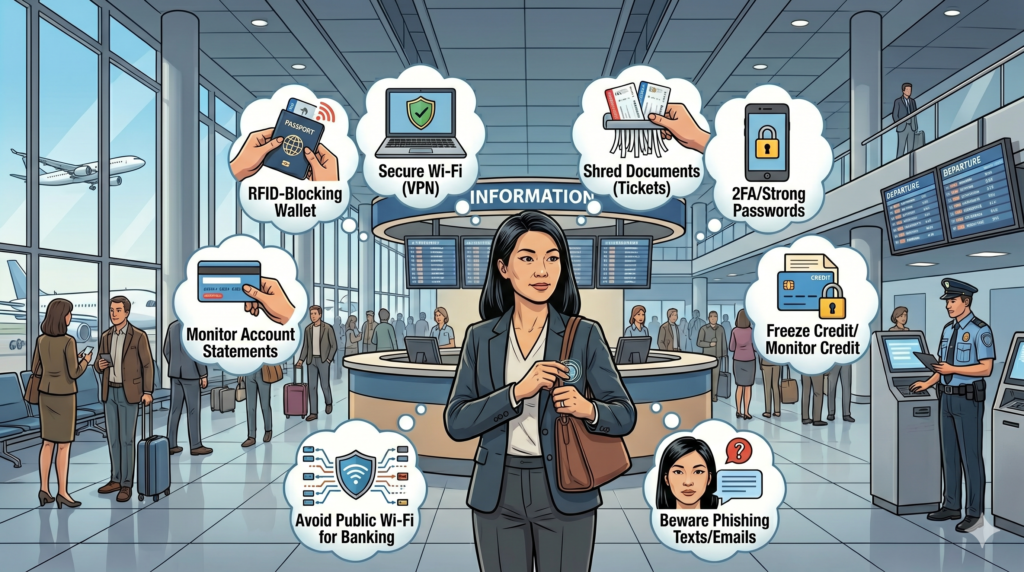
Identity theft after travel doesn’t always look like the dramatic version on TV. There’s no hooded figure at a keyboard. The first sign is usually small — a credit card statement with a charge from a state you’ve never visited, an email about an account you didn’t open, a denial of credit when you applied for something routine. By the time most travelers notice, the damage has been propagating quietly for weeks. The good news is that U.S. federal law gives victims an unusually robust toolkit to recover, and the FTC’s IdentityTheft.gov platform consolidates most of the recovery into a single workflow.
This guide is specifically for travelers — people who carry their full identity documentation across borders, use ATMs in countries with different fraud landscapes, log into banking apps over hotel networks, and frequently can’t tell the difference between “expected international charges” and “fraudulent international charges” on a single statement. The recovery framework is the same as for domestic identity theft, but a few details matter more for travelers: how to detect it earlier, how to differentiate document theft from full identity compromise, and how to lock down accounts when you’re still abroad.
Speed matters. The earlier you catch identity theft, the easier the recovery. The longer it runs unchecked, the more accounts get opened in your name, the more your credit gets shredded, and the more federal and state agencies you’ll have to interact with to clean up.
If your identity is stolen, run this sequence: (1) freeze your credit at all three bureaus — Equifax, Experian, TransUnion — instantly online and free. (2) Place a fraud alert. (3) File at IdentityTheft.gov for a federal recovery plan. (4) File a police report. (5) Notify each affected institution with the FTC report number. (6) Pull your free credit reports and dispute any unauthorized accounts.
Document theft is different from identity theft. A stolen passport or driver’s license is document theft — replace the document and notify the issuer. Identity theft means someone is using your information to open credit, file taxes, or impersonate you. The recovery paths overlap but aren’t identical.
Document Theft vs Identity Theft
Travelers often confuse these two categories, which leads to under-responding to one and over-responding to the other. The difference matters for what you do next.
Document theft
Your passport, driver’s license, or ID card was lost or stolen, but no fraudulent activity has appeared. Risk is forward-looking. Action: replace the document, notify the issuer, monitor your credit for 90 days. The thief may or may not use the document for fraud.
Passport guide →Identity theft
Someone is actively using your personal information — opening credit, filing tax returns, getting employment, taking out loans, accessing accounts. Action: full lockdown — credit freeze, FTC report, police report, account-by-account remediation.
FTC recovery portal →The Immediate Lockdown — First 24 Hours
If you’ve confirmed identity theft (an account opened in your name, fraudulent charges across multiple cards, an unfamiliar tax filing, a credit denial because of accounts you don’t recognize), this is the first 24 hours. Run these steps in order.
Freeze your credit at all three bureaus
Free, online, instant. Equifax (equifax.com), Experian (experian.com), TransUnion (transunion.com). A freeze blocks new credit applications in your name. Existing accounts are unaffected. Unfreeze temporarily when you legitimately need to apply for credit.
Place a fraud alert
One call (or web form) to any of the three bureaus auto-shares the alert with the others. Lasts one year and renewable. Forces lenders to verify identity through additional means. Free.
Lock cards and notify banks
Use the in-app freeze toggle on every credit and debit card. Call your bank’s fraud line for each account. Document each call with a case number. See our card freeze guide for the per-issuer process.
File at IdentityTheft.gov
The FTC’s portal generates a personalized recovery plan and an Identity Theft Report. The Report has legal weight — banks and credit bureaus are required to honor it. Print or save the PDF.
File a police report
Required for some recovery actions (especially for tax or government benefit fraud). Bring the FTC report and any documentation of fraudulent accounts. Get a case number.
Pull all three credit reports
Free at AnnualCreditReport.com. Identify every account you didn’t open. Each gets disputed individually with the bureau and with the lender — both are required.
The Three-Bureau System Explained
U.S. credit reporting runs on three private companies. Each maintains an independent file. Identity thieves often hit all three. Recovery requires interacting with each separately, even though most of the time the actions can be parallelized.
| Bureau | Phone | Online Freeze |
|---|---|---|
| Equifax | 1-800-685-1111 | equifax.com/personal/credit-report-services/ |
| Experian | 1-888-397-3742 | experian.com/freeze/ |
| TransUnion | 1-888-909-8872 | transunion.com/credit-freeze |
| Innovis (4th bureau) | 1-800-540-2505 | innovis.com/personal/security-freeze |
| NCTUE (telecom/utilities) | 1-866-349-5355 | nctue.com/Consumers |
The fourth bureau (Innovis) and the National Consumer Telecom & Utilities Exchange (NCTUE) are less famous but used by some lenders and utilities — freezing those too closes the remaining gaps.
Document-Specific Replacement
If specific documents were stolen, each one has its own replacement path. Start with the most-used document and work down.
Driver’s license
Replace at your state DMV. Most states allow online replacement. Bring secondary ID, proof of address, and the police report if available. Replacement fee typically $20–$40. Some states automatically mark a replacement license to indicate the original was reported lost or stolen.
Social Security card
Replace through the Social Security Administration at ssa.gov. Free. SSN replacement does NOT change your SSN — that’s a separate, much harder process reserved for severe ongoing fraud cases. Most identity theft victims don’t change their SSN; they freeze credit and monitor instead.
Passport
If abroad, see our embassy replacement guide. If domestic, file at your local passport agency. Report it stolen at travel.state.gov immediately to invalidate the document globally.
Medicare/health insurance card
Call Medicare at 1-800-MEDICARE for replacement. Medical identity theft is a fast-growing category — fraudsters use stolen Medicare numbers to bill for services or drugs. Review your Medicare Summary Notices for charges you don’t recognize.
Account-by-Account Cleanup
Once the bureaus are frozen, the next phase is cleaning up the specific accounts. For every fraudulent account or charge, three things have to happen.
Notify the institution
Contact the bank, card issuer, lender, or service provider. Provide the FTC Identity Theft Report number and ask them to close the fraudulent account and remove it from your record. Get a case number from them.
Dispute with the credit bureaus
For each fraudulent account on your credit report, file a dispute with whichever bureau is reporting it. The Identity Theft Report you generated at IdentityTheft.gov forces the bureaus to remove these items within 4 business days under federal law.
Request a written confirmation
Always ask for the closure or removal in writing. If a fraudulent debt later resurfaces (common with sold debt portfolios), the written confirmation is your defense.
If someone files a fraudulent tax return in your name, the IRS won’t notify you — your e-filed return will simply be rejected as a duplicate. Recovery requires filing IRS Form 14039 (Identity Theft Affidavit) and getting an IRS Identity Protection PIN. The IRS process can take 12+ months. If you suspect tax identity theft, file Form 14039 immediately and don’t wait until tax season.
Identity Monitoring Services
After a confirmed compromise, ongoing monitoring catches downstream issues — accounts opened months later, dark web data appearances, credit pulls you didn’t authorize. Services vary in coverage and price.
LifeLock (Norton)
Bundled credit monitoring, identity theft insurance, dark web monitoring, lost wallet protection. The category leader by marketing presence; varies by tier from ~$10 to $35/month.
LifeLock →Aura
All-in-one with identity monitoring, antivirus, password manager, and VPN. Strong family plan options. Tends toward the higher end on price but bundles services that travelers often pay for separately.
Aura →IdentityForce
Long-running service with strong real-time alerts and identity restoration support. Lower-tier plans cover the basics; higher tiers add three-bureau monitoring and credit score tracking.
IdentityForce →Experian Credit Monitoring
Free tier offers Experian-only monitoring. Paid tiers add three-bureau coverage. Useful if you primarily want credit-focused alerts rather than full identity coverage.
Experian →For travelers who want a single layered approach, comprehensive travel insurance like InsureMyTrip or World Nomads often includes identity theft assistance benefits — useful for the immediate post-trip recovery period when you’re not yet sure if compromise occurred.
Prevention for Future Trips
Identity theft prevention is more effective than identity theft recovery. A few habits reduce your exposure dramatically.
Don’t carry unnecessary documents
Travel with the minimum identification needed. Leave Social Security cards, secondary credit cards, and unused IDs at home. If your wallet is stolen, what’s in the wallet is the attack surface.
Use a VPN on every public network
Hotel and airport Wi-Fi networks are routine targets for credential theft. NordVPN on every device, every time. The few seconds of friction prevent the categories of compromise that lead to identity theft.
Two-factor authentication on every important account
Email, banking, social, anywhere with stored payment data. Use authenticator apps (Authy, Google Authenticator) rather than SMS — SIM-swap attacks targeting travelers can compromise SMS-based 2FA.
Add Bitdefender or similar on devices
Mobile-aware antivirus like Bitdefender catches credential-stealing malware before it sends your data to a remote attacker.
Set up a family safe word
For verifying any urgent calls. Voice clone scams pair frequently with identity theft. See our safe word setup guide.
Stats: The Identity Theft Landscape
FAQ: Identity Theft Recovery
How long does full identity theft recovery take?
Highly variable. Simple cases (one or two fraudulent accounts) resolve in 30–60 days. Complex cases — multiple accounts, tax fraud, medical fraud — can take 12+ months. The FTC reports an average of about 6 months to fully resolve. The earlier you catch it, the shorter the recovery.
Will identity theft hurt my credit score forever?
No. Once fraudulent accounts are removed, the negative impact disappears. Your score typically returns to baseline within 3–6 months after cleanup. Some victims see scores rebound faster because they’re now actively monitoring credit.
Should I change my Social Security number?
Almost never. The SSA only changes SSNs in cases of severe ongoing fraud where freezes and monitoring have failed. A new SSN doesn’t erase your credit history — it follows you — and creates new problems with employment records, tax filings, and benefits. Try every other tool first.
Is a credit freeze the same as a fraud alert?
No. A freeze blocks new credit applications entirely until you lift it. A fraud alert tells lenders to verify your identity before opening new credit but doesn’t block applications. A freeze is stronger; a fraud alert is easier and reaches all bureaus from one request. Use both.
What if the fraud happened years ago and I’m only now finding it?
You can still file the FTC Identity Theft Report and dispute the accounts. There’s no statute of limitations on disputing fraudulent items on your credit report — though older accounts may already have aged off. Pull all three credit reports first to see what’s still being reported.
Will my insurance cover identity theft losses?
Some homeowners and renters policies include identity theft coverage. Many credit cards offer it as a benefit. Travel insurance often covers it for trip-related theft. Check existing policies before paying for standalone coverage — you may already have it.
Is dark web monitoring worth paying for?
It’s useful as part of a bundled service but rarely worth paying for alone. The free Have I Been Pwned service covers most of the same ground. The value of dark web monitoring is the alert speed, not the existence of the data — by the time data appears on the dark web, it’s been compromised long enough to act on.
Can I sue the company that leaked my data?
Sometimes — usually as part of a class action. Most major data breaches result in class action settlements that pay each victim modest amounts ($50–$500). Watch your email for breach notifications; they include claim instructions. Individual lawsuits are rarely cost-effective unless damages are very high.
Verified Resources & Authorities
- FTC IdentityTheft.gov — Federal Recovery Portal
- FTC Privacy & Identity Resources
- AnnualCreditReport.com — Free Credit Reports
- CFPB Credit Reports & Scores
- IRS Identity Theft Resources
- Social Security Administration — Fraud
- FBI Internet Crime Complaint Center (IC3)
- Have I Been Pwned — Data Breach Check