
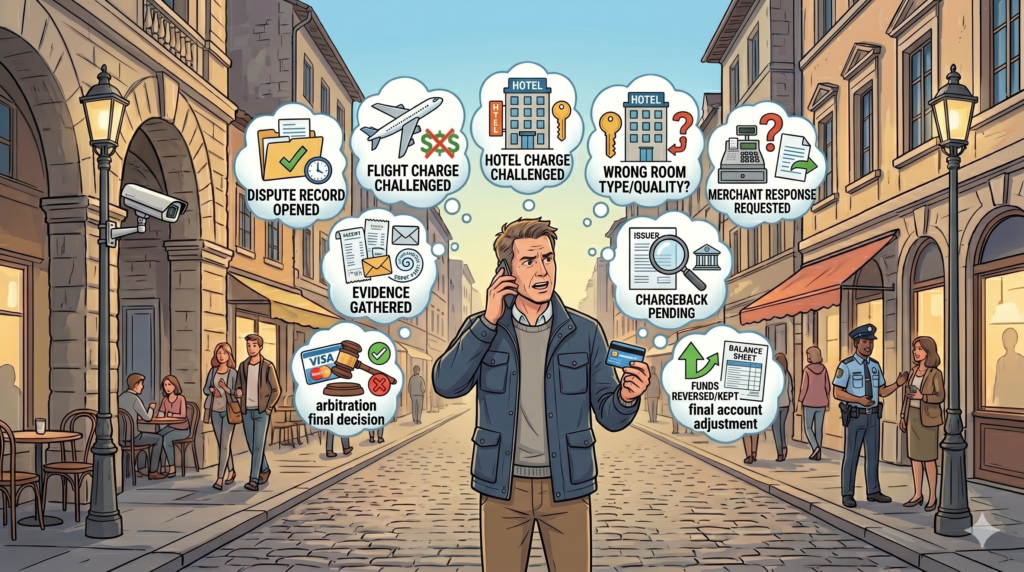
A chargeback is the most powerful consumer protection tool you have when something goes wrong with a travel purchase. Cancelled hotel that won’t refund? Rental car company billing $2,400 for damage that wasn’t your fault? Tour operator that took the deposit and disappeared? In all of those cases, your credit card issuer can — under federal law and the card network rules — pull the money back from the merchant and refund you, often within weeks. The merchant has to fight to keep the money, not the other way around.
The catch is that chargebacks are time-sensitive, evidence-driven, and frequently denied on first attempt. Most travelers either miss the 60-day window, file under the wrong reason code, or accept the bank’s first denial when a properly constructed appeal would have won. This guide covers the legal framework (Fair Credit Billing Act, Regulation Z), the deadlines that actually apply, the evidence categories that win disputes, the most common travel chargeback scenarios with specific tactics, the dispute letter template that issuers respond to, and the escalation paths when the bank won’t cooperate.
Chargebacks are not magic — you can’t just “dispute everything you don’t like.” But used correctly, they’re the strongest recourse a traveler has.
You have 60 days from the date the disputed charge appears on your statement to file a chargeback under the Fair Credit Billing Act. Try to resolve with the merchant first (banks often require this), then file the dispute through your card’s app or by written letter. Provide written evidence (receipts, emails, photos, contracts). The bank has up to 90 days to investigate and is required to credit you provisionally during the dispute. Most travel chargebacks settle within 30–45 days.
Two clocks to know: The 60-day federal billing dispute window (FCBA) and the 120-day Visa/Mastercard chargeback window for “services not provided” — useful for trips booked far in advance.
The Legal Framework
Chargeback rights live in two overlapping systems: U.S. federal law and the private rules of the card networks (Visa, Mastercard, Amex, Discover). Your rights depend on which system you invoke.
The Fair Credit Billing Act (FCBA)
Enacted in 1974, the FCBA gives U.S. credit cardholders the right to dispute “billing errors” — including charges for goods or services not delivered, charges in the wrong amount, and charges for items that don’t match the description. The window is 60 days from the statement closing date. The merchant must be given a chance to refund first; if they refuse, the bank takes over.
Network chargeback rules
Visa and Mastercard publish operating rules that allow longer windows for specific reason codes — up to 540 days for certain “services not rendered” disputes. The most useful travel-specific window is 120 days from the expected service date. This means a hotel booking made in January for a July stay can be disputed as late as November if the hotel cancels or fails to deliver.
Debit cards are different
Debit card disputes fall under the Electronic Fund Transfer Act (Regulation E), which is generally less consumer-friendly than the FCBA. This is why most travel finance writers recommend running travel purchases through credit cards whenever possible — the dispute process is dramatically stronger.
The Deadline Map
| Dispute Type | Deadline | Authority |
|---|---|---|
| Billing error / wrong amount | 60 days from statement | FCBA |
| Goods not received | 120 days from expected delivery | Visa/Mastercard rules |
| Services not rendered (travel) | 120 days from expected service date | Visa/Mastercard rules |
| Fraudulent / unauthorized charge | 60 days (FCBA) / 120 days (network) | Both |
| Quality of service dispute | 60 days from receipt of goods/service | FCBA |
| Subscription / recurring not cancelled | 120 days from cancellation request | Network rules |
The Six-Step Dispute Process
Contact the merchant first
Banks frequently ask “have you tried the merchant?” and may delay processing if you haven’t. Email or call the merchant requesting a refund. Save every reply. Document the date of your request and the date of any refusal.
Gather your evidence
Original booking confirmation, receipts, email correspondence with the merchant, photos showing damage or non-delivery, screenshots of advertised terms, third-party documentation (police reports, government advisories). The bank decides on paper, not on goodwill.
File the dispute through the card app
Every major issuer now supports in-app dispute filing — Chase, Amex, Capital One, Citi, BofA. Find the charge, tap Dispute, follow the form. Choose the reason code carefully (next section). Upload your evidence files.
Send a written dispute letter
Even after filing through the app, the FCBA officially requires written notice for full legal protection. Mail or upload the letter (template below). Keep a copy. Your rights are stronger when you’ve sent something in writing.
Receive the provisional credit
Most issuers credit your account provisionally within 1–2 billing cycles. The merchant then has 30–45 days to respond. If they don’t respond or can’t disprove the dispute, the credit becomes permanent.
If denied, escalate
Don’t accept a first denial. Request the merchant’s evidence package, prepare a rebuttal, and re-submit. If still denied, file with the CFPB — banks reverse a high percentage of denials within 30 days of a CFPB complaint.
What Evidence Wins Disputes
Card issuers and networks decide chargebacks the same way small claims courts decide cases — on paper. The merchant has their evidence; you need yours. Strong dispute packages share five elements.
The contract or booking confirmation
What you bought, in writing. Email confirmations, screenshots of booking pages, signed contracts. This establishes what the merchant promised.
Proof of payment
The credit card statement line, payment receipt, transaction confirmation. Confirms the charge tied to the booking.
Proof of non-delivery or breach
Photos, videos, third-party reports, hotel staff statements, police reports for theft or damage. Shows the merchant didn’t deliver.
Refund request correspondence
Your email asking for a refund, the merchant’s reply (or proof they ignored it). Shows good-faith effort to resolve before disputing.
External documentation
Government travel advisories (for force-majeure cancellations), airline disruption notices, news reports of merchant closure, BBB complaints, online reviews documenting widespread issues.
Damage/quality documentation
For service quality disputes: photos with timestamps, video walkthroughs, written statements from witnesses, third-party inspection reports.
The Dispute Letter Template
Every issuer accepts in-app dispute submissions, but a written letter creates a stronger paper trail and triggers stronger FCBA protections. Send via certified mail or upload as a PDF to the dispute case file.
[Your Name]
[Your Address]
[Account Number]
[Date]
Billing Inquiries Department
[Card Issuer Name]
[Issuer Billing Address]
Re: Notice of Billing Dispute Under the Fair Credit Billing Act
I am writing to dispute a billing error on my account. The disputed charge appears on my statement dated [date] in the amount of [$ amount], charged by [merchant name].
The amount is in error because [brief, factual explanation — e.g., “the hotel cancelled my reservation on June 12 and has refused to issue a refund despite repeated written requests”].
I am requesting that this charge be removed from my account, that any related finance charges be reversed, and that the appropriate corrections be made to my account. As required by the Fair Credit Billing Act, I am providing this written notice within 60 days of the statement on which the disputed charge first appeared.
Enclosed are copies of the supporting documents: [list — booking confirmation, refund request emails, etc.].
Please acknowledge receipt within 30 days as required by federal law, and complete your investigation within 90 days.
Sincerely,
[Your Signature]
Travel-Specific Chargeback Scenarios
Cancelled hotel that won’t refund
Most common travel dispute. Reason code: “services not rendered.” Strong dispute if the hotel cancelled and you have the cancellation email; weaker if you cancelled outside the merchant’s stated cancellation window. Always include the cancellation policy from the original booking page as evidence — many merchants change cancellation terms after the fact.
Fraudulent rental car damage charges
Rental car post-return damage claims are one of the most disputed categories. Best defense: timestamped photos of the car at pickup and drop-off, ideally with a rental staff member visible. Request the rental company’s damage assessment in writing. If their claim references damage you can prove was pre-existing (your photos), the chargeback is usually granted.
Double-charged taxi or rideshare
Common scam in some tourist cities. Reason code: “duplicate processing.” Provide the receipt(s) showing two charges for the same ride, plus the original booking screenshot. Most are resolved within two weeks.
Tour operator failure or no-show
If a tour, day excursion, or activity provider doesn’t show up or shuts down, dispute under “services not rendered.” Evidence: booking confirmation, attempted contact (calls, emails), photos of the meeting point with timestamp, statements from other affected travelers if available.
Airline ticket for cancelled flight (no refund offered)
Under U.S. DOT rules, airlines must refund passengers when they cancel a flight, even if the passenger originally accepted a voucher. If the airline refuses, dispute the original ticket charge with documentation of the cancellation and your refund request. The DOT regulations are persuasive evidence.
Currency conversion / DCC fraud
“Dynamic Currency Conversion” — being charged in your home currency instead of local — is technically optional and must be disclosed. If the merchant didn’t ask and the rate is dramatically worse than the bank’s, you can dispute the difference. Reason code: “transaction in incorrect amount.”
When the Bank Says No
First denials are common, especially for travel disputes where the merchant pushes back. The chargeback isn’t over.
Request the merchant’s response package
Federal law requires the bank to give you the documentation the merchant submitted. Ask for it in writing. Read it carefully — many merchant rebuttals contain factual errors or rely on terms you can disprove.
Submit a rebuttal
Address each merchant claim directly. Add new evidence if any has emerged. Many issuers will accept a re-opened dispute with new evidence even after the official window has closed.
File a CFPB complaint
The Consumer Financial Protection Bureau accepts complaints about banks at consumerfinance.gov/complaint. Banks are required to respond within 15 days. CFPB complaints have a high reversal rate — banks often re-open disputes that were previously denied.
Escalate to state regulators
State attorneys general and state banking commissioners both accept consumer complaints about credit card disputes. Use this as a parallel track to CFPB, not a replacement.
Small claims court
For disputes over a few hundred dollars, suing the merchant directly in small claims court is often viable. The merchant frequently settles rather than appear. Filing fees are typically $30–$100.
Filing chargebacks for charges you legitimately owe is called “friendly fraud” and can result in account closure, denial of future credit, and (in extreme cases) prosecution. Use chargebacks for genuine errors and breaches — not as a shortcut to avoid paying for things you used.
Stats: How Often Chargebacks Win
Premium Travel Cards and Trip Protection
Some premium travel cards add layers on top of the federal chargeback protections — trip cancellation insurance, baggage protection, rental car coverage, and concierge advocacy services. The Chase Sapphire Preferred, Chase Sapphire Reserve, and Amex Platinum all include trip cancellation insurance that pays out for covered reasons (illness, severe weather, jury duty) without requiring a chargeback.
For booking-side fraud protection, services that pair with cards — like InsureMyTrip — sometimes cover the gap when chargebacks fail (for example, if the merchant goes bankrupt). And for travel finance flexibility abroad, fee-free travel checking like Charles Schwab reduces the need to use debit at all, keeping more transactions under the stronger FCBA protections.
FAQ: Travel Chargebacks
Will disputing a charge hurt my credit score?
No. Filing a chargeback is invisible to credit bureaus. The disputed amount typically goes into a “pending dispute” status and doesn’t accrue interest or count toward minimum payments while under investigation.
Can I dispute a charge from years ago?
Generally no. The hard limits are 60 days (FCBA) and 540 days (Visa/Mastercard outer limit for specific scenarios). After those, the formal chargeback process is closed. You can still pursue the merchant directly through small claims or written demands.
What if I paid for travel a year in advance and it doesn’t happen?
Use the network rules, not the FCBA. Visa and Mastercard both allow 120 days from the expected service date for “services not rendered” — meaning a January booking for July travel that doesn’t happen can be disputed in November.
Can the merchant come after me legally?
In theory yes — the merchant can sue you for the disputed amount. In practice, almost no merchant pursues civil action over chargebacks under a few thousand dollars. Some merchants will ban you from future bookings or refuse service; this is allowed.
Should I cancel the card to escape a recurring charge?
No — closing the card doesn’t always stop the charge, and it limits your dispute options. Instead: dispute the existing charge, ask the bank for a “stop payment” on future charges, and contact the merchant in writing to demand cancellation. Document everything.
What happens if the merchant goes bankrupt?
Chargebacks still work. The card network claws back the funds from the merchant’s acquiring bank. You don’t have to wait for bankruptcy proceedings. This is one of the strongest reasons to use credit cards for large travel deposits.
How long does provisional credit take?
1–2 billing cycles for most issuers. Some — Amex, Chase — issue provisional credit within days for clean disputes. The credit is reversed if the dispute is later denied, so don’t spend the money until the dispute is fully resolved.
Can I dispute a charge if I authorized it but the service was bad?
Yes — under the FCBA, “quality of goods/services” is a valid dispute category. The bar is higher than fraud disputes; you’ll need documentation showing the service materially failed to match what was advertised. Photos, written reviews, third-party reports all help.