
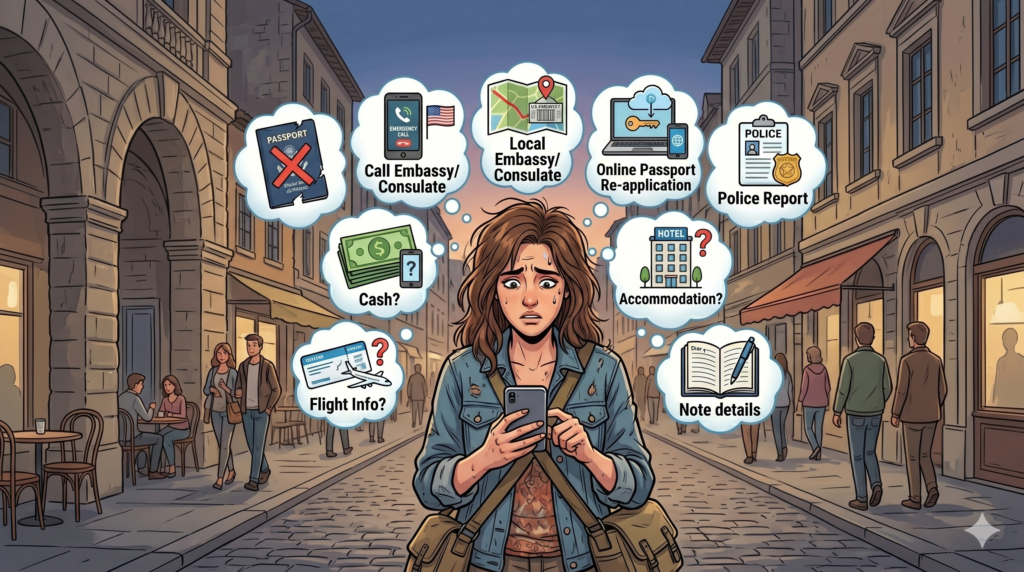
Losing a passport abroad feels catastrophic — the document that proves you’re allowed to be in this country, that lets you go home, that links you to consular protection, suddenly isn’t yours anymore. The good news is that every major embassy on earth has handled this exact situation thousands of times, and the replacement process is far more standardized than most travelers realize. The bad news: it costs money, eats at least one full day, and you cannot expedite away the appointment requirement at most embassies.
This guide walks through the embassy procedure step by step for U.S., U.K., Canadian, and Australian citizens, the typical wait times, the documentation that actually speeds things up, and the difference between an emergency travel document (gets you home) and a full passport replacement (lets you keep traveling). We’ll also cover the digital-backup workflow that turns a 72-hour disaster into a same-day fix, the photo specs that vary surprisingly little by country, and what to do at the airport when you’ve got a flight in six hours and no passport.
Almost every U.S. embassy can issue an emergency passport in 24 hours when there’s a confirmed flight; the U.K. issues Emergency Travel Documents in roughly the same window. The single biggest variable in your replacement timeline is whether you arrive at the embassy with the right documents on the first try.
Report it, then go to your embassy. Report the loss to local police (most embassies require a report number), schedule the earliest available embassy appointment online, and bring: a passport photo, government-issued ID or photocopy of the lost passport, proof of citizenship, proof of onward travel, and the fee. Most embassies issue an Emergency Passport or Emergency Travel Document within 24–72 hours when there’s a documented urgent need.
U.S. emergency passport fee: $130 application fee + $35 execution fee = $165 total. The often-cited “$175” includes the photo fee charged inside many embassies. Cash, credit card, or money order accepted depending on post.
The Step-by-Step Embassy Procedure
This sequence applies to most major Western embassies. Skipping a step rarely speeds things up — embassies will not issue a passport without a police report, citizenship proof, and a valid reason for the issuance.
File a police report
Find the nearest police station. In tourist-heavy cities, hotel concierges typically know which station handles English-speaking visitors. Get a written report with a case number. Required by most embassies and by your travel insurance.
Report the passport lost online
Go to your country’s official passport reporting page (links below) and submit the loss form. This invalidates the passport globally so it can’t be used by whoever found it. Do this before the embassy visit — they’ll ask if you’ve reported it.
Book the earliest embassy appointment
Most embassies require online appointment booking. For genuine emergencies — flight in next 72 hours, medical issue, family emergency — call the after-hours duty officer line and request a same-day or next-day slot. Walk-ins without appointments are usually turned away.
Get a passport photo
Most embassies do not take photos in-house, despite the “execution fee.” Find a photo shop or a corner pharmacy — every major city has them within a few blocks of the embassy. Specs vary slightly by country but most accept 2″×2″ white-background standard.
Gather supporting documents
Driver’s license, photocopy or photo of the lost passport, proof of citizenship (birth certificate, naturalization papers — a digital copy emailed to yourself counts), and proof of onward travel (flight confirmation). Bring more than you think you need.
Attend the appointment and pay the fee
Standard embassy security: no electronics, no large bags. Bring cash and a card; not all embassies accept both. The interview is brief — verify identity, confirm citizenship, sign the application, get fingerprinted (in some cases). Typical appointment runs 30–60 minutes.
Pick up the new passport
U.S. emergency passports are typically ready same-day or next-day. Full validity passports take 1–2 weeks. U.K. Emergency Travel Documents: often issued same-day. Canadian and Australian: 24–72 hours for emergency documents. Arrive at the pickup window 15 minutes early.
Wait Times and Document Types
Not every replacement is a passport. Most embassies issue two distinct documents depending on your situation, and choosing correctly saves time.
| Country | Emergency Document | Typical Wait | Validity |
|---|---|---|---|
| USA | Emergency Passport (limited validity) or Full 10-year | 24–72 hrs (emergency); 2 weeks (full) | 1 year (emergency) / 10 yrs |
| UK | Emergency Travel Document (ETD) | Same day to 48 hrs | Single journey home |
| Canada | Emergency Travel Document or Temporary Passport | Same day to 5 business days | Single use / up to 1 year |
| Australia | Emergency Passport | 1–3 business days | 7 months |
| EU (most) | Emergency Travel Document (ETD) | Same day to 48 hrs | Single journey home |
Country-Specific Embassy Procedures
The Document Checklist
Embassies don’t typically issue passports without identity verification. Bring as many of these as you can. The more you have, the faster the appointment.
Bring to the embassy
- Passport-sized photo (2″×2″ for U.S.; 35×45mm for UK/EU/most)
- Police report with case number
- Photocopy or photo of lost passport (any quality)
- Government-issued photo ID (driver’s license, military ID)
- Secondary citizenship proof (birth certificate, naturalization papers, expired passport)
- Proof of onward travel (flight confirmation, itinerary)
- Proof of legal entry to the country (entry stamp photo, visa)
- Cash and credit card for the fee
- A second person (witness) if available — useful for U.S. emergency cases
If your wallet was stolen with the passport, embassies can still issue an emergency document — but expect a longer process. They’ll verify your identity through a phone interview with a U.S. citizen who knows you (a relative or close friend), and may request additional evidence like utility bills or government records. Have someone at home ready to confirm your identity by phone.
The Digital Backup Workflow
The single biggest variable in your replacement speed is whether you can prove citizenship without the lost document. Build a digital backup before you ever leave home and a 72-hour ordeal becomes a same-day fix.
What to back up — and where
Photograph (don’t scan) the bio page of your passport, your driver’s license, and your birth certificate. Store one copy in encrypted cloud storage you can access from any device — Google Drive, iCloud, Dropbox — and one copy in your email drafts folder. Email it to yourself so it’s accessible from any browser without your phone.
Use a VPN like NordVPN when accessing these documents over hotel or airport Wi-Fi — the airport network you sign in to to retrieve a backup is exactly the one most likely to be sniffed.
What an embassy can verify by phone or database
U.S. citizens have it easiest. The State Department can confirm citizenship through internal records as long as you’ve held a passport in the last 15 years. U.K. and Canadian embassies can verify through their own passport databases. Australia generally requires a paper record. The point: even with zero documents, modern embassies can usually re-establish your identity within 24 hours.
Getting Home With No Passport
An Emergency Travel Document (ETD) is purpose-built for this scenario. It’s a single-use document that lets you fly home (sometimes with one transit) and nothing else. ETDs are usually faster to issue than a full passport because the validity is tightly limited.
Airline policies vary. Most accept ETDs without issue, but some budget carriers will deny boarding if the document doesn’t match the booking name format exactly. Confirm with the airline before booking your replacement flight. If you’re transiting through a third country on the way home, check that country’s transit visa rules — some countries don’t accept ETDs as valid transit documents.
For the visa side of replacement travel, services like iVisa and Sherpa can help confirm what your ETD allows.
Stats and Reality Check
Travel Insurance and Passport Coverage
Most comprehensive travel insurance policies reimburse passport replacement fees and the additional travel costs caused by the loss — extra hotel nights waiting for the document, replacement flights, even some incidentals. InsureMyTrip lets you compare policies that explicitly cover passport replacement, while World Nomads covers it under most of their plans.
For coverage that includes emergency passport assistance and consular help, look for policies that specifically mention “lost or stolen documents” in the benefits — not all do. A policy that costs $30 more for the trip can pay for itself the moment a passport disappears.
FAQ: Lost Passport Questions
Can I get an emergency passport without a flight booked?
Usually no. Most embassies require proof of imminent travel for “emergency” expedited service. Without a flight, you’ll get a regular replacement on the standard timeline — 1–2 weeks for U.S. citizens at most posts. Book a refundable flight as proof, then change it once the passport is issued.
What if I find my passport after reporting it lost?
The found passport is permanently invalidated and cannot be used to travel — even if it physically still works at older borders. Using it is a federal crime in the U.S. and a serious offense in most countries. Destroy it or return it to the embassy.
Can someone else pick up my replacement passport?
Generally no. Passport pickup typically requires the applicant in person. Some embassies allow a designated representative with a notarized power of attorney for medical emergencies — but this varies dramatically by post.
Will my visas in the lost passport still work?
The visa stamps themselves are technically still valid, but they’re useless without the passport they’re attached to. For most countries you’ll need to re-apply for the visa. Some — Schengen, India — have processes to “transfer” valid visas to a new passport for a smaller fee. Check with the issuing country’s embassy.
What if my passport is stolen at the airport before a flight?
Get to the airport’s federal police or customs office immediately and ask for a stolen-document report on the spot. Some major airports — Heathrow, JFK, Frankfurt — have direct embassy liaisons that can issue an ETD in hours rather than days. Your airline will rebook you once the document is issued, often without change fees if a police report is in hand.
Do I need to pay if my passport was stolen, not lost?
Yes — embassies charge the fee regardless. Travel insurance typically reimburses both the fee and any associated costs after you submit the police report, but the embassy itself doesn’t waive fees for theft.
How long is an emergency passport valid?
Varies by country. U.S. emergency passports are valid for 1 year (limited validity) and can be exchanged for a full 10-year passport when you return home, often without paying again. U.K. ETDs are single-journey. Australian emergency passports are valid for 7 months.
What if I’m in a country with no embassy from my home country?
Most countries have reciprocal arrangements. U.S. citizens in countries without a U.S. embassy can use Canadian or Australian consular services. The U.K. has reciprocal coverage with most Commonwealth and EU countries. Call your home country’s foreign ministry hotline for the right route.
Verified Resources & Authorities