
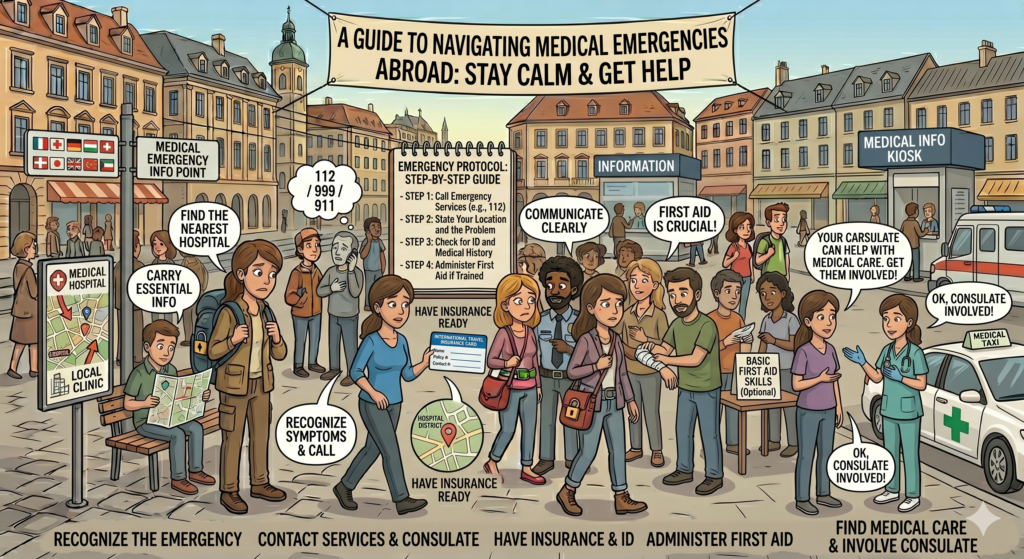
A medical emergency abroad without travel insurance can produce a six-figure bill. Pre-trip preparation costs around $50 plus the price of an insurance policy: destination-appropriate vaccinations, prescriptions in original containers with a doctor’s letter, $100,000 minimum medical coverage, and explicit medical evacuation cover of at least $500,000. Total cost of doing it right is less than a checked bag. Total cost of getting it wrong can be financially catastrophic.
What a Medical Emergency Abroad Actually Looks Like
Three travelers have the same scooter accident on a beach road in Bali. The first has comprehensive travel insurance with medical evacuation. The hospital bill at BIMC Hospital Kuta is paid directly by the insurer. A medical escort flies the traveler home in stable condition for follow-up care. Total out-of-pocket: the policy excess.
The second has a credit card with limited travel benefits. Some of the bill is covered. Some isn’t. The traveler flies home on a commercial flight in a leg cast and ends up with around $12,000 in unrecovered expenses spread across the hospital, the airline, and physiotherapy back home.
The third has nothing. The hospital wants $42,000 paid before discharge. There is no evacuation option. The credit card maxes out. Family back home wires the rest. The financial impact follows the traveler back across the Pacific and stays for the next several years.
This isn’t hypothetical. Variations of it happen every week somewhere in the world. The difference between the three outcomes is the preparation that happened before anyone got on the plane.
The 30-Day Pre-Trip Health Checklist
Vaccinations and Health Authorizations
Some destinations require or strongly recommend vaccinations that take weeks to take effect. Start the process at least 4–6 weeks before departure.
- USA: CDC Travelers’ Health — destination-specific recommendations updated monthly.
- UK: NHS Fit for Travel — equivalent destination guidance from the British government.
- Yellow fever certificates are required for entry to many African and South American countries. Some require proof at the border. The WHO yellow fever list is the authoritative reference.
- Routine vaccinations: verify standard immunizations are current — MMR, tetanus, hepatitis A and B.
- Travel-specific vaccines depending on destination and activity: typhoid, Japanese encephalitis, rabies, cholera.
Prescription Medications
Carry enough medication for the entire trip plus a buffer. Critical preparations:
- Original pharmacy-labeled containers only. Never decant medications into pill organizers for international travel.
- Doctor’s letter for any controlled substance: Adderall, opioid pain medications, ADHD medications, certain antidepressants.
- Check destination legality. Adderall is illegal in Japan and South Korea. Codeine is heavily restricted in the UAE. Pseudoephedrine (Sudafed) is restricted in Japan and Mexico. The CDC traveler’s medication guide lists destination-specific rules.
- Photograph every prescription and store in encrypted cloud storage in case originals are lost.
Personal Medical Information
- Know the blood type. Critical in emergency transfusion situations.
- List allergies and chronic conditions on a card in the wallet, ideally in English and the local language.
- Medical alert bracelet for travelers with serious allergies, blood thinner use, diabetes, or implanted devices.
- Recent ECG or medical records for travelers with a cardiac history. Useful comparison reference for treating physicians abroad.
Travel Insurance — What Actually Matters
Most travelers buy travel insurance and never read the policy. That is the inverse of what works. Premium price is almost irrelevant compared to understanding what the policy covers.
Medical Coverage Limits That Matter
- $100,000 minimum for most international destinations. Hospital care in major facilities globally can exceed this for serious incidents.
- $500,000+ for the United States. American medical care is the most expensive in the world. A serious incident as a tourist can produce bills in the hundreds of thousands of dollars.
- $200,000+ for Japan, Australia, Switzerland. High-cost medical systems where foreigners pay retail prices.
Medical Evacuation — The Coverage Most Travelers Don’t Know to Ask About
Medical evacuation is the cost of getting from where the traveler is to where they can be properly treated. Ground ambulance to a tertiary center, air ambulance from a remote location, dedicated medical jets. None of this is part of standard hospital bills, and the costs are extraordinary.
- Local ambulance evacuation: $1,000 to $10,000
- Air ambulance within a country: $10,000 to $50,000
- International air ambulance with commercial flight + medical escort: $25,000 to $75,000
- International air ambulance, dedicated medical jet: $50,000 to $250,000+
Verify the policy has explicit medical evacuation coverage of at least $500,000. This is the single most important coverage item travelers underestimate.
What Domestic Health Insurance Probably Doesn’t Cover
Most domestic health insurance provides limited or no international coverage. US Medicare provides essentially zero international coverage in most circumstances. Even premium domestic plans rarely include medical evacuation. The assumption that “my health insurance covers me everywhere” is one of the most expensive misconceptions in modern travel.
Insure My Trip compares 20+ providers side-by-side on these criteria. World Nomads includes adventure activity coverage that excludes from many standard policies — scuba, motorbike, trekking above altitude. For digital nomads or anyone without a fixed return date, SafetyWing‘s subscription model covers ongoing trips without annual renewals.
Practical Health Risks on the Ground
Food and Water Safety
Traveler’s diarrhea is the most common health complaint of international travelers. The CDC reports it affects 30 to 70 percent of travelers depending on destination. The standard rules:
- If the tap water isn’t drinkable, the ice from it isn’t either. The most common transmission route in restaurants is iced drinks.
- Hot, freshly cooked food from busy stalls is generally safer than buffet food sitting at room temperature.
- Bottled water with a sealed cap. Accept no substitute. Refilled bottles are sold to tourists in some destinations.
- Wash hands before eating. Soap and water if possible, hand sanitizer if not.
- Pack rehydration salts (ORS) for serious cases. Available cheaply at any pharmacy.
Heat and Sun
Severely underestimated by almost every visitor to tropical climates. Severe dehydration and heat exhaustion can develop within hours in Bangkok, Dubai, or Singapore summer temperatures. Drink water consistently, not reactively after thirst sets in. Sun exposure causes more medical incidents than most visitors expect.
Road Safety — The Leading Cause of Death
According to the WHO road traffic injuries fact sheet, road crashes kill roughly 1.19 million people globally each year, with 92% of those deaths occurring in low- and middle-income countries. Road traffic injuries are the leading cause of death for people aged 5 to 29. Among international travelers, road accidents kill more people than crime, disease, and terrorism combined. Specific risks:
- Wear a helmet on any rented scooter or motorcycle. Always. No exceptions for “just down the road.” WHO data shows correct helmet use reduces the risk of death in a crash by more than 6 times and the risk of brain injury by up to 74%.
- Avoid driving at night in destinations with poor road quality or animal traffic — Southeast Asia, parts of Africa, Latin America.
- Verify rental insurance. Many policies exclude scooters and motorcycles entirely or carry heavy excesses.
- Local taxi standards vary. Rideshare apps with seatbelts and accountability are safer than informal taxis in many destinations.
Insect-Borne Illness
Dengue, malaria, Zika, and chikungunya are real risks in specific destinations. Use DEET-based repellent (25 to 30 percent concentration), wear long sleeves at dusk, sleep under treated mosquito nets in high-risk areas, and check the CDC travel disease guidance for prophylactic medications before specific destinations.
What to Do If Medical Care Is Needed Abroad
- Contact the travel insurance emergency line first. They direct travelers to in-network hospitals and pre-authorize coverage. Skipping this step can cost tens of thousands of dollars in claim disputes later.
- Major international hospitals in capital cities have English-speaking staff and standards comparable to home. Bumrungrad in Bangkok, Mount Elizabeth in Singapore, BIMC in Bali, the American Hospital of Paris are well-known examples.
- Document everything. Receipts, prescriptions, doctor’s notes, discharge papers. Required for insurance claims.
- Notify the embassy for serious incidents. Consular staff can help with family communication, medical record translation, and repatriation logistics.
- Don’t pay out of pocket if avoidable. Many insurers pay the hospital directly for in-network providers. Reimbursement after the fact takes months.
Right Now, in an Emergency
Local emergency number: 112 across most of Europe and many other countries. 911 in USA, Canada, Mexico, Argentina, several Pacific nations. Save the local emergency number for the destination before arriving.
Travel insurance 24-hour line: first call for any non-immediate emergency. They direct to in-network care.
International SOS: premium service included in some corporate insurance and available as add-on coverage. internationalsos.com.
Government health resources:
- USA: CDC Travelers’ Health
- UK: NHS Fit for Travel
- Canada: Travel Health Notices
- Australia: Smartraveller Health
WHO International Travel and Health: who.int/travel-advice — the most authoritative source for global health risks by destination.
Before the Trip
- EpicLayover Government Travel Advisory Directory — country-specific advisories with health and safety information consolidated.
- CDC Travelers’ Health Destination List — vaccinations, disease risks, and pre-travel preparation by country.
- NHS Fit for Travel Destinations — UK government’s destination-specific health guidance.
- WHO International Travel and Health — global authoritative source on disease risks, vaccinations, and outbreaks.
- IAMAT (International Association for Medical Assistance to Travellers) — directory of vetted English-speaking doctors in 90+ countries.
- Medicare’s official travel coverage page — confirms the gaps that travel insurance must fill.
Bottom Line
Travel medical emergencies are the largest financial risk of international travel and the most preventable. Doing it right (vaccinations, prescriptions, comprehensive insurance with medical evacuation) typically costs under $200 for a two-week trip. Doing it wrong can cost $50,000 to $250,000+ in unrecoverable medical bills.
Start vaccinations a month out. Pack medications in original containers. Read the policy and verify medical and evacuation limits. Save the 24-hour emergency line. Note the blood type. The preparation pays for itself the first time it’s needed, and most often it is never needed at all, which is the entire point.