
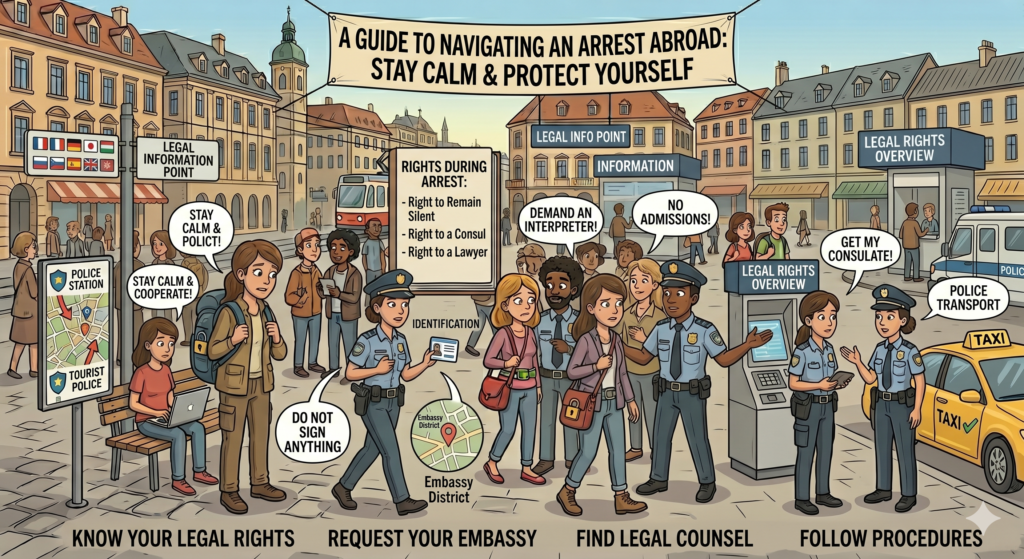
A traveler arrested abroad has one fundamental right under Article 36 of the Vienna Convention on Consular Relations: contact with their home country’s embassy or consulate. Use that right immediately. The embassy can confirm detention, supply a list of local lawyers, and notify family. It cannot demand release, pay bail, or interfere in proceedings. The 6-step protocol below is the difference between a survivable detention and a much worse one.
What Happens If a Traveler Gets Arrested Abroad
The US State Department has historically reported that more than 2,500 American citizens are arrested in foreign countries each year, and that number tracks closely with figures from the UK, Canada, and Australia. According to the James W. Foley Legacy Foundation’s 2024 Hostage and Wrongful Detainee Landscape report, about 98 percent of those detentions involve legitimate local legal proceedings — meaning the traveler genuinely broke a local law, even if accidentally. Only the remaining sliver involves wrongful detention by hostile state actors, and that subset gets disproportionate media attention while the everyday cases (drug possession, visa overstay, photography in restricted areas) are how most travelers actually wind up in custody.
Arrest abroad is fundamentally different from arrest at home. The constitutional rights an American, Briton, or Australian takes for granted — fast access to a lawyer, presumption of innocence, the right to remain silent — vary dramatically across borders. In some countries those rights don’t exist in the same form. In others they exist on paper but not in practice. What does exist almost everywhere is the right to consular contact. That is the foundation of everything else in this report.
Vienna Convention Rights — In Plain English
The Vienna Convention on Consular Relations (1963) is one of the most widely ratified treaties in the world. Article 36 is the one that matters here. It guarantees that any foreign national detained in another country has the right to:
- Contact their consulate or embassy without delay
- Have consular officials notified of the detention
- Receive consular visits while in custody
- Receive consular assistance in arranging legal representation
In practice, the police are required to inform a detainee of this right, but in many countries the detainee has to assert it explicitly. Ask. Repeat. Don’t sign anything until the embassy has been notified.
What an Embassy Can Do
- Confirm detention and the location of holding
- Provide a list of local English-speaking attorneys
- Notify family with the detainee’s permission
- Visit the detainee in custody to check welfare
- Help with prison transfer procedures in some cases
- Convey messages between detainee and family
- Assist with practical matters: medication delivery, religious accommodations, dietary needs
What an Embassy Cannot Do
- Get a detainee released
- Pay bail, fines, or legal fees
- Provide legal advice or court representation
- Demand preferential treatment
- Override the local justice system
- Guarantee any specific outcome
The US State Department’s official guidance on arrest abroad is published at travel.state.gov. The UK FCDO equivalent and Australian Smartraveller guidance follow nearly identical protocols. Consular protection is real and valuable. It is not a get-out-of-jail card.
Why Travelers Actually Get Arrested
1. Drug Possession (Top Cause Globally)
Drug possession is the single most common cause of traveler arrest abroad and the most consequentially serious. Substances legal at home may be illegal at the destination. Cannabis is legal recreationally in Canada, much of the United States, and parts of Europe — and a long prison sentence in Singapore, Malaysia, Indonesia, Saudi Arabia, the UAE, Japan, and South Korea. Indonesia and Singapore both maintain the death penalty for drug trafficking offenses, and what counts as “trafficking” can be measured in single grams.
“I didn’t know it was in my bag” is not a defense that will keep a traveler out of custody. Always check every compartment of any bag or clothing given by anyone before international travel.
2. Visa Overstays
Overstaying a visa even by one day is an immigration violation that can result in detention, deportation, fines, and multi-year entry bans. Some countries (UAE, Thailand) charge daily overstay fines. Others detain overstayers immediately. Thailand’s overstay fine is 500 baht per day, capped at 20,000 baht, plus a multi-year ban from re-entry depending on the length of the overstay.
3. Photography in Prohibited Areas
Military installations, government buildings, certain religious sites, and some bridges and infrastructure are off-limits for photography in many countries. The prohibition is often poorly signposted in English, especially in the UAE, Egypt, India, and parts of Southeast Asia. “I didn’t know” is rarely a defense.
4. Public Intoxication and Alcohol Offenses
The UAE has historically detained tourists for alcohol-related offenses including public intoxication and possession outside licensed venues. Saudi Arabia operates similar restrictions. Travelers should review the alcohol-specific section of any government advisory before flying — laws change quickly and enforcement does too.
5. Disrespect of Religious or Cultural Sites
Inappropriate dress at religious sites, criticism of the government or royal family (Thailand’s lèse-majesté laws, codified in Article 112 of the Thai Criminal Code, carry sentences up to 15 years per count), or behavior considered disrespectful at temples and mosques can all trigger detention. Foreign tourists have served prison time in Thailand for social media posts deemed insulting to the monarchy.
6. Involvement in Demonstrations or Civil Unrest
Even as a bystander. Police responses to civil unrest are often broad and indiscriminate within the immediate vicinity. If a protest is forming, leave the area immediately regardless of personal political view.
7. Prescription Medication Issues
Medications legally prescribed at home may be controlled substances elsewhere. Adderall is illegal in Japan and South Korea. Codeine is heavily restricted in the UAE. Pseudoephedrine (the active ingredient in Sudafed) is restricted in Japan and Mexico. The CDC traveler’s medication guide lists destination-specific restrictions. Always carry medications in original pharmacy-labeled containers with a doctor’s letter for controlled substances.
The 6-Step Protocol If Detained
- Stay calm. Do not argue, shout, or physically resist under any circumstances. Escalation creates additional charges. Compliance is not an admission of guilt.
- Clearly request to contact the embassy or consulate. State this in the simplest possible terms. Repeat it if necessary. This is the single most important right to assert.
- Do not make statements beyond identifying yourself. Don’t explain. Don’t justify. Don’t provide context until a lawyer is present. Anything said can be used in proceedings, and translation errors compound the risk.
- Do not sign anything you cannot read. Documents signed at the time of arrest carry legal weight in many countries. Ask for an interpreter. Ask for a lawyer. Don’t sign until both are present, regardless of what officers claim will happen if a detainee refuses.
- Note details. Officer name and badge number. Facility name and address. Time of detention. Names of anyone else present.
- Once a phone call is allowed: embassy first, travel insurance emergency line second, family third. In that order.
Pre-Trip Preparation That Actually Pays Off
- Register with a government traveler program. STEP (USA), FCDO (UK), Smartraveller (Australia), and Registration of Canadians Abroad are all free. They take five minutes. They mean the home country can locate the traveler in an emergency.
- Read the destination advisory before booking. The EpicLayover Government Travel Advisory directory consolidates US, UK, Canadian, and Australian advisories in one place. The local laws section of each is required reading.
- Save the embassy’s address and 24-hour emergency phone for every country on the itinerary. The after-hours number is different from the main office.
- Photograph passport, visa, prescriptions, and travel insurance card. Store in encrypted cloud and email copies. Critical if originals are seized or lost.
- Research local laws for unusual circumstances: medications, electronics (drones are restricted in dozens of countries), dress codes, photography. Government advisories cover most of them.
- Travel insurance with legal expense coverage. Many policies include limited legal expense cover. Read the policy before flying, not after.
If a Family Member Is Detained Abroad
The first call from the family side goes to the relevant home-country foreign affairs department, not the embassy directly:
- USA: Office of Overseas Citizens Services, US State Department — +1 (888) 407-4747 (24-hour) or +1 (202) 501-4444 from abroad
- UK: FCDO 24-hour line — +44 (0)20 7008 5000
- Canada: Emergency Watch and Response Centre — +1 (613) 996-8885 (collect calls accepted)
- Australia: Consular Emergency Centre — +61 (0)2 6261 3305
These numbers are staffed around the clock. The operator can begin the process of locating the detainee, dispatching a consular officer, and beginning communication on behalf of the family.
Government Embassy Locators & 24-Hour Lines
- USA: usembassy.gov for embassy locator. Overseas Citizens Services 24/7: +1 (888) 407-4747.
- UK: UK Embassy Locator. FCDO 24-hour: +44 (0)20 7008 5000.
- Canada: travel.gc.ca/assistance. Emergency Watch: +1 (613) 996-8885.
- Australia: DFAT Embassy Locator. Consular Emergency Centre: +61 (0)2 6261 3305.
- EU citizens: Any EU member state embassy can provide consular protection if the home country has no representation.
Legal Help & Advocacy
The relevant embassy provides a list of local English-speaking lawyers. Independent organizations include Reprieve for serious cases (death penalty, torture, capital sentencing) and Fair Trials International for cases inside Europe.
Before the Trip
- EpicLayover Government Travel Advisory Directory — country-specific advisories from major Western governments, in one place.
- US State Department: Arrest or Detention Abroad — the official US guidance, including what consular officers can and cannot do.
- UK FCDO: Being Arrested Abroad — equivalent UK government guidance.
- Vienna Convention on Consular Relations (full text) — the treaty itself, particularly Article 36.
- CDC Traveler’s Medication Guide — destination-specific restrictions on prescription medications.
Bottom Line
Most travelers will never need a single thing in this report. The ones who do are usually the ones who never thought it could happen. Preparation costs nothing: register with the home government, save the embassy number, never carry anything not packed personally, never sign documents that can’t be read.
If something goes wrong, the protocol matters. Stay calm. Contact the embassy. Don’t sign. Don’t talk. Get a lawyer. The first sixty minutes of a foreign detention often shape the next sixty months. The travelers who handle it well are the ones who knew the rules before walking into the situation.