
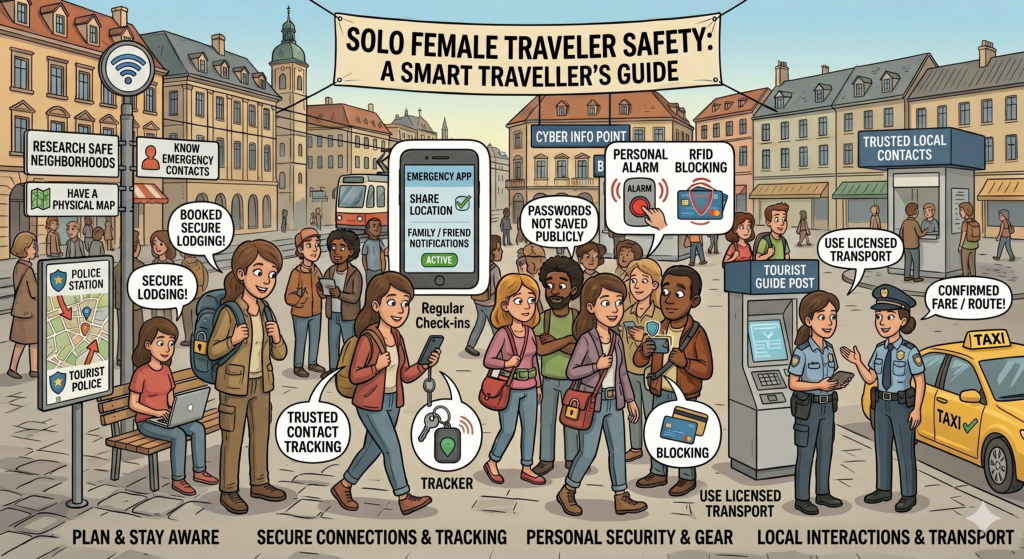
Solo female travel is the fastest-growing segment of international tourism, and most trips are safe and rewarding. The defensive layer that matters most: a central, well-reviewed accommodation; rideshare apps over street taxis; live location sharing with a trusted person; pre-booked airport transfers; and an awareness of which destinations carry which specific risks. Generic advice (“trust your instincts”) isn’t useful. Specific patterns and specific countermeasures are.
Is Solo Female Travel Safe?
The data backs the answer. Female solo travelers accounted for 54.6 percent of the solo travel industry’s revenue in 2025 (Grand View Research Solo Travel Market Report). Future Partners found 40 percent of female travelers planning a solo trip in 2025 — an 8 percentage point jump from 2024 (NBC News coverage of Future Partners survey). Visa applications for solo female travelers grew at an average month-over-month rate of 61.9 percent across an 11-month period, according to data from Atlys.
The Solo Female Travelers Club’s 2024 annual survey, drawing on roughly 5,000 responses from women globally, found that the percentage of women who report feeling unsafe drops from 78 percent to 59 percent after taking ten or more solo trips (Solo Female Travelers 2024 report). Experience changes the experience. The first solo trip is harder than the tenth. Both are achievable for the vast majority of women.
The risk profile is not identical to solo male travel in every destination. The risk is also not so disproportionate that it should determine whether a woman travels. This report focuses on what specifically helps once on the ground — not on whether to go.
What This Report Doesn’t Do
It doesn’t tell anyone to “trust your instincts.” Instincts are good — that part is obvious. It doesn’t recommend “being aware of your surroundings.” It doesn’t suggest staying home or only traveling in groups. The premise is that the trip is happening. The question is what works once it’s underway.
Accommodation: Where You Sleep Is the Most Controllable Variable
The right accommodation in the wrong neighborhood is worse than a mid-range hotel in the right one.
What to Filter For When Booking
- Central, well-lit area — not the cheapest option in an isolated district. The taxi ride home at midnight matters.
- Recent reviews from women specifically — they flag what the official description doesn’t (lock quality, neighborhood feel, late-night safety).
- Solid lock on the room door — many cheaper accommodations have weak locks. A doorstop alarm under $10 closes the gap.
- 24-hour reception or staffed entrance — particularly valuable for late arrivals.
- Walking distance to public transport and busy streets — reduces dependence on taxis at unfamiliar hours.
Booking.com and Agoda both have strong filtering for solo female reviews and verified properties. Reviews from the past six months matter more than older ones; neighborhoods change.
On Arrival
- Test the lock on the room door — both deadbolt and chain.
- Add a doorstop alarm if the lock feels insubstantial.
- Don’t share the room number with strangers — including in elevators, hotel bars, or anywhere on property.
- Identify the emergency exits on the floor. Five minutes of awareness, real value if anything goes wrong.
Transport: Rideshare Over Street Taxis
The transport layer is where most night-time solo travel risk concentrates. The technology has gotten dramatically better in the last five years.
Why Rideshare Apps Are Safer
Rideshare apps (Uber, Grab, Bolt, Lyft, regional equivalents) provide four protections a street taxi doesn’t:
- Driver identity and license plate recorded before entry
- Trip route recorded in real time
- Live trip-share function — sends location, driver, and ETA to a contact while the trip is active
- Cashless payment — no fare negotiating, no cash handoffs at destination
If something goes wrong on a rideshare trip, there’s a digital record. A street taxi in an unfamiliar city offers none of that.
The Airport Transfer Question
The single highest-risk transport moment of any trip is the taxi or rideshare from the airport when a traveler has just landed — tired, disoriented, carrying everything, often at night. Welcome Pickups solves this specifically: a verified, fixed-price driver meets the traveler in arrivals with a name on a sign. No unlicensed taxis, no fare negotiation, no walking out into a chaotic taxi rank in a city that’s still unfamiliar.
Live Location Sharing — The Quiet Game-Changer
Live location sharing is the most underrated solo travel safety tool of the last five years. Setup takes two minutes. The result: someone trusted has a real-time view of where the traveler is at all times.
How to Set It Up
iPhone (Find My): Open the Find My app → People tab → Share My Location → choose contact and duration. “Share Indefinitely” is the right setting for ongoing trips.
Android (Google Maps): Open Google Maps → tap profile picture → Location sharing → select contact and duration. Works between iPhone and Android.
Rideshare apps: Every major app (Uber, Grab, Bolt) has a “Share trip” or “Share status” button on the trip screen. Use it for every late-night trip in an unfamiliar city.
The Harassment Question — Honestly
Street harassment exists in most countries, to varying degrees. It is not the traveler’s fault, not a function of dress, and not the price of solo travel. It is also something the best preparation in the world only partially addresses, because it’s behavior by others.
What Actually Helps
- Walk with purpose — confident pace, head up, eyes forward. Conspicuous tourist uncertainty draws attention of every kind.
- Have a flat “no” prepared — in the local language if possible. Firm, no further engagement, no smile-softening. Engagement (even negative) is often what the harasser is seeking.
- Wedding rings as a tool, not a deception — many solo travelers wear a simple band. Whether to do this is personal; some find it useful, others find the principle objectionable.
- Step into a busy place if approached — café, shop, hotel lobby. Public spaces with witnesses break the dynamic.
- Trust the read of a situation — leave when something feels off, even if it can’t be articulated. There’s no obligation to be polite to anyone making a traveler uncomfortable.
Country and Region Risk Patterns
Risk varies by destination — not in a way that should determine where to go, but in a way worth knowing before adjusting the approach. The U.S. State Department, U.K. FCDO, and Australian Smartraveller all publish country-specific advisories that are the authoritative starting point. EpicLayover’s directory of 50 government travel advisory websites consolidates them in one place.
Generally Lower-Risk Destinations
Iceland (number one on the Global Peace Index for 16 consecutive years), Japan, New Zealand, Norway, Denmark, the Netherlands, Portugal, Singapore. Strong public infrastructure, low violent crime rates, well-developed solo female travel culture. The Solo Female Travelers Club’s 2024 survey identified Japan, Iceland, and New Zealand as top destinations for experienced solo female travelers.
Destinations Requiring More Specific Preparation
Cairo, Marrakech, parts of India, parts of Latin America with high catcalling rates, certain destinations with strict dress codes. None of these are off-limits — millions of women travel them every year — but they reward research and a more deliberate approach.
The “Friendly Stranger Invitation”
An invitation to a man’s home, family restaurant, or “uncle’s hotel” carries a specific risk profile in some destinations that it doesn’t in others. Trust the read of the context. Most are genuine cultural hospitality. A small percentage are not. The cost of declining a genuine offer is mild social awkwardness; the cost of accepting a non-genuine one can be much higher.
The Buddy System on Solo Trips
Solo doesn’t mean isolated. The strongest solo female travelers maintain three layers of social structure:
- One person at home who knows the itinerary and gets passive location share
- Hostel common areas, organized day tours, food tours, walking tours — structured social interaction with low risk
- Solo female travel communities online — Girls LOVE Travel (2M+ members), Solo Female Travelers Network, destination-specific Facebook groups. Practical advice, real-time alerts, meetup possibilities.
The number of women-only travel companies has increased by approximately 230 percent over the past few years (Atlys solo female travel statistics 2025). For first-time solo travelers, a small-group women-only tour to start can build the confidence required for fully independent solo travel later.
Resources and Help
If You Need Help Right Now
Embassy or consulate — first contact for any serious incident. Save the address and 24-hour number for every country you visit before flying. EpicLayover’s directory of 50 government travel advisory websites has links to every major nation’s official source.
Travel insurance — 24-hour emergency line on every policy. Save it before flying.
Government registration:
- USA: STEP — step.state.gov
- UK: FCDO Travel Advice — gov.uk/foreign-travel-advice
- Canada: Registration of Canadians Abroad — travel.gc.ca
- Australia: Smartraveller — smartraveller.gov.au
Local emergency numbers: 112 works across most of Europe and many other countries. 911 in the USA, Canada, and several Pacific nations. Save the local number for the destination before arrival.
Bottom Line
Solo female travel is one of the most consistently rewarding experiences in modern adult life. The risk profile is real, manageable, and has gotten better — not worse — with the technology of the last five years. Live location sharing, rideshare apps, verified accommodations, pre-booked airport transfers have closed most of the gaps that used to require either a male travel companion or an organized tour.
Pick the right neighborhood. Set up location share before flying. Use rideshare apps. Pre-book the first transfer. Trust the read of situations. Then go.
- Solo Female Travelers Club — 2024 Annual Report (5,000+ respondents)
- Grand View Research — Solo Travel Market Size and Share 2025
- NBC News — Future Partners traveler survey 2025
- Atlys — Solo Female Travel Statistics 2025
- U.S. State Department Travel Advisories
- U.K. Foreign Travel Advice (FCDO)
- Australian Smartraveller
Before the Trip
- EpicLayover’s Government Travel Advisory Directory — country-specific advisories with safety information for women travelers.
- US Smart Traveler Enrollment Program (STEP) — free registration for emergency contact in-country.
- UK FCDO Foreign Travel Advice — equivalent UK government guidance with women’s safety sections by country.
- Smartraveller: Advice for Women Travellers — Australian government’s dedicated guidance.
- Girls LOVE Travel community — 1M+ member solo female travel community with destination-specific Q&A.
- Solo Female Travelers Network — vetted community with reviews, meetups, and trip reports.