
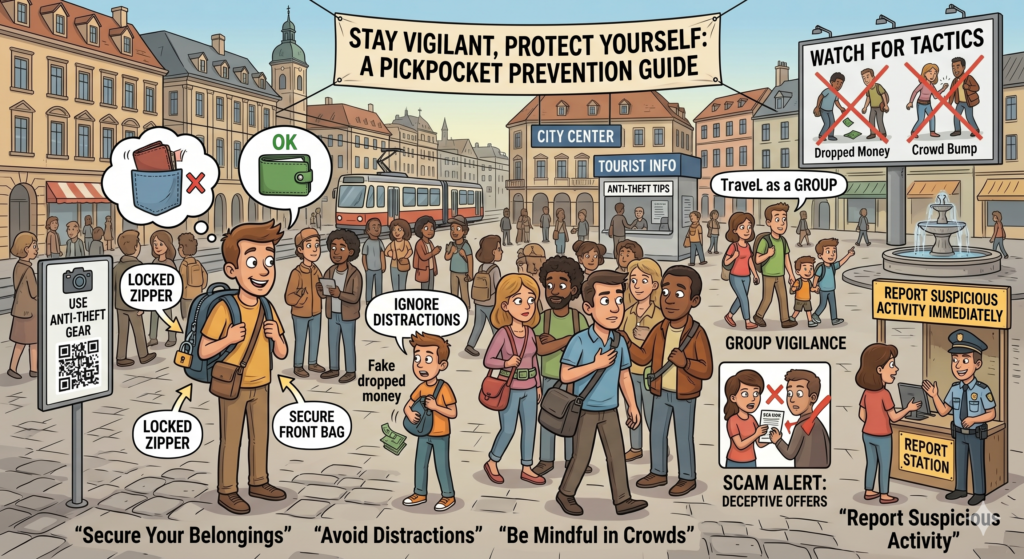
Pickpocketing is the most common crime affecting tourists worldwide. It is also almost entirely preventable. Five habits stop it cold: a crossbody bag worn across the chest with the hand resting on it, the phone out of any back pocket, two cards distributed across two physical locations, the trained reflex of putting a hand on the bag whenever someone bumps into you, and a money belt as the layer of last resort. Costs nothing. Becomes automatic in a week.
How Common Is Pickpocketing?
The numbers from the past two years make the scale clear. The U.K. Crime Survey for England and Wales recorded an estimated 78,000 phone or bag snatches in the year ending March 2024 — a 153 percent increase on the previous year and equivalent to roughly 200 snatch thefts every day (House of Commons Library briefing). London alone accounted for 116,656 phone thefts in 2024, a record figure that translates to 320 phones snatched every day or roughly one every four and a half minutes (Metropolitan Police data via Crush Crime FOI).
Continental Europe runs at similar levels. Quotezone’s 2024 European Pickpocketing Index found Italy with 478 mentions of pickpocketing per million visitors to its top tourist attractions — the highest in Europe — followed by France with 251 and Spain with 111 (Euronews coverage of Quotezone analysis). A 2025 analysis of 13,293 theft-related tourist reviews placed Paris on top globally at 16.5 percent of all theft mentions, with Rome at 10.7 percent and Barcelona at 5.3 percent (Radical Storage Pickpocket Capitals analysis). Rome reported a 68 percent increase in pickpocketing between 2019 and 2024.
None of this means avoiding the destinations. It means changing how to carry things in them.
How Pickpockets Operate
Most pickpockets work in teams of two or three. The roles divide cleanly:
- The distractor creates a brief commotion. A bump, a spilled drink, a clipboard pushed at the face, a sudden conversation that doesn’t quite make sense.
- The lifter does the extraction. Phone from a back pocket, wallet from a side pocket, anything from an open bag — in two to four seconds.
- The runner receives the stolen item from the lifter and walks calmly away in a different direction.
This division is why pickpocketing remains so hard to prosecute. The lifter has nothing on them when stopped. The runner is gone. The distractor was “just being friendly.” Even when caught, the system in many cities struggles to keep up — a Spanish report cited in La Vanguardia noted that thefts under €400 are classified as minor offences with court delays of six to nine months, leaving repeat offenders effectively at large (expatmadrid.com analysis of La Vanguardia data).
The Most Common Scripts
The Bump-and-Lift: Someone bumps into a traveler in a crowded space, apologizes, and walks on. Two seconds is all it takes. The defense: every contact triggers a hand on the bag, not eyes on the person.
The Petition: A person presenting as deaf, mute, or homeless thrusts a clipboard at the chest asking for a signature. The clipboard blocks the view of the bag. An accomplice operates from the side. The defense: never let anyone push anything against the body. Step back, hand on bag, walk on.
The Spill: Someone “accidentally” spills coffee, ice cream, or soda on a shirt, then offers to help clean it up. The close proximity is the cover. The defense: do not let strangers touch you to “help” with a spill. Step away, watch the bag.
The Metro Squeeze: Just before the doors close, the crowd surges to board. Hands are everywhere. By the time the train moves, the phone is gone. London’s Victoria line saw 2,034 phones stolen in 2024 — the worst-performing line in the city — followed by the Central line at 1,902 and the Jubilee at 1,804 (Time Out London via Telegraph FOI).
Where Pickpockets Operate
The pattern is consistent across cities. Pickpockets cluster where tourist density meets value concentration. The highest-risk environments globally:
- Metro and transit boarding moments. Paris (Lines 1, 4, 9), London (Victoria, Central, Jubilee), Barcelona (L3 to Sagrada Familia), Rome (Linea A to the Vatican), Madrid (Sol).
- Around major attractions. Trevi Fountain, Eiffel Tower base, Sagrada Familia entrance, Charles Bridge, the Colosseum, Sacré-Cœur steps, the area around Termini station in Rome.
- Markets and bazaars. La Boqueria in Barcelona, Camden Market in London, Khan el-Khalili in Cairo, Chatuchak in Bangkok, Jemaa el-Fnaa in Marrakech.
- Airport arrivals halls. When travelers are tired, distracted, and carrying everything they own.
- Beach areas with bag-on-towel culture. Particularly Barcelona’s La Barceloneta, where the metro station saw a 47 percent jump in theft reports in 2024.
The cities with the most documented pickpocket activity for 2026: Paris, Rome, Barcelona, London, Bangkok, Prague, Buenos Aires, Marrakech, Bogotá, Bali. None of these are reasons to skip the city. They are reasons to wear a bag differently when in it.
The Five Habits That Make You Invisible
1. Crossbody Bag, Worn in Front
Not on the back. Not on the shoulder. Not trailing behind. A crossbody bag worn across the chest, clasp facing inward, with one hand resting on it in any crowd. A purpose-built anti-theft bag with slash-resistant material, lockable zippers, and RFID-blocking card slots is the gold standard. The Travelon Anti-Theft Classic Sling remains the most-recommended option in this category.
2. Phone Out of Any Back Pocket
Phone theft is the fastest-growing tourist crime category in the world. In Bogotá, Barcelona, and Naples, scooter riders snatch phones from the hands of pedestrians using them while walking. The fix: phone in a front pocket or zipped pouch. Don’t walk with it in hand unless it’s needed, and don’t leave it on a café table — even briefly.
3. Two Cards, Two Locations
Never carry both the primary and backup card in the same wallet. Daily card in the wallet. Backup card in the hotel safe, money belt, or a different bag entirely. Wise and Revolut make the recovery side easier — both freeze instantly from the app, and replacement virtual cards arrive within minutes.
4. React to Distractions With a Hand on the Bag
This is the most powerful habit on the list. If anyone bumps you, spills on you, drops something at your feet, or asks for the time in a crowd: your first move is your hand on your bag, not your eyes on the disturbance. Train it until it’s automatic. It defeats almost every script in this report.
5. A Money Belt as Last Resort
Worn flat under clothing — for the passport, backup credit card, and emergency cash. Not for daily spending. The point is the layer of resilience: if the daily bag is taken, documents and money still function for the rest of the day. The Zero Grid RFID Travel Wallet is a strong entry-level option.
What to Do If Your Bag Is Snatched
- Let go immediately if grabbed. Don’t pull, don’t fight, don’t chase.
- Note details — direction of escape, vehicle description, clothing.
- Freeze cards immediately from the banking app — usually 10 seconds with Wise, Revolut, or your bank app.
- Report to local police — required for any insurance claim. Tourist police in Barcelona (Mossos d’Esquadra at Nou de la Rambla), Rome (Via di San Vitale 15), and Bangkok (dedicated Sukhumvit offices) handle reports in English.
- Contact travel insurance emergency line within 24 hours.
- Remote-wipe the phone via Find My iPhone or Find My Device.
The First 30 Minutes
1. Cards. Open the banking app and freeze every card. Wise and Revolut freeze in seconds. Home bank cards may require a phone call to the international collect number on the back.
2. Phone. From any computer: icloud.com/find or google.com/android/find. Mark as lost. Erase if recovery looks unlikely.
3. Passport. If the passport was in the bag, the embassy or consulate is the next call. Most issue emergency travel documents within 24 hours when a digital copy of the original is available. Use EpicLayover’s directory of government travel advisory websites for embassy contact details by country.
4. Police report. Required for every insurance claim. Most major tourist cities have dedicated tourist police units with English-speaking staff.
5. Travel insurance. Call the 24-hour emergency line on the policy. Document everything with photos and the police report number.
The Equipment That Makes a Real Difference
- Anti-theft crossbody bag — slash-resistant fabric, lockable zippers, RFID slots. The Travelon Anti-Theft Sling is the standard recommendation.
- RFID-blocking wallet — protects cards from contactless skimming, which has become a real concern in dense tourist environments.
- Doorstop alarm — under $10 — adds a meaningful layer to hotel room security where lock quality is uncertain.
- Find My set up before flying — both Apple and Google. Test it from another computer before the trip.
- Travel insurance — without it, theft losses are out of pocket. With it, electronics, cash, and replacement documents are usually covered up to the policy limit.
Bottom Line
Pickpocketing is a behavior problem with a behavior solution. The five habits above are not difficult and not expensive. They take a few minutes to learn and become automatic within a week of travel. Add the right gear, distribute assets across two physical locations, and the worst-case scenario stops being a trip-ending crisis and becomes an annoying afternoon of phone calls.
- U.K. House of Commons Library — Mobile Phone Thefts briefing — full data on the 153 percent year-over-year jump in U.K. snatch thefts.
- Evening Standard — record London phone theft figures 2024
- Euronews — Quotezone European Pickpocketing Index 2024
- Radical Storage Pickpocket Capitals analysis — global ranking by tourist review mentions.
- U.K. Foreign, Commonwealth & Development Office Travel Advice
- U.S. State Department Travel Advisories
Before the Trip
- EpicLayover’s Government Travel Advisory Directory — destination-specific safety alerts in one place.
- US State Department Travel Advisories — country-by-country crime and safety warnings.
- UK FCDO Foreign Travel Advice — equivalent UK government guidance.
- Australian Smartraveller — particularly strong on Southeast Asia and Pacific destinations.
- Interpol Crimes Against Individuals — international crime trends and prevention guidance.